Expected Credit Loss Provisioning is not a topic where one headline rate or one commercial label is enough. The correct treatment depends on the operative law, the exact legal form of the transaction, the parties, timing, documentation and the way the amount is ultimately reported or accounted for.
Finin2min takeaway
- Start with the legal classification and the current rule—not a rate copied from an older example.
- Model tax/regulatory/accounting and cash-flow effects together where they interact.
- Reconcile the final position to source records, filing schedules and supporting evidence.
- Re-run the analysis when a controlling fact such as party status, date, valuation, contract term or regulatory category changes.
1. Current rule and the points that actually control the answer
ECL is forward-looking rather than an incurred-loss trigger
Ind AS 109 uses an expected-credit-loss model. Trade-receivable provision matrices typically segment exposures, use historical loss experience and adjust for reasonable forward-looking information; the model requires governance over overlays, cures, write-offs and data quality.
For Expected Credit Loss Provisioning, this point can change the tax, regulatory, accounting or cash-flow result even when the commercial transaction looks unchanged. It should therefore be tested before the computation or filing is finalised.
- the tax character of each income/loss stream
- the permitted set-off or pass-through
- return reporting and withholding reconciliation
ECL is forward-looking
Ind AS 109 requires expected—not merely incurred—credit losses. Historical defaults are the starting dataset, not the final provision rate.
For Expected Credit Loss Provisioning, this point can change the tax, regulatory, accounting or cash-flow result even when the commercial transaction looks unchanged. It should therefore be tested before the computation or filing is finalised.
- the valuation base
- the valuation date / period
- the supporting calculation and source records
Provision matrix should segment risk
Trade receivables can be grouped by customer type, geography, ageing, security or other shared credit-risk characteristics. Combining fundamentally different portfolios into one loss rate can hide deterioration.
For Expected Credit Loss Provisioning, this point can change the tax, regulatory, accounting or cash-flow result even when the commercial transaction looks unchanged. It should therefore be tested before the computation or filing is finalised.
- the valuation base
- the valuation date / period
- the supporting calculation and source records
Forward-looking overlays need governance
Macroeconomic changes, sector stress and customer-specific events can justify adjustments to historical loss rates, but the overlay should be documented, approved and back-tested rather than selected to reach a desired provision.
For Expected Credit Loss Provisioning, this point can change the tax, regulatory, accounting or cash-flow result even when the commercial transaction looks unchanged. It should therefore be tested before the computation or filing is finalised.
- the valuation base
- the valuation date / period
- the supporting calculation and source records
Write-off and recovery policy must tie to the model
Cures, restructurings, subsequent collections and write-offs should feed back into observed default rates. Otherwise the matrix becomes progressively detached from actual portfolio behaviour.
For Expected Credit Loss Provisioning, this point can change the tax, regulatory, accounting or cash-flow result even when the commercial transaction looks unchanged. It should therefore be tested before the computation or filing is finalised.
- the valuation base
- the valuation date / period
- the supporting calculation and source records
Current-law control
A robust business-model or governance conclusion should separate legal approval, accounting recognition, valuation methodology, tax treatment and cash-flow economics. The same transaction can use different values for different purposes; a board-approved number, accounting fair value and tax fair market value should never be assumed to be interchangeable.
- An ECL provision matrix should segment receivables by shared credit-risk characteristics and use loss rates that reflect historical experience adjusted for current and forward-looking information.
- The model governance file should retain data source, segmentation, cure/write-off logic, overlays and back-testing.
2. Detailed analysis: what a professional review should cover
The practical risk here lies in using the correct legal, accounting or valuation basis for the decision. Approval documents, measurement assumptions, source data, cash-flow mechanics, accounting entries and board or investor outputs should reconcile to one auditable model or working paper.
Model governance
A good model is not just a spreadsheet. It needs a clear valuation date, source data, assumptions, scenario logic, review trail and a bridge from the model to the accounting or board decision.
Accounting vs. economics
Separate economic cash flows from accounting recognition. Ind AS can accelerate or defer recognition relative to cash; tax can create a third timing layer.
Sensitivity is mandatory
Where output depends on discount rate, growth, default probability, exit multiple, option conversion or lease term, show sensitivities rather than one point estimate.
Article-specific decision matrix
| Decision point | Current-position question | Evidence to retain |
|---|---|---|
| ECL is forward-looking rather than an incurred-loss trigger | Ind AS 109 uses an expected-credit-loss model. Trade-receivable provision matrices typically segment exposures, use historical loss experience and adjust for reasonable forward-looking information; the model requires governance over overlays, cures, write-offs… | aged receivables / loan data |
| ECL is forward-looking | Ind AS 109 requires expected—not merely incurred—credit losses. Historical defaults are the starting dataset, not the final provision rate. | default and recovery history |
| Provision matrix should segment risk | Trade receivables can be grouped by customer type, geography, ageing, security or other shared credit-risk characteristics. Combining fundamentally different portfolios into one loss rate can hide deterioration. | forward-looking macro overlay |
| Forward-looking overlays need governance | Macroeconomic changes, sector stress and customer-specific events can justify adjustments to historical loss rates, but the overlay should be documented, approved and back-tested rather than selected to reach a desired provision. | model validation and back-testing |
| Write-off and recovery policy must tie to the model | Cures, restructurings, subsequent collections and write-offs should feed back into observed default rates. Otherwise the matrix becomes progressively detached from actual portfolio behaviour. | board / shareholder approvals and transaction documents |
Practical nuance
An ECL provision matrix should segment receivables by shared credit-risk characteristics and use loss rates that reflect historical experience adjusted for current and forward-looking information.
Documentation nuance
For Expected Credit Loss (ECL) Provisioning, define the decision variable before building the model. A valuation, accounting measurement, statutory price, board-approved price and negotiated transaction price may all be legitimate while answering different questions.
3. Step-by-step execution workflow
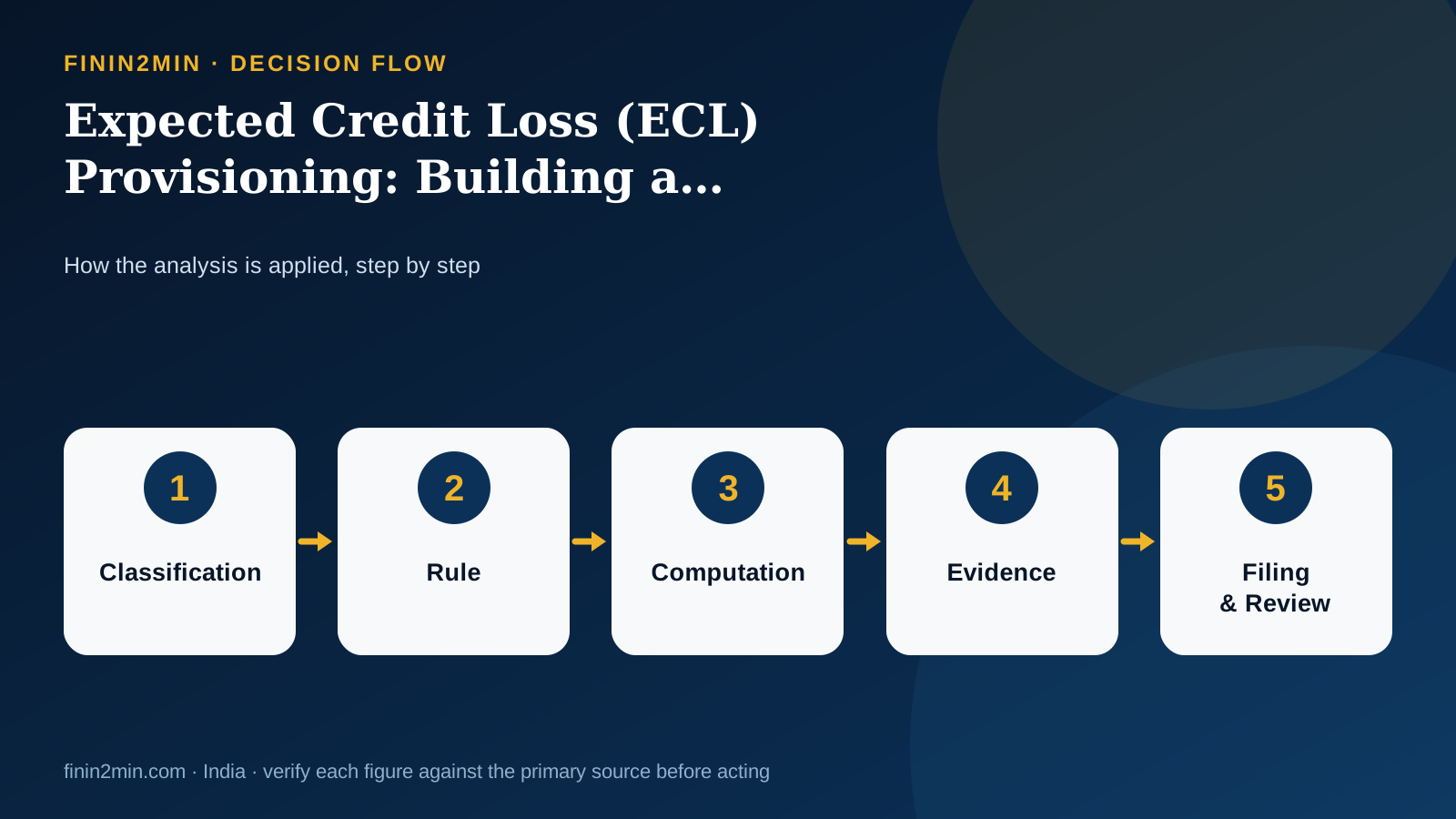
The six steps should be documented in sequence. If the final filing or accounting entry cannot be traced back through the workflow to the source document and legal provision, the position is not yet audit-ready.
4. Worked example and scenario analysis
Illustrative scenario — not a universal tax or legal result Assume management is evaluating Expected Credit Loss (ECL) Provisioning for a business with ₹40 crore of enterprise value and an operating case that grows cash flow by 10% annually for the forecast period. Build the base case first, separate operating drivers from capital structure, and then test at least two downside scenarios. The model should make it obvious which assumptions create most of the value; if changing one terminal, margin or financing assumption moves value dramatically, that sensitivity belongs in the decision memo, not hidden in a spreadsheet tab.
Recalculate the conclusion for at least three variations: (1) a change in party/residential or regulatory status, (2) a change in transaction date or holding/tenure, and (3) a change in value, consideration or cash-flow structure. This reveals whether the result is robust or depends on a single fragile assumption.
For Expected Credit Loss (ECL) Provisioning: Building a Provision Matrix under Ind AS 109, a reviewer should be able to explain the result in four reconciled layers: the governing legal or accounting rule, the numerical working, the document that proves each input, and the exact filing / financial-statement / transaction output. Where the commercial outcome changes under a different date, party status, valuation basis or classification, the working paper should show that sensitivity explicitly rather than burying it in assumptions.
5. Evidence file, controls and common failure points
Evidence to retain
- aged receivables / loan data
- default and recovery history
- forward-looking macro overlay
- model validation and back-testing
- board / shareholder approvals and transaction documents
- cap table, ledgers and financial statements
Red flags to review
- using a flat percentage without evidence
- ignoring forward-looking information
- failing to separate 12-month vs lifetime ECL where relevant
Purpose-specific value — Tax FMV, accounting fair value, transaction price and board-approved value may differ. Label every model output by purpose. Units and signs — Many large model errors are unit, currency, percentage or cash/debt sign errors. Put explicit checks on every summary page. Circularity — Interest, cash sweep, revolver and tax calculations can create circular references. Use controlled iteration or a documented algebraic solution. Sensitivity discipline — Do not vary every input randomly. Stress the small number of drivers that actually change the decision and explain why the range is reasonable. Version control — Retain the signed/approved model version and assumptions. A later spreadsheet change should not silently rewrite the basis of a completed decision.
What decision is the model supposed to support? Which legal/accounting/tax definition determines the measurement basis? What is the valuation date and currency/unit convention? Which inputs are observed, estimated or management judgments? What base/downside/upside sensitivity is decision-useful? Are circularity, signs, debt/cash and dilution checks built into the model? How does the model output flow into accounting entries, approvals or disclosures? Can another reviewer reproduce the result from the assumption log?
Reviewer sign-off questions
- Is the legal provision current for the transaction / tax year being analysed?
- Does the classification in the working paper match the contract, ledger and filing?
- Are values, dates, rates and assumptions independently traceable to evidence?
- Has the team documented any judgement, exception, litigation risk or alternative interpretation?
- Would another reviewer be able to reproduce the result without asking for undocumented assumptions?
Implementation checklist: from analysis to an audit-ready file
For Expected Credit Loss (ECL) Provisioning: Building a Provision Matrix under Ind AS 109, the review should finish with a file that another professional can reproduce without relying on oral explanations. The following controls convert the technical conclusion into an execution-ready record.
Control 1: aged receivables / loan data
Retain aged receivables / loan data as a primary input, not merely as background support. The working paper should identify the relevant date, amount, party and legal character visible in that record, then cross-reference it to the computation and final filing / accounting output. Where the document does not directly prove an assumption, record the additional evidence or judgement used to bridge the gap.
Control 2: default and recovery history
Retain default and recovery history as a primary input, not merely as background support. The working paper should identify the relevant date, amount, party and legal character visible in that record, then cross-reference it to the computation and final filing / accounting output. Where the document does not directly prove an assumption, record the additional evidence or judgement used to bridge the gap.
Control 3: forward-looking macro overlay
Retain forward-looking macro overlay as a primary input, not merely as background support. The working paper should identify the relevant date, amount, party and legal character visible in that record, then cross-reference it to the computation and final filing / accounting output. Where the document does not directly prove an assumption, record the additional evidence or judgement used to bridge the gap.
Control 4: model validation and back-testing
Retain model validation and back-testing as a primary input, not merely as background support. The working paper should identify the relevant date, amount, party and legal character visible in that record, then cross-reference it to the computation and final filing / accounting output. Where the document does not directly prove an assumption, record the additional evidence or judgement used to bridge the gap.
Pre-sign-off challenge test
Before sign-off, challenge the conclusion specifically for: using a flat percentage without evidence; ignoring forward-looking information; failing to separate 12-month vs lifetime ECL where relevant. If any of these conditions is present, re-open classification and computation rather than treating the issue as a disclosure-only point.
6. Frequently asked questions
What does “ECL is forward-looking rather than an incurred-loss trigger” mean for Expected Credit Loss Provisioning?
Ind AS 109 uses an expected-credit-loss model. Trade-receivable provision matrices typically segment exposures, use historical loss experience and adjust for reasonable forward-looking information; the model requires governance over overlays, cures, write-offs and data quality.
What does “ECL is forward-looking” mean for Expected Credit Loss Provisioning?
Ind AS 109 requires expected—not merely incurred—credit losses. Historical defaults are the starting dataset, not the final provision rate.
What does “Provision matrix should segment risk” mean for Expected Credit Loss Provisioning?
Trade receivables can be grouped by customer type, geography, ageing, security or other shared credit-risk characteristics. Combining fundamentally different portfolios into one loss rate can hide deterioration.
What should be documented before taking a position on Expected Credit Loss Provisioning?
At minimum, preserve aged receivables / loan data, default and recovery history, forward-looking macro overlay, model validation and back-testing. The calculation should be traceable from source records to the legal provision and the final return, filing, accounting entry or board decision.
What is the most common review risk?
The highest-risk errors include using a flat percentage without evidence, ignoring forward-looking information, failing to separate 12-month vs lifetime ECL where relevant. A reviewer should test these items separately rather than relying on a single summary memo.
When should professional advice be obtained?
Seek transaction-specific advice where facts cross multiple regimes, involve material value, foreign parties, litigation, valuation judgement, restructuring, significant estimates or a position that is not clearly covered by the latest statutory text / regulator guidance.
7. Related Finin2min topics
- Sweat Equity Shares: Valuation Methods, Companies Act Conditions and Cap-Table Dilution
- Directors’ & Officers’ (D&O) Liability Insurance: Governance, Coverage and Tax-Deductibility Questions
- Significant Beneficial Owner (SBO) Rules: Tracing Ultimate Ownership and Filing Form BEN-2
- Mandatory Dematerialisation of Private-Company Shares: Rule 9B Applicability, ISIN and Transaction Controls
- Ind AS 116 Lease Accounting: Calculating the Right-of-Use Asset and Lease Liability
Primary sources and validation basis
Use the linked official material as the starting point. Check the latest amendment / circular / notification applicable to the specific date and facts before filing or executing a transaction.
- ICAI — Compendium of Indian Accounting Standards (2025–26)
- Ministry of Corporate Affairs — Companies Act / Rules