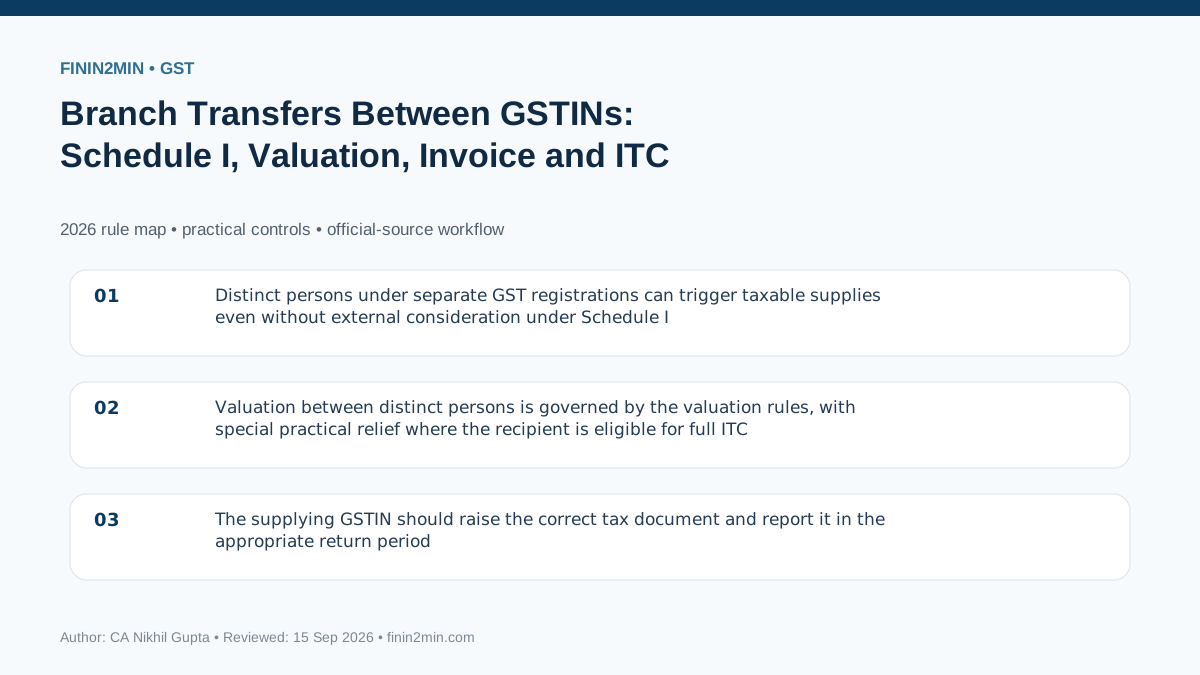
Separate GST registrations of the same legal entity are “distinct persons”. Schedule I can therefore treat supplies between them as taxable even when no consideration is charged.
Current rule and what decides the result
GST treats separate registrations of the same legal person as distinct persons for specified purposes. Schedule I therefore brings supplies between those registrations into tax even without consideration when made in the course or furtherance of business. Rule 28 begins with open-market value, but its full-ITC proviso is commercially important: where the recipient is eligible for full input tax credit, the value declared in the invoice is deemed to be open-market value.
Key rules to apply
- When the recipient branch is eligible for full input-tax credit, the value declared in the invoice is deemed to be the open-market value.
- Schedule I covers supplies between related/distinct persons in the course or furtherance of business even without consideration.
- Two GSTINs under the same PAN in different States—or separate registrations where permitted—can be distinct persons for GST.
- Value normally begins with open-market value; like-kind/quality and cost/residual methods follow when needed.
- If the recipient is eligible for full ITC, the invoice value is deemed to be open-market value, reducing valuation disputes.
- A tax invoice is generally required for taxable inter-GSTIN supply and the transaction flows through outward-supply reporting and the recipient’s ITC process.
Full ITC at the recipient branch
Delhi GSTIN sends finished goods to its Maharashtra GSTIN. Comparable third-party selling price is ₹10 lakh, but the company invoices the branch at ₹7 lakh. If the Maharashtra registration is entitled to full ITC on the supply, Rule 28's deeming proviso makes the invoice value acceptable as open-market value. GST is therefore computed on ₹7 lakh under that proviso, subject to the other facts. The group should still issue the tax invoice and report the outward supply; 'same PAN' does not make the movement non-taxable.
Recipient has restricted ITC
Assume the same goods move to a branch that uses them partly for exempt supplies and is not eligible for full ITC. The invoice-value deeming relief cannot simply be assumed. If open-market value is ₹10 lakh, the valuation exercise must start from Rule 28's normal hierarchy rather than choosing ₹7 lakh solely to reduce tax. This is why finance teams should record the recipient's ITC status before setting an inter-branch transfer-pricing policy.
How to apply it step by step
- Identify the supplying and receiving GSTINs and confirm that they are distinct persons under the registration framework.
- Classify what is moving—goods, services, shared corporate cost, fixed asset or another supply—and determine the place-of-supply consequences.
- Check the recipient's eligibility for full ITC before relying on the Rule 28 invoice-value deeming proviso.
- If full ITC is not available, document open-market value or the next applicable valuation method in the Rule 28/valuation hierarchy.
- Issue the correct tax invoice and apply the tax rate and IGST/CGST-SGST treatment based on the locations involved.
- For physical goods, separately test e-way bill and movement-document requirements.
- Report the supply in the outward-return workflow and ensure the recipient books and claims only eligible ITC.
- Reconcile branch ledgers so intercompany eliminations in financial statements do not erase GST evidence.
Common mistakes and edge cases
- Calling a transfer 'stock movement' and omitting GST because there is no consideration.
- Using a nominal ₹1 invoice without checking whether the recipient has full ITC.
- Applying the full-ITC proviso to a branch that makes exempt supplies or has blocked credit.
- Posting only an accounting journal without a tax invoice or movement documents.
- Confusing the GST valuation of the supply with the internal management-accounting transfer price.
FAQs
Is GST payable when both GSTINs belong to the same PAN?
It can be. Separate registrations are treated as distinct persons, and Schedule I can tax supplies between them even without consideration when the statutory conditions are met.
Can the company choose any invoice value between branches?
Where the recipient is eligible for full ITC, Rule 28 deems the invoice value to be open-market value. If that condition is not met, the normal Rule 28 valuation hierarchy must be applied and supported.
Does a branch transfer require a tax invoice?
A taxable supply between distinct persons generally requires the prescribed tax invoice and return reporting. The absence of an external customer does not remove the documentation requirement.
Is an e-way bill automatically required?
Not automatically in every fact pattern, but goods movement must be tested under the e-way bill thresholds and exemptions separately. Valuation relief under Rule 28 does not switch off movement compliance.
What if the receiving branch has partly exempt turnover?
Do not assume full ITC. Restricted or proportionate credit can prevent use of the full-ITC deeming proviso, making the open-market/alternative valuation steps relevant.
Why reconcile the branches if both entries eliminate on consolidation?
GST is registration-based, while financial consolidation is entity-level. The tax invoice, outward-supply report and recipient ITC must still reconcile even though the internal revenue and expense may eliminate in consolidated accounts.
Related Finin2min guides
- Branch Transfer of Capital Goods Between GSTINs
- Branch Transfer Between States: GST, E-Invoice and Valuation Rules
- Warehousing Services: Taxability, Valuation, ITC and Invoice Flow
- SaaS Exports: Taxability, Valuation, ITC and Invoice Flow
- Export of Services: Taxability, Valuation, ITC and Invoice Flow
- E-Commerce Operators: Taxability, Valuation, ITC and Invoice Flow
- Residential Apartment Projects: Taxability, Valuation, ITC and Invoice Flow
- Canteen and Employee Benefit ITC: Taxability, Valuation, ITC and Invoice Flow