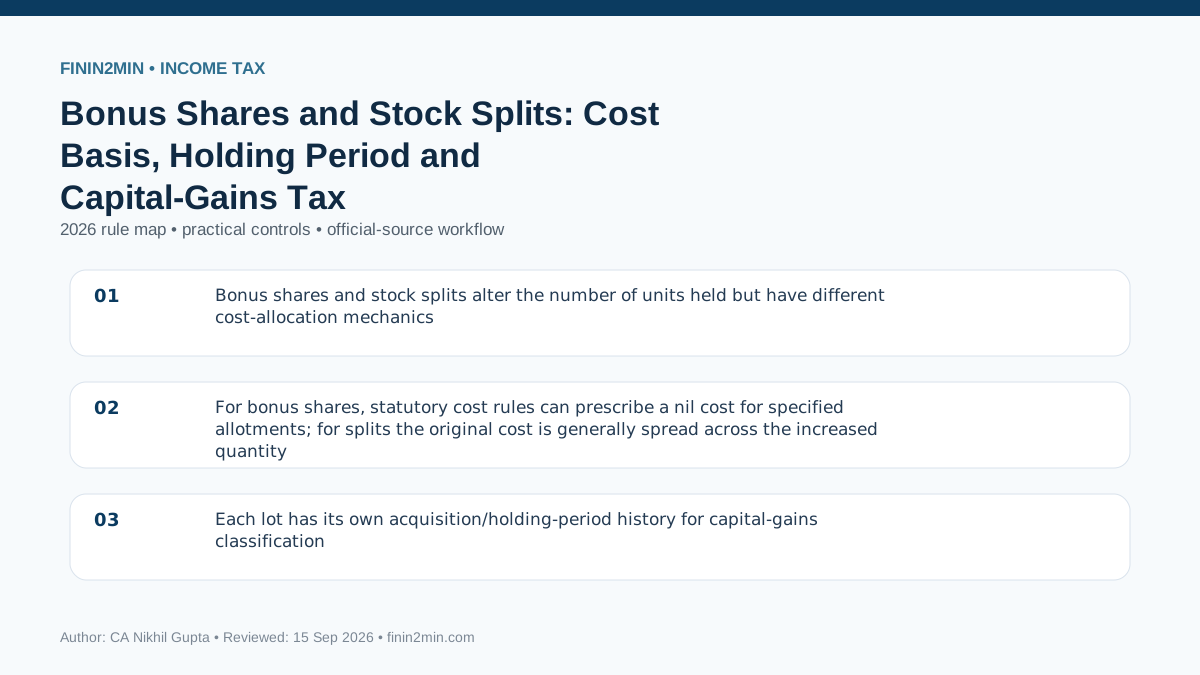
A bonus issue and a stock split both increase the number of shares, but the tax cost mechanics are not the same. Bonus shares allotted without payment generally receive nil cost under section 55 and start a new holding period from allotment.
Current rule and what decides the result
Bonus shares and stock splits both increase unit count but use different cost mechanics. Qualifying bonus shares allotted without payment generally have nil acquisition cost and start their own holding period from allotment. A stock split, by contrast, subdivides the existing investment: the aggregate pre-split cost is spread over the larger number of post-split shares while the original acquisition history is preserved. Listed-equity rates then depend on holding period, STT conditions and the law in force at sale.
Key rules to apply
- A stock split normally spreads the existing aggregate cost across the increased number of shares while preserving the historical acquisition of the original investment.
- Section 55 assigns nil cost to qualifying bonus financial assets allotted without payment on the basis of existing holdings.
- The Income Tax Department’s share guidance measures the bonus-share holding period from the allotment date.
- A split changes denomination/number of shares; the pre-split aggregate cost is apportioned across the post-split shares rather than creating free new cost.
- Where section 111A/112A conditions are met, current listed-equity STCG/LTCG rates and the ₹1.25 lakh section 112A aggregate threshold apply.
- Demat statements and broker capital-gains reports must identify which acquisition lots are sold; bonus allotments create a separate lot/date.
Bonus shares create a separate lot
Ravi owns 100 listed shares bought at ₹400 each, total cost ₹40,000. The company issues a 1:1 bonus, so he receives 100 bonus shares for no payment. Those bonus shares form a separate lot with nil cost under the bonus-share rule and a holding period beginning on the allotment date. If he later sells 50 bonus shares at ₹600 each, the gross capital gain on that bonus lot is ₹30,000 before transfer expenses; whether it is short- or long-term depends on how long those bonus shares themselves were held.
A 1:2 split does not create nil-cost shares
Assume the same 100 shares costing ₹40,000 undergo a 1:2 split so the investor holds 200 shares. The aggregate cost remains ₹40,000, giving an apportioned cost of ₹200 per post-split share. Selling 50 post-split shares therefore carries ₹10,000 of cost, not zero. The split changes face value and unit count; it does not create a new free allotment comparable to bonus shares.
How to apply it step by step
- Download the corporate-action statement showing record date, ex-date, allotment ratio and effective split ratio.
- Separate original, bonus, rights, ESOP and split-adjusted lots instead of averaging all shares blindly.
- For bonus shares, record nil cost where the statutory rule applies and use the bonus allotment date for the holding-period clock.
- For a stock split, preserve aggregate historical cost and divide it across the resulting shares in the split ratio.
- Apply FIFO or the relevant lot-identification rule consistently with demat records when shares are sold.
- Check whether the sold shares meet the listed-equity holding and STT conditions for the applicable short- or long-term rate.
- For pre-2018 listed holdings, test grandfathering rules separately; do not mix them with the bonus-share nil-cost rule.
- Reconcile the broker gain report with your corporate-action working before filing the return.
Common mistakes and edge cases
- Assigning nil cost to post-split shares.
- Giving bonus shares the purchase date of the original shares.
- Averaging original and bonus cost in a way that destroys lot-level holding periods.
- Applying bonus-share rules to rights issues, demergers or ESOP allotments.
- Relying on a broker report that did not import an old corporate action correctly.
FAQs
What is the cost of bonus shares?
For qualifying bonus financial assets allotted without payment on the basis of existing holdings, the statutory rule generally assigns nil acquisition cost. That lot should be tracked separately from the original paid shares.
When does the bonus-share holding period start?
From the allotment date of the bonus shares. The original share's purchase date does not automatically carry over to the newly allotted bonus lot.
What happens to cost after a stock split?
The aggregate historical cost is normally preserved and apportioned over the increased number of shares. A 1:2 split of 100 shares costing ₹40,000 produces 200 shares with an average apportioned cost of ₹200 each.
Do listed-equity rates apply to bonus shares?
They can when the later sale satisfies the listed-equity and STT conditions. The rate then depends on whether the bonus lot is short- or long-term under its own allotment date.
Does a bonus issue change the cost of my original shares?
The original lot keeps its own cost. The new bonus lot generally carries the statutory nil cost, so combining both into one averaged cost can produce the wrong tax result.
What evidence should be retained?
Keep the broker/demat corporate-action statement, original contract notes, bonus allotment or split details, sale contract notes and your lot-level capital-gain worksheet. Those documents explain both unit count and cost changes.
Related Finin2min guides
- Stock Splits and Consolidations: Cost Allocation, Holding Period and Capital-Gains Traps
- Capital Gains Holding Period: 12-Month vs 24-Month Rules
- Bonus Shares Sold: Zero Cost, Holding Period and Which ITR?
- Gifted Shares: Cost of Acquisition & Capital Gains
- ESOP Sale After Employer Acquisition: Cost Basis, Perquisite and Capital-Gains Reconciliation
- Bonus Shares, Stock Splits & Buybacks
- Physical Shares to Demat: Capital Gains Impact
- NRI Capital Gains on Indian Shares and Mutual Funds