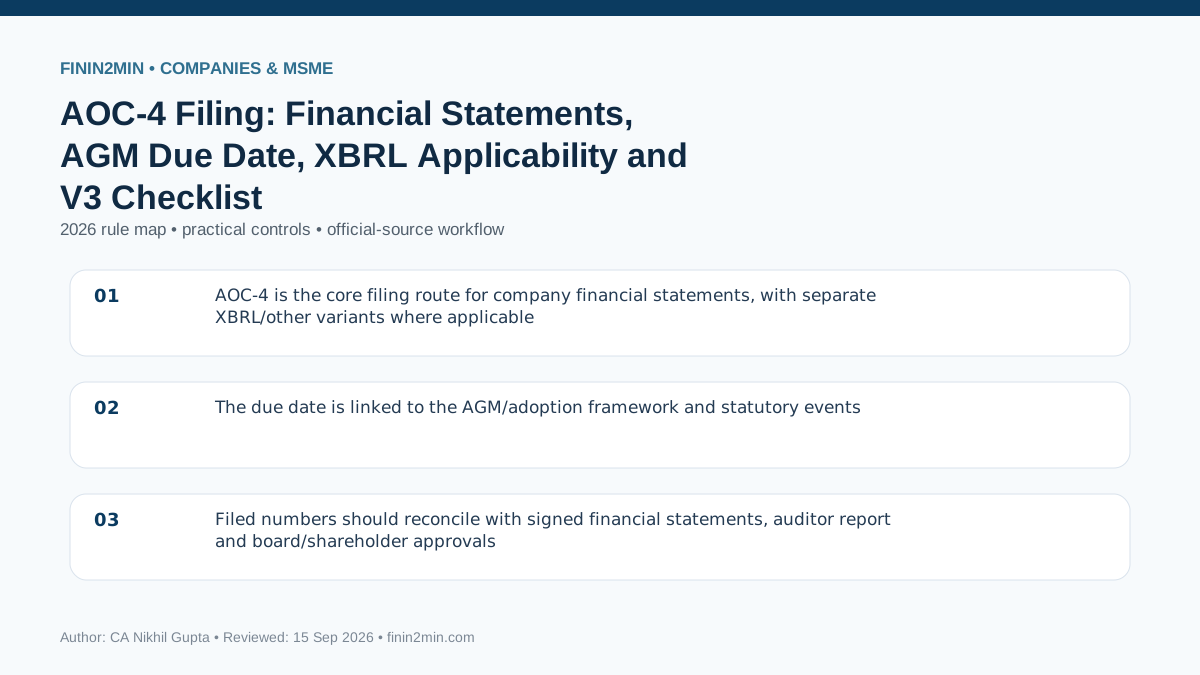
AOC-4 is the Companies Act filing used to place financial statements and related documents on MCA records. For most companies, section 137 links the filing deadline to 30 days from the AGM; special cases such as OPCs use a different statutory timing.
Current rule and what decides the result
Section 137 of the Companies Act requires companies to file the financial statements and prescribed attachments with the Registrar. For a company that holds an AGM, the ordinary AOC-4 timeline is generally 30 days from the AGM; an OPC follows the separate 180-days-from-financial-year-end rule. Before uploading, the company must choose the correct form family—AOC-4, AOC-4 CFS, AOC-4 XBRL or another applicable variant—and reconcile the e-form with the Board-approved and AGM-adopted accounts. Delay can trigger the statutory additional-fee mechanism, commonly ₹100 per day for the filing default, apart from the Act’s penalty exposure.
Key rules to apply
- The correct form variant—ordinary AOC-4, CFS, XBRL or another applicable form—must be selected before upload.
- For a company that holds an AGM, financial statements and prescribed attachments are generally filed within 30 days of the AGM under section 137.
- An OPC follows the specific filing rule tied to 180 days from financial-year end rather than mechanically using an AGM date it does not have.
- XBRL applicability is governed by the Companies (Filing of Documents and Forms in Extensible Business Reporting Language) Rules and current class/threshold criteria; listed status, specified capital/turnover and Ind AS coverage can matter.
- Additional fee for delayed filing can accrue at ₹100 per day under the fee framework, separate from possible section 137 penalties for default.
- Signed financial statements, Board’s report, auditor’s report and applicable statements/attachments must match the approved accounts and form variant.
Normal company after AGM
A private company closes FY 2025–26 on 31 March 2026 and holds its AGM on 25 September 2026. Assuming no special adjournment or other exception, the 30-day section 137 clock points to 25 October 2026 for the financial-statement filing. If the company uploads on 9 November, the team should count the filing delay under the MCA fee rules and separately evaluate any statutory penalty exposure rather than treating the portal fee as a complete cure.
OPC timeline
An OPC closes FY 2025–26 on 31 March 2026. It does not manufacture an AGM date merely to calculate AOC-4. The statutory OPC route uses 180 days from financial-year end, which falls on 27 September 2026 in this example. The form variant and attachments still have to match the approved financial statements and any applicable audit/Board material.
How to apply it step by step
- Freeze the signed financial statements, Board’s report and auditor’s report before form preparation.
- Confirm AGM date, adjournment facts or OPC status and compute the statutory due date.
- Test whether consolidated financial statements are required and whether AOC-4 CFS is also needed.
- Apply the current XBRL applicability criteria instead of assuming every large company files ordinary PDF accounts.
- Match CIN, capital, directors, auditor and financial-period data with MCA master data.
- Validate DSCs and the professional certification requirement before the filing day.
- Run V3 pre-scrutiny and resolve taxonomy/attachment validation errors before payment.
- Save the SRN, challan and filed form with the signed accounts as the permanent filing evidence.
Common mistakes and edge cases
- Counting 30 days from financial-year end instead of from the AGM for an ordinary company.
- Using ordinary AOC-4 when CFS/XBRL is applicable.
- Uploading unsigned or internally inconsistent attachments.
- Assuming payment of additional fee eliminates statutory default consequences.
- Waiting until the due date to discover expired DSC or V3 pre-scrutiny errors.
FAQs
What is the ordinary AOC-4 due date?
Does an OPC use the AGM-based 30-day rule?
No. The Act gives an OPC a separate timeline linked to 180 days from the financial-year end.
Is XBRL optional?
No where the notified class/threshold rules require it; applicability should be tested before filing.
Is AOC-4 CFS the same as AOC-4?
No. Consolidated financial statements have their own filing requirement/form treatment.
What should be retained after filing?
At minimum the filed form, attachments, SRN/challan and the signed approved financial statements.
Can V3 reject a legally correct set of accounts?
The portal can still block submission because of data, DSC, taxonomy or pre-scrutiny validation issues, which need operational resolution.
Related Finin2min guides
- AOC-4 Filing After AGM: Financial Statement Filing Checklist
- AOC-4 XBRL Applicability for Indian Companies
- ITR-4 AY 2026-27 Due Date 31 August 2026
- AOC-4 CFS Applicability: Avoiding a Wrong ‘Not Applicable’ Selection and Filing Penalty
- ITR-3 Due Date AY 2026-27: Audit and Non-Audit Cases
- ROC Penalty for Financial-Statement Filing Default: AOC-4 Chronology, Responsibility and Mitigation File