57th GST Council Meeting 2026: What Changes for Taxpayers, Businesses and Key Industries
Arrest powers, prosecution, refunds, ITC, registration, returns, e-way bills, exports, e-commerce and the industry impact of the 8 October 2026 Council recommendations.
📄 Download the PDF edition (free sign-in)
Finin2min 2-Minute Summary
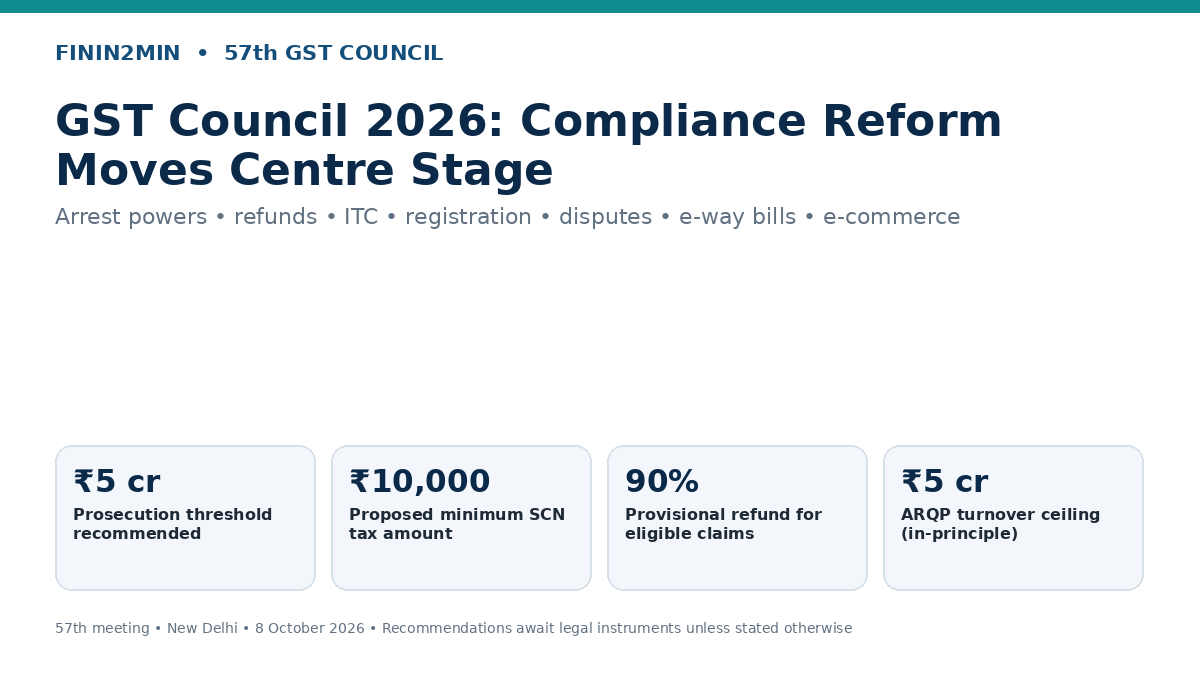
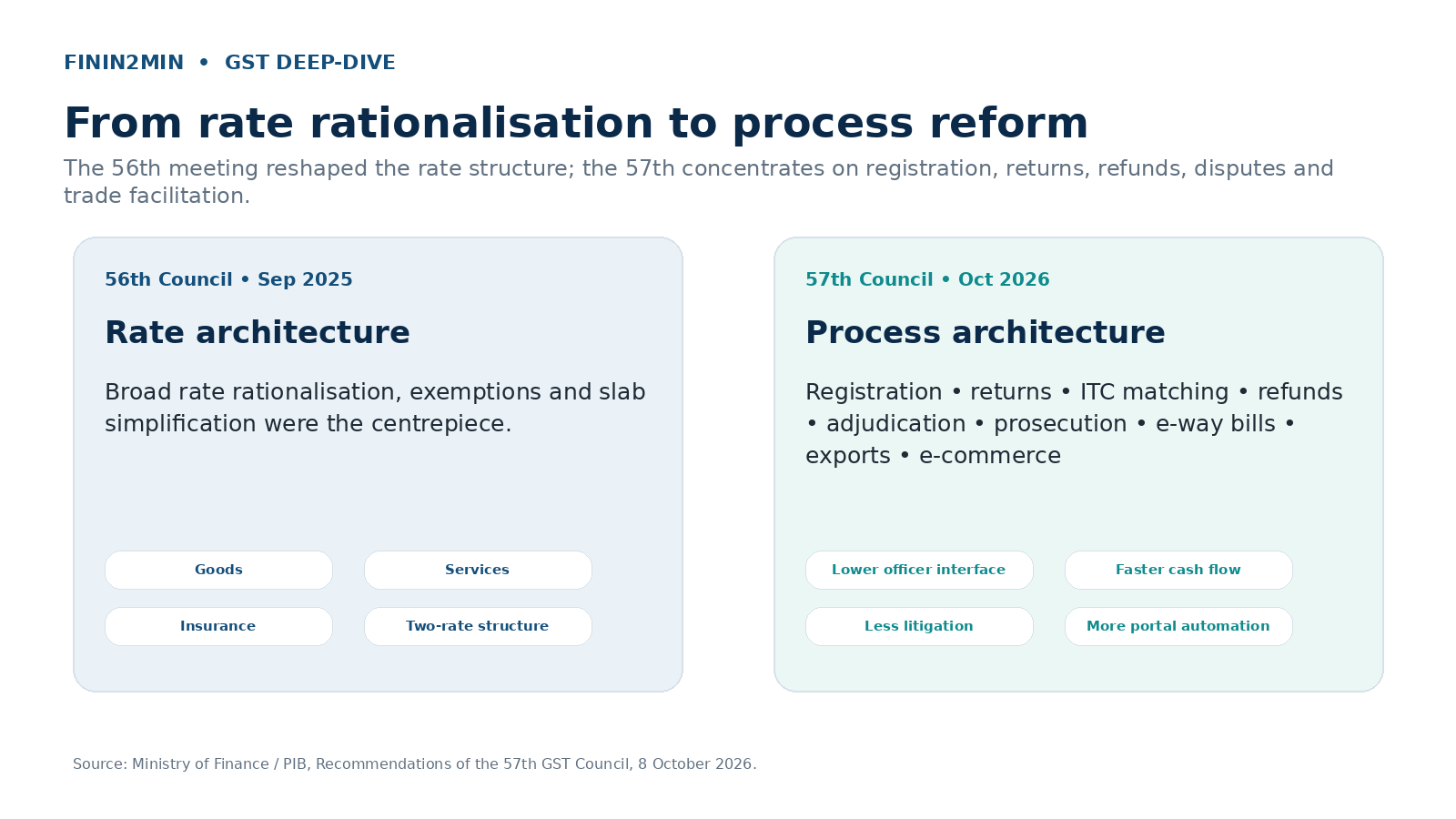
The 57th GST Council meeting marks a shift in the reform agenda. The previous Council meeting was dominated by rate rationalisation; the 8 October 2026 meeting is primarily about how GST is administered - registration, return correction, refunds, input tax credit, dispute resolution, prosecution, e-way bills, exports and digital compliance.
- Arrest powers: the Council recommended complete withdrawal of GST arrest powers by omitting section 69 of the CGST Act. Prosecution would remain, but the monetary threshold is proposed to rise from ₹1 crore to ₹5 crore and the offence architecture under section 132 would be narrowed.
- Refunds: the Council recommended system-led refunds, including automatic sanction of excess cash-ledger claims, a shorter 10-day acknowledgement/deficiency window, and 90% automatic provisional refund for eligible zero-rated and inverted-duty claims based on system risk evaluation.
- Disputes: a ₹10,000 minimum tax amount is proposed for show-cause notices; the maximum general penalty under section 125 is proposed to fall from ₹25,000 to ₹10,000; and a ₹40 crore combined cap is proposed for pre-deposit in penalty-only appeals.
- ITC: refund eligibility is proposed to expand to input services and capital goods in specified refund situations, while section 17(5) blocked-credit restrictions are proposed to be relaxed for several business inputs including specified catering, insurance, telecom towers, pipelines, free samples and legally required destruction/expiry cases.
- Registration and e-commerce: amendments, cancellation and small-seller registrations are proposed to become more automated. A proposed rule 14B would allow eligible small goods sellers to use an e-commerce operator's warehouse as their principal place of business in a State/UT where they have no physical presence.
- Legal status: these are GST Council recommendations, not automatically operative law. The Ministry of Finance expressly states that the decisions will take legal effect only through the relevant amendments, notifications and circulars.
1. What happened at the 57th GST Council meeting?
The GST Council met in New Delhi on 8 October 2026 under the chairpersonship of Union Finance and Corporate Affairs Minister Nirmala Sitharaman. The official release characterises the meeting as a process-reform exercise covering registration, returns, refunds, adjudication, trade facilitation and selected rate/clarification issues.
The distinction from the 56th meeting is important. The September 2025 meeting focused on next-generation rate rationalisation. The 57th meeting is mainly about reducing friction inside the GST system: fewer avoidable notices, faster refunds, more system-based actions, easier registration and cancellation, broader credit flow, and tighter safeguards around coercive powers.
2. Registration reforms: less officer interface, more system action
2.1 Clearer document requirements for new registrations
The Council recommended a comprehensive circular specifying the documents and information required for registration, changes to FORM GST REG-01 so applicants can select prescribed documents through structured fields, and a more guided GST portal interface with drop-downs, tool-tips and contextual assistance.
The practical objective is straightforward: reduce the cycle in which an applicant uploads documents, receives a query, uploads another set and waits for manual processing. A more structured form also gives officers less room to ask for documents that are not part of the prescribed data set.
2.2 Registration amendments may become almost real-time
An amendment to rule 19 is proposed so that changes to registration particulars are accepted automatically on the portal, except changes to the Principal Place of Business (PPoB). For taxpayers registered through the automatic route under rule 14A, even PPoB amendments are proposed to be automatically accepted.
For multi-location businesses, this matters because changes in trade name, contact details, additional places or other particulars can otherwise remain pending and create downstream issues in invoicing, e-way bills, bank validation and notices.
2.3 Cancellation of registration becomes more system-based
The Council proposed a two-phase automatic cancellation architecture. In the first phase, applications in FORM GST REG-16 can be system-approved after pending returns are filed and dues are paid, subject to specified ITC and final-return conditions. In phase two, the objective is broader automatic acceptance once pending returns and dues are cleared, with GSTR-10 information integrated into the cancellation application.
The Council also recommended a system-based framework for suo-moto cancellation and revocation linked to specific non-compliances such as return filing and bank-account information.
2.4 Small e-commerce sellers: proposed Rule 14B
One of the most commercially important registration proposals is the insertion of rule 14B. Eligible small suppliers of goods selling through an Electronic Commerce Operator (ECO) could obtain registration in a State/UT where they do not have physical presence by declaring the ECO's warehouse there as their PPoB.
The Council's proposed condition is that the seller intends to pass on ITC of not more than ₹2.5 lakh per month, excluding stock transfers between distinct persons, along with other conditions to be prescribed.
Illustration: A Jaipur-based small seller wants to serve customers from an e-commerce fulfilment warehouse in Karnataka but has no office there. If the final rule follows the Council recommendation and the seller satisfies the conditions, the warehouse may be declared as PPoB instead of the seller establishing a conventional physical office merely for GST registration.
3. Returns and ITC matching: a redesign of the correction architecture
The Council recommended a set of changes intended to reduce mismatches between GSTR-1/1A/IFF, GSTR-3B and GSTR-2B. This is important because a mismatch can currently trigger system intimations, reconciliations and sometimes demand proceedings even when the underlying transaction is genuine.
The proposed architecture includes:
- enhancements in GSTR-1/1A/IFF for better alignment with GSTR-3B;
- a new rule 86D for an electronic statement of tax paid under reverse charge and the ITC claimed against it;
- a proposed rule 61(1A) mechanism for correction/rectification of reported liability so GSTR-3B aligns with GSTR-1/1A/IFF;
- invoice-level information in DRC-03 for voluntary payments;
- a rule 60(6A) framework for IMS so a recipient can accept, reject or keep eligible documents pending for GSTR-2B purposes, subject to conditions;
- a new rule 86C electronic credit reversal and reclaim statement; and
- a proposed rule 61(1B) correction mechanism so ITC in GSTR-3B aligns with ITC made available in GSTR-2B.
The Council recommended that this alternate liability-and-ITC amendment mechanism may be brought into force from the return for April 2027, after a time-bound public consultation and system work.
This is not a minor form change. If implemented well, it can move GST return compliance away from a rigid "report once, repair through notices" model toward a more structured reconciliation-and-correction model.
4. Refunds: the biggest immediate working-capital reform
For exporters, inverted-duty businesses and taxpayers with money stuck in the electronic cash ledger, the refund package may be the most valuable part of the meeting.
4.1 Full automatic refund of eligible excess cash-ledger balance
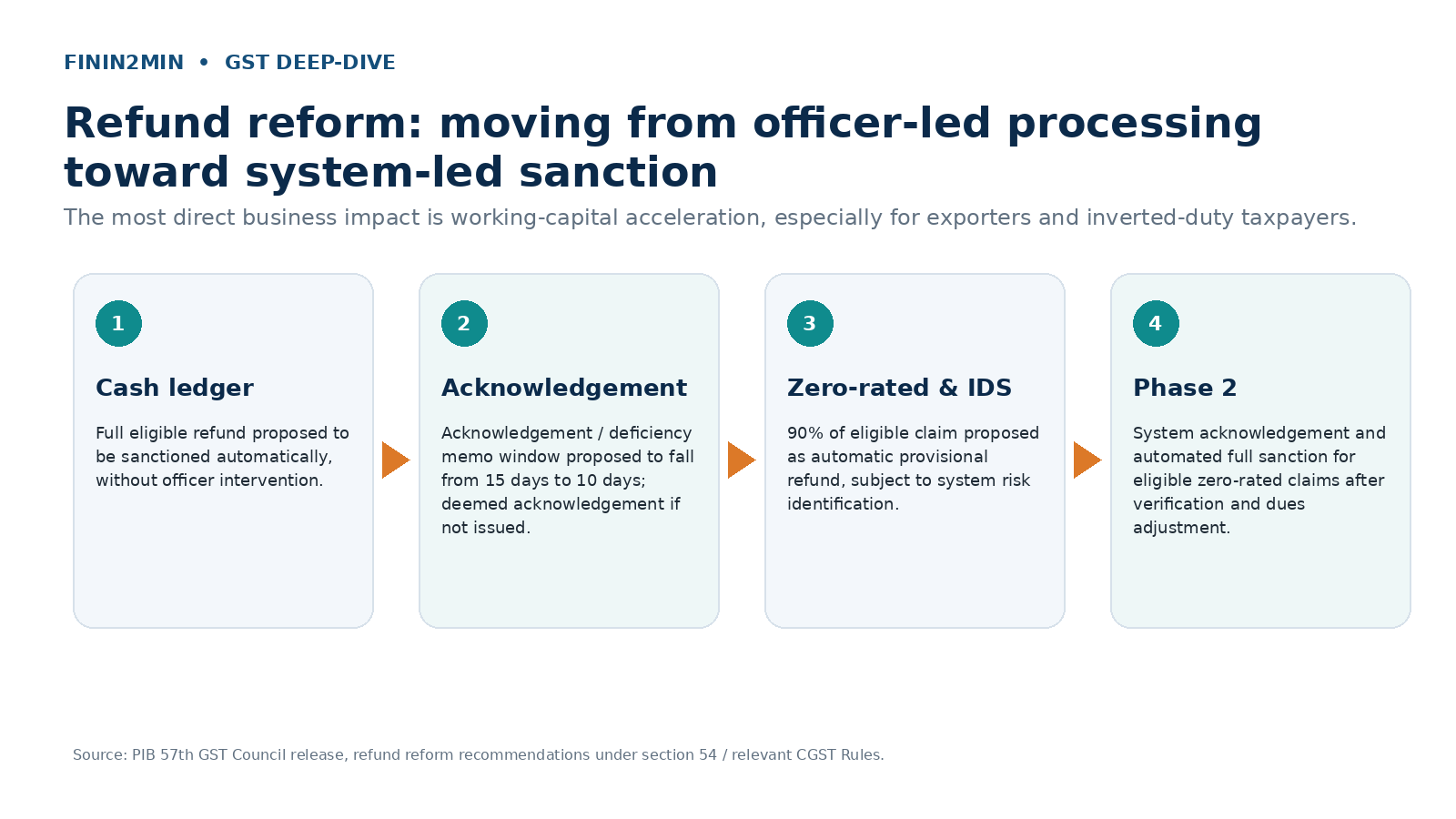
The Council recommended system sanction of the full refund claim for excess balance in the electronic cash ledger, without officer intervention.
4.2 Acknowledgement window: 15 days to 10 days
The time limit for an acknowledgement or deficiency memo is proposed to be reduced to 10 days. If neither is issued within that period, the system would provide deemed acknowledgement.
4.3 90% automatic provisional refund
For zero-rated supplies and inverted-duty claims, 90% of the amount claimed is proposed to be sanctioned on a provisional basis automatically by the system, based on risk identification and evaluation.
Worked example: If an eligible exporter files a ₹50 lakh refund claim and the final system/risk conditions are met, the proposed 90% provisional mechanism could release ₹45 lakh at the provisional stage. The balance would follow the final processing architecture. This example illustrates the Council proposal; it is not yet an operative entitlement until the legal and system changes take effect.
4.4 Phase 2: automated full sanction in eligible zero-rated cases
The next phase is intended to provide system acknowledgement and automated full sanction for eligible zero-rated claims after verification and adjustment of pending dues, again based on system risk evaluation.
4.5 RFD-01 and formula changes
The Council also recommended:
- structuring FORM GST RFD-01 so information is system-readable and scanned-document uploads can be dispensed with for specified claims;
- removing the 1.5-times domestic-value restriction in rule 89(4)(C) for the maximum turnover value of zero-rated goods; and
- clarifying that the ₹1,000 minimum refund threshold under section 54(14) is tested on the total CGST + SGST/UTGST + IGST amount.
For working-capital-intensive businesses, the economic significance is not the tax rate but the days of cash locked in GST. A faster refund converts a tax-administration reform directly into a treasury benefit.
5. Disputes, notices and penalties: moving away from low-value litigation
The Council's adjudication package is one of the strongest ease-of-doing-business elements of the meeting.
5.1 Common standards for notices and orders
A circular is proposed to guide officers on the quality and timeliness of demand notices, adjudication orders and appeal orders, the proper use of fraud / wilful-misstatement / suppression allegations, natural justice and personal hearings.
That matters because the classification of a case as fraud or non-fraud changes limitation periods, penalty exposure and the tone of the proceeding. The Council's direction is that serious allegations should be invoked on the facts of the individual case rather than as a standard drafting device.
5.2 ₹10,000 minimum threshold for show-cause notices
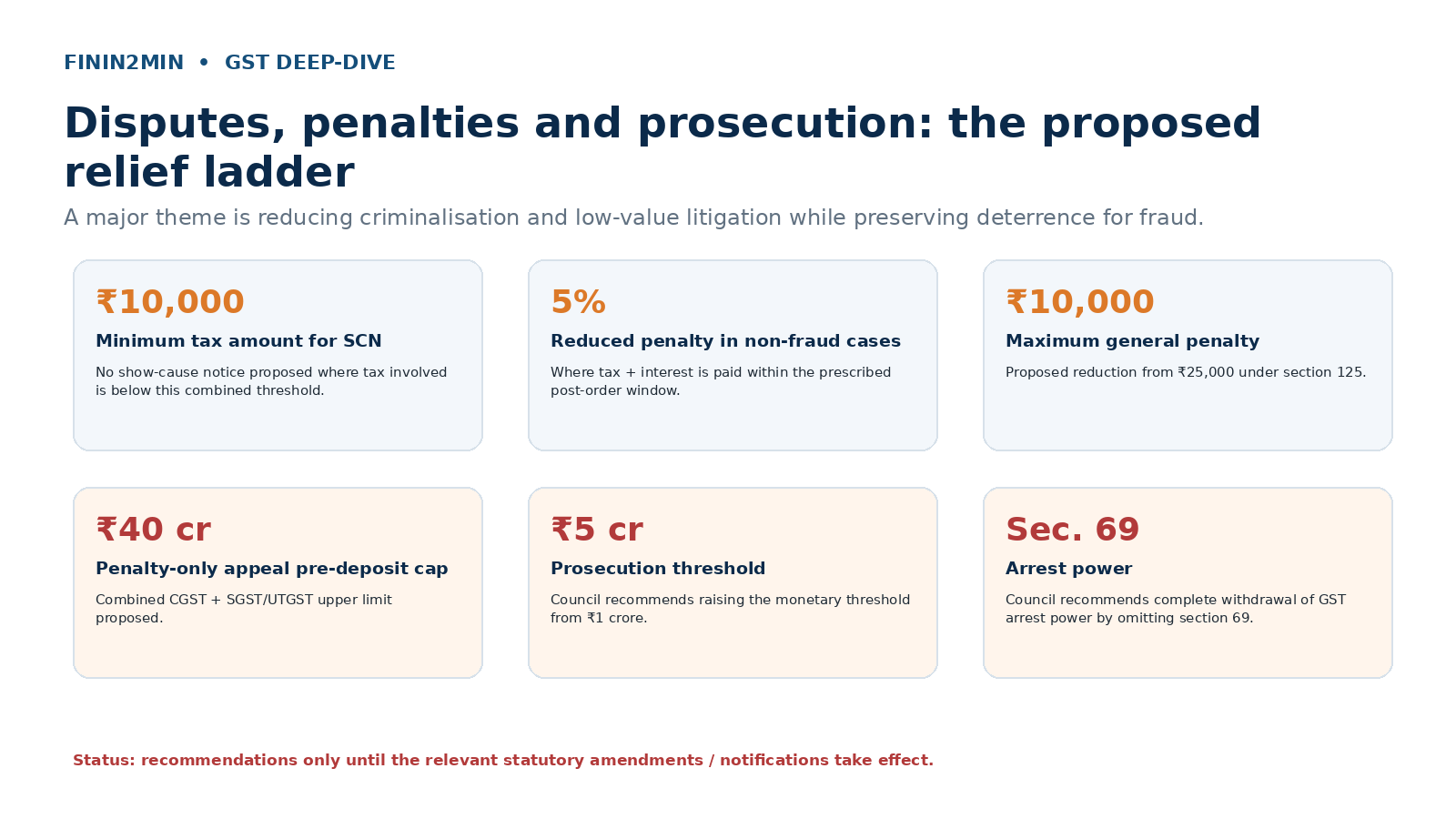
The Council recommended amendments to sections 73, 74 and 74A so that no show-cause notice is issued where the combined tax amount involved is below ₹10,000. It also recommended transitional protection for pending notices and appeals below the threshold once the statutory provision comes into force.
5.3 Reduced penalty in non-fraud cases
A 5% penalty is proposed in non-fraud cases where tax and interest are discharged within the prescribed post-order period - 30 days under section 73 or 60 days under section 74A, as described in the Council release. The minimum penalty condition of ₹10,000 in non-fraud cases is also proposed to be removed.
5.4 General penalty to fall from ₹25,000 to ₹10,000
The maximum general penalty under section 125 is proposed to be reduced from ₹25,000 to ₹10,000.
5.5 Cap on pre-deposit in penalty-only appeals
Where an order involves only penalty and no tax demand, the Council recommended a combined upper limit of ₹40 crore on appeal pre-deposit - ₹20 crore under CGST and ₹20 crore under SGST/UTGST - for appeals before the Appellate Authority or the Appellate Tribunal, as applicable under the proposed amendments.
6. Arrest and prosecution: a major change in enforcement philosophy
The most headline-sensitive recommendation is the proposed complete withdrawal of arrest powers under GST through omission of section 69 of the CGST Act.
This should not be misunderstood as decriminalisation of every GST offence. The Council simultaneously proposed a redesigned prosecution framework under section 132:
- the monetary threshold for prosecution would rise from ₹1 crore to ₹5 crore;
- specified offence clauses would be narrowed or omitted; and
- fraudulent ITC cases would be targeted more specifically.
The policy direction is therefore less coercive power for routine tax administration, but continued criminal consequences for sufficiently serious fraud/evasion cases after the proposed law changes.
For directors, CFOs and tax heads, this changes risk assessment. The focus should shift further toward documentary evidence, genuine supply, invoice integrity, ITC eligibility and fraud controls rather than assuming that every large tax dispute carries the same coercive risk.
7. ITC reforms: potentially large balance-sheet impact
7.1 Refund of accumulated ITC on input services and capital goods
The Council recommended widening refund eligibility under section 54(3):
- in zero-rated refunds, accumulated ITC on capital goods would become eligible;
- in inverted-duty refunds, accumulated ITC on input services and capital goods would become eligible.
The Council specifically recommended that input-service ITC for inverted-duty refunds be available for ITC availed on or after 1 November 2026.
For capital goods, the proposed refund would be spread over 60 months and apply to ITC availed on capital goods on or after 1 April 2027.
This is potentially material for sectors where capital expenditure and service inputs are high but output rates are structurally lower than input incidence.
7.2 Section 17(5): wider availability of credit
The Council recommended amending section 17(5) to remove restrictions on ITC, among other items, for specified supplies relating to:
- outdoor catering;
- health and life insurance;
- telecommunication towers;
- pipelines outside factory premises;
- free samples; and
- goods destroyed or written off on expiry of shelf life where such disposal is required by law.
The exact scope will depend on the final statutory language. Businesses should not reverse historical positions merely from the press release; instead, they should identify blocked-credit pools that may become usable once the amendment is enacted.
8. Exports and cross-border services: several structural frictions targeted
The Council recommended amendments to the IGST Act intended to make export treatment easier in several recurring fact patterns.
8.1 Foreign establishments / branches
The Council recommended removing the condition in section 2(6) that currently prevents certain supplies from qualifying as export of services where the supplier and recipient are establishments of distinct persons under the IGST framework.
This is particularly relevant for Indian service providers dealing with overseas branches or related establishments.
8.2 Services where goods are physically made available
The Council recommended omitting section 13(3)(a), so the place of supply for the covered services would move to the default rule under section 13(2) - generally the recipient's location - potentially improving export eligibility for Indian service providers serving foreign recipients.
8.3 Overseas buyer, delivery into SEZ/FTWZ
The Council proposed an explanation to section 16(1) so that goods sold to an overseas buyer but physically delivered to that buyer in an SEZ/FTWZ can qualify for zero-rating when the prescribed payment conditions are satisfied.
8.4 Receipt in foreign exchange / permitted INR
A circular is proposed to clarify issues around receipt of payment in foreign exchange or Indian rupees where permitted for export of goods and services.
For export businesses, these changes combine two benefits: clearer eligibility for zero-rating and a faster refund engine.
9. E-way bill and goods movement: fewer routine transit interceptions
The Council recommended amendments to sections 68, 129 and 130 that would reshape interception of goods in transit.
The proposed framework says a conveyance should be intercepted only on specific intelligence and with authorisation by an officer not below the rank of Joint Commissioner. Further inspection, detention or seizure would generally be linked to the State where either the supplier or recipient is located or registered - not a transit State.
The Council also recommended that confiscation under section 130 should not apply to goods/conveyances in transit.
An important exception remains: where there is no e-way bill or no document showing origin/destination, inspection and detention can still take place irrespective of jurisdiction.
For logistics-intensive companies, this can reduce transit uncertainty, trip delays and the risk of different field practices across States. It does not remove the obligation to generate and carry proper e-way bill / transport documentation.
10. Small taxpayers and B2C businesses
10.1 Late-fee relief up to ₹5 crore turnover
The Council recommended waiver of late fee on delayed section 39(1) returns for taxpayers with preceding-year annual turnover up to ₹5 crore, provided the delayed return is filed by the end of the month in which it was due.
10.2 ARQP: Annual Return Quarterly Payment concept
The Council approved in principle a concept note for an optional Annual Return Quarterly Payment (ARQP) scheme for taxpayers with aggregate turnover up to ₹5 crore in the preceding financial year who are exclusively engaged in B2C supplies.
This is not yet an operational scheme. The eventual design will need rules, forms, payment logic and safeguards. If implemented cleanly, it could materially reduce return-filing frequency for small consumer-facing businesses while retaining quarterly tax payment.
11. Other compliance changes worth tracking
The Council also recommended:
- alignment of sections 16, 37 and 39 with the section 16(4) ITC time limit;
- clarity under section 9(5) on ECO liability for notified services irrespective of business model;
- a validation clause for notices held invalid by courts for covering multiple financial years;
- extension of e-invoicing to specified domestic RCM supplies received from unregistered persons and import of services for taxpayers with aggregate annual turnover of ₹5 crore and above; and
- amendments to align GST Appellate Tribunal provisions with the 2026 tribunal law framework.
The e-invoicing proposal deserves particular attention because it can create a new system/compliance obligation for finance teams handling reverse charge and imported services. ERP configuration, vendor master data and self-invoicing processes may need redesign once the final rules become available.
12. Goods: targeted clarifications rather than a broad rate reset
The 57th meeting did not repeat the broad rate-rationalisation exercise of the 56th meeting. Instead, the official release lists targeted classification, credit and rate clarifications.
Key goods-related items include:
- Sublimation paper: classification under heading 4809, with past cases proposed to be regularised on an as-is-where-is basis.
- Toys: clarification that the relevant rate entries cover all categories under heading 9503 and are not limited to tricycles, scooters and pedal cars.
- Sea-weed extract bio-stimulants: classification under heading 3101 as fertilisers when registered under the specified Fertiliser Control Order schedule, with past-case regularisation.
- Second-hand vehicles under margin scheme: ITC proposed to be allowed on inputs other than the second-hand vehicle itself and on input services such as spares, repairs, technology, rent, marketing and advertising. The restriction continues to relate to tax paid on the procured second-hand vehicle.
- Specified waste and scrap: RCM is proposed where plastics/electrical/electronic/tyre waste and used cooking oil are supplied by an unregistered person to a registered person; 2% TDS is proposed for specified registered-to-registered supplies.
- Psyllium seeds (Isabgol): NIL GST proposed irrespective of fresh/chilled/frozen/dried form.
- Re-treaded tractor tyres: rate anomaly proposed to be aligned with new tractor tyres.
- CSD historical cess: specified compensation-cess non-levy periods for vehicles and aerated drinks are proposed to be exempted/regularised.
13. Services: EV mobility, delivery, hospitality, highways and financial services
EV passenger transport and rental
An option is proposed to pay 5% GST with restricted ITC on specified passenger-transport and motor-vehicle-rental services using electric vehicles where battery charging is included in the consideration.
Delivery through e-commerce operators
For specified delivery services supplied through an ECO, the Council proposed section 9(5) treatment and a 5% rate without ITC in the described cases. The exact scope will need to be read with the final notification and registration rules.
Motor vehicle leasing
A clarification is proposed for recovery of registration charges, road tax, insurance and FASTag amounts by the lessor from the lessee.
Same-line ITC for hospitality and fitness
The Council proposed limited same-line ITC for restaurant/outdoor catering, hotel accommodation up to ₹7,500 per unit per day, and gym/fitness services, broadly on the model already used for certain passenger/tour/rental services.
Regional helicopter transport
Passenger transportation by helicopter on a seat-sharing basis to/from airports or helipads in north-eastern States, Sikkim and Bagdogra is proposed to be exempt.
Agriculture and allied services
Storage/warehousing of seeds meant for sowing and curing of coffee supplied by coffee curers to cultivators are proposed to be exempt.
R&D services
A self-certification mechanism by the head of the institution/organisation is proposed to establish that the activity is R&D rather than consultancy for the relevant exemption.
Foreign shipping lines
Import of services without consideration by an Indian establishment of a foreign shipping company from its overseas related person/establishment is proposed to be exempt, with past-period regularisation on an as-is-where-is basis.
Highway TOT model
The upfront/concession amount paid under the Toll Operate Transfer model for the specified government grant of toll rights is proposed to be exempt, along with a special GST valuation/time-of-payment procedure for O&M services.
Banks: Fund Transfer Pricing
The Council proposed clarification that the notional amount treated as interest in a bank's internal Fund Transfer Pricing framework falls within the relevant definition of interest for the exemption notification.
14. Industry-wise impact
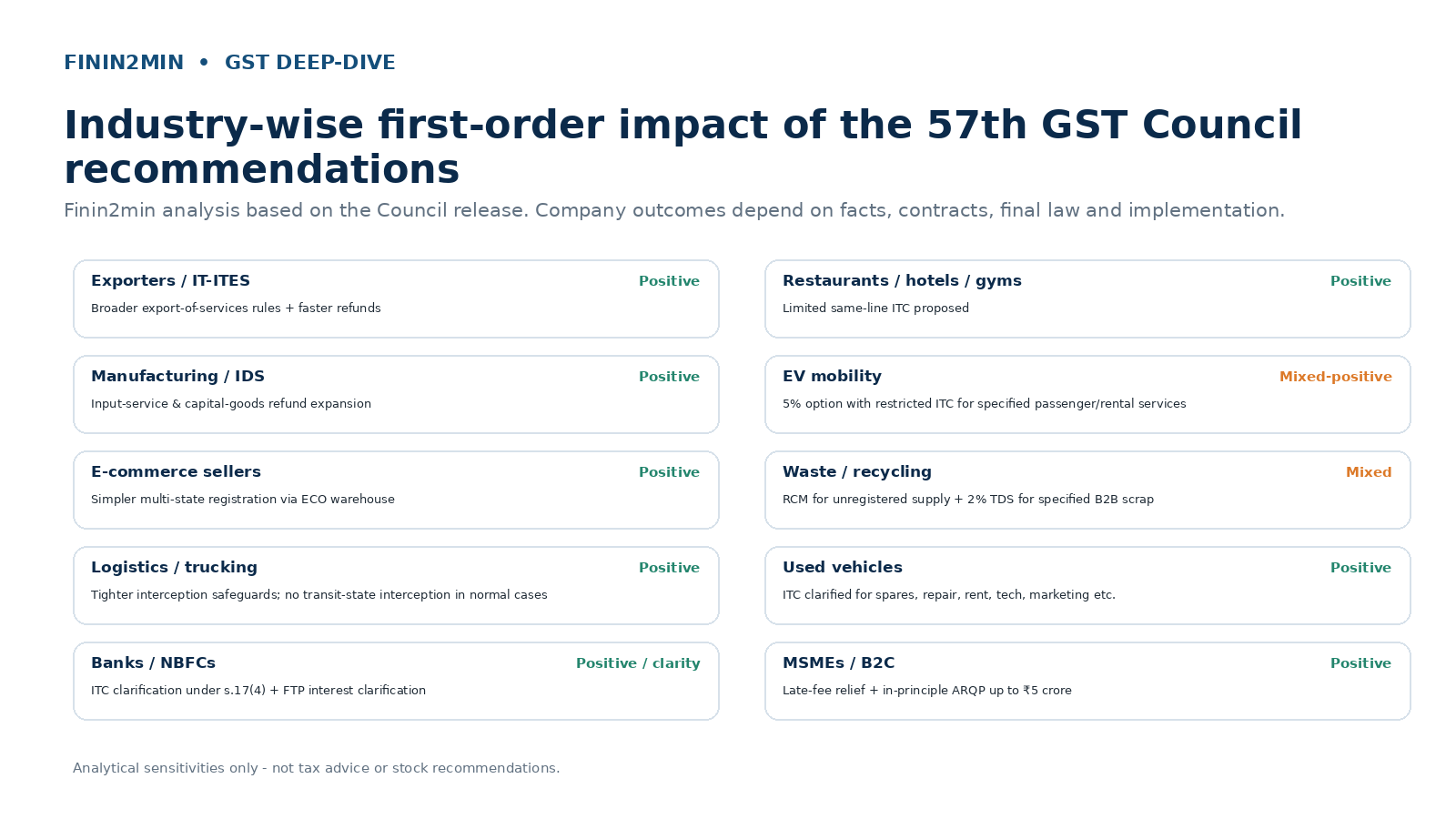
Exporters and IT/ITES - clearly positive if enacted as proposed
Exporters get a potentially powerful combination: faster refunds, broader refund base, fewer place-of-supply frictions and better treatment of foreign establishments/branches. The real benefit will depend on implementation quality and how risk parameters are designed for automated refunds.
Manufacturing and inverted-duty sectors - working capital improves
The expansion to input-service and capital-goods ITC refunds can materially change cash conversion for sectors with structural accumulation. The 60-month treatment for capital goods means the benefit is spread, not a one-time full refund.
E-commerce and D2C - lower state-entry friction
Rule 14B can make multi-state fulfilment easier for small sellers. ECOs will likely need to coordinate warehouse documentation, seller eligibility and registration master data.
Logistics - lower transit friction but tighter documentation discipline
Fewer routine transit-state interceptions are positive, but the explicit exception for missing e-way bills or origin/destination documents means documentation quality becomes even more important.
Banking and NBFC - multiple clarity points
The Council proposes clarifications on section 17(4) ITC, pre-deposits and internal Funds Transfer Pricing. Large financial institutions should map the circulars carefully because the accounting treatment and GST treatment of internal allocations are not always identical.
Telecom and infrastructure - section 17(5) could unlock credit
The proposed relaxation for telecom towers and pipelines outside factory premises can be significant for capital-intensive networks if the final amendment follows the press release.
Hospitality, restaurants and gyms - same-line ITC may reduce cascading
Limited credit for inputs in the same line of business can improve economics, but the exact scope, rate interaction and documentation will only be clear from the notification/rules.
Used-car ecosystem - operating costs get better credit treatment
Clarifying ITC on spares, repairs, rent, technology and marketing can reduce embedded tax for dealers using the margin scheme.
Recycling / scrap - mixed impact
The RCM and 2% TDS proposals formalise specified waste streams. Registered buyers face additional tax/TDS processes, while the system may improve transaction traceability.
15. What finance and tax teams should do now
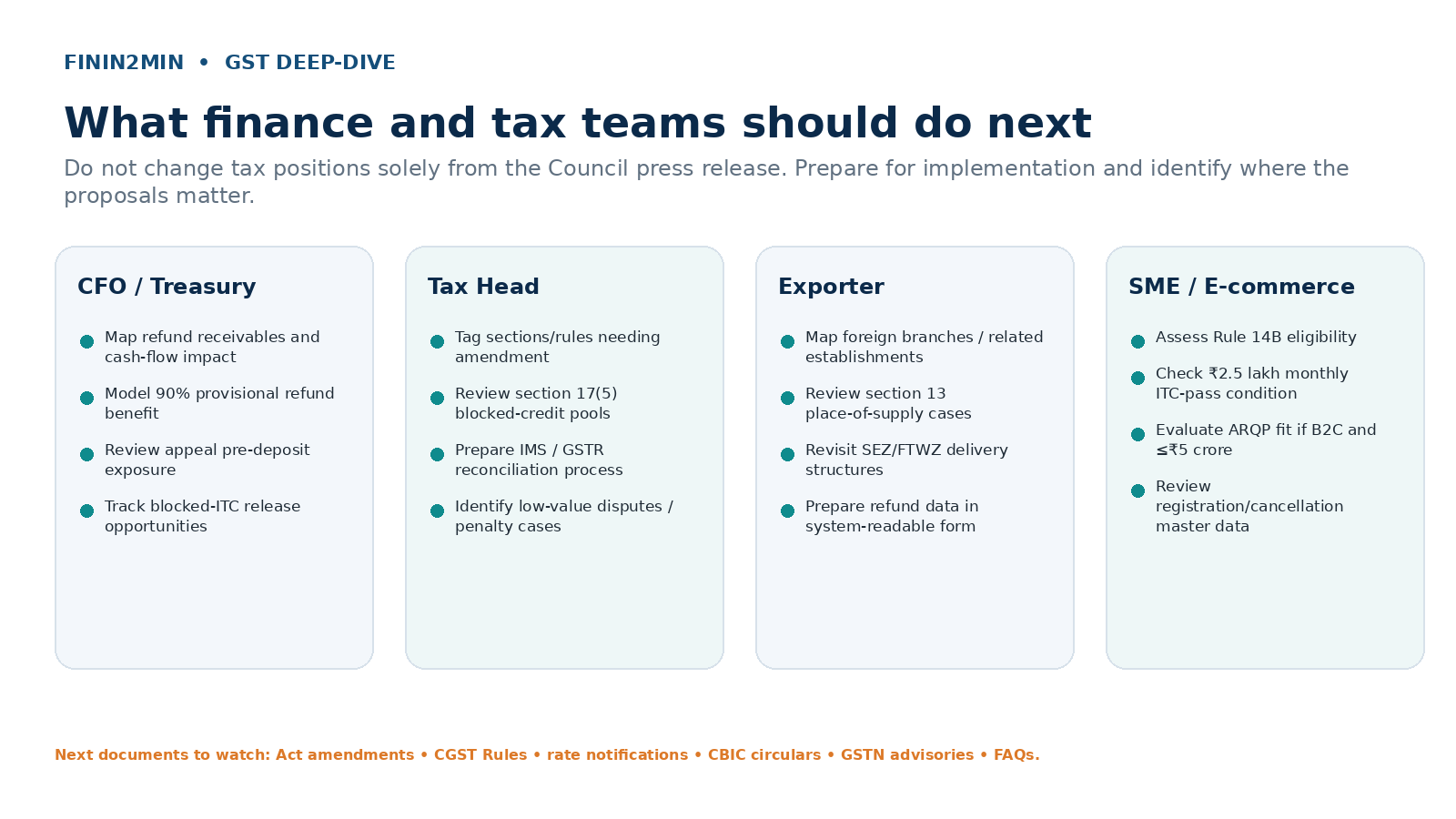
Do not book a tax benefit merely because the Council has recommended it. Instead, use the period before implementation to prepare.
- Build a change register: map every relevant recommendation to your entity, GSTINs, ERP process and owner.
- Quantify blocked ITC: identify credit pools that may become eligible under section 17(5) or the expanded refund rules.
- Model refund cash flow: exporters and inverted-duty businesses should estimate the benefit of 90% provisional refunds and the wider refund base.
- Review open litigation: flag matters below ₹10,000 tax, general-penalty cases, non-fraud matters and penalty-only appeals that may be affected by the proposed thresholds/caps.
- Map prosecution exposure: identify cases where the ₹5 crore proposed threshold or narrower section 132 scope could matter, without assuming relief before enactment.
- Prepare return systems: tax engines should be capable of invoice-level DRC-03 references, IMS actions, RCM statements, reversal/reclaim statements and April-2027 correction architecture.
- Review e-commerce state registrations: small sellers and ECOs should identify States where warehouse-based registration may reduce physical-presence friction.
- Review export structures: service exporters should map overseas branches, distinct-person issues, section 13 cases and SEZ/FTWZ deliveries.
- Track notification dependencies: rate/exemption recommendations need the relevant rate notifications; law changes need amendments; portal features need GSTN deployment.
16. Implementation map: what to watch next
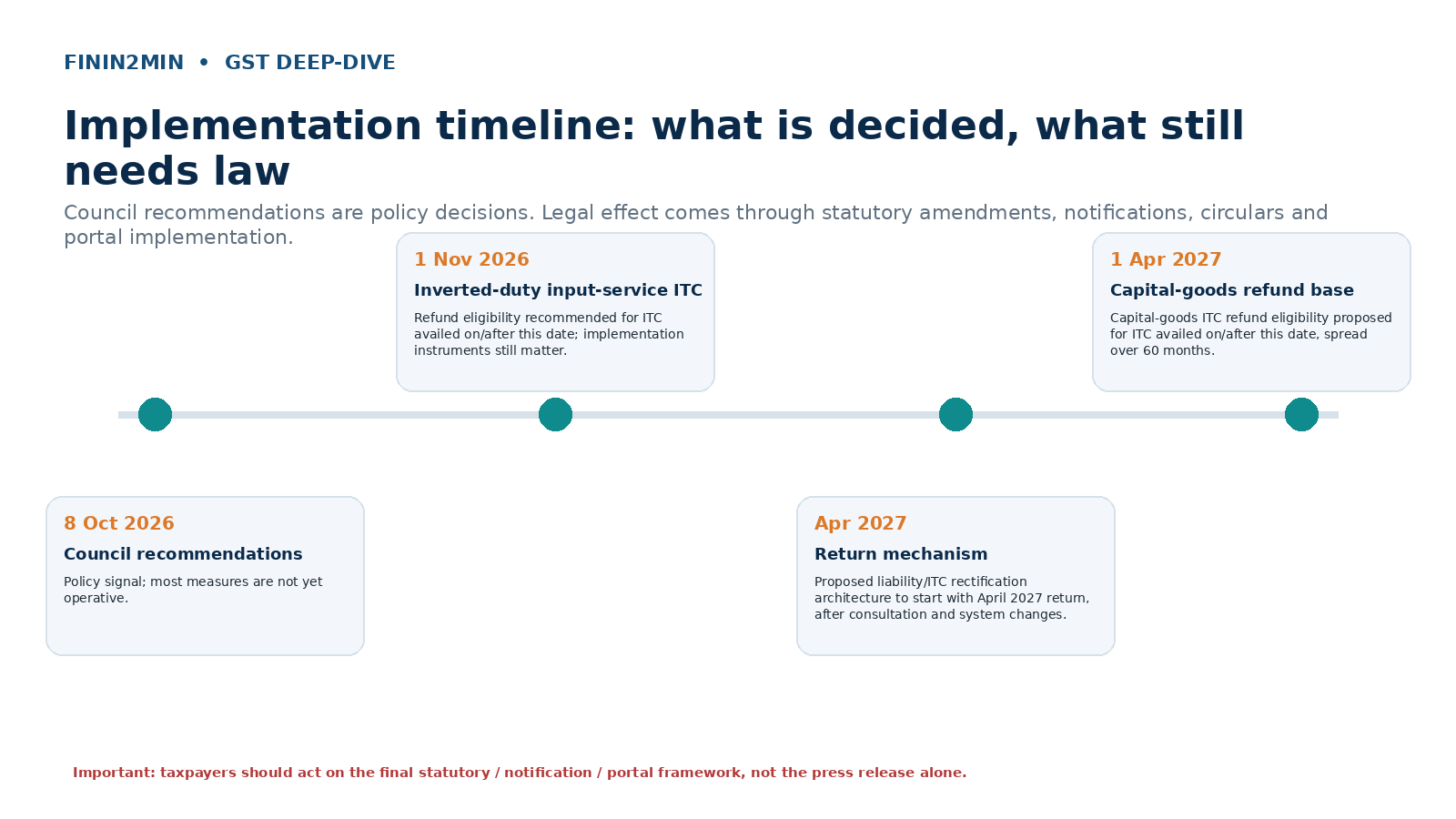
The next legal documents matter as much as the Council meeting itself:
- amendments to the CGST Act and IGST Act;
- corresponding State GST amendments where required;
- CGST Rules amendments, including proposed rules 14B, 23A, 86C and 86D;
- rate and exemption notifications;
- CBIC circulars on registration, ITC, refunds, notices, export payments and other interpretational issues;
- GSTN advisories and portal release notes for automated registration, cancellation, refund and return modules; and
- official FAQs announced by the Ministry of Finance.
The Council release itself expressly says the recommendations are presented in simple language for stakeholders and will be given legal effect through the relevant circulars, notifications and law amendments, which alone have force of law.
17. Finin2min assessment: why this meeting matters
The 57th meeting is not primarily a rate story. It is an administration and trust architecture story.
The policy direction is visible across multiple recommendations: automate what can be automated; reduce low-value notices; make refunds more system-led; provide clearer correction paths before mismatches become disputes; narrow coercive tools; reduce penalties; improve export treatment; and allow ITC to flow more freely where the existing design creates cascading.
If implemented faithfully, the most economically meaningful effects may be:
- lower working-capital lock-up for exporters and inverted-duty sectors;
- lower compliance time for registration/cancellation and routine return corrections;
- lower litigation intensity for low-value and non-fraud cases;
- lower logistics friction from transit-state interceptions;
- higher credit efficiency from expanded ITC/refund eligibility; and
- lower entry barriers for small businesses expanding through e-commerce.
The execution risk is equally important. Automation works only if portal logic, risk rules, state implementation and officer practices are aligned. A system-driven refund mechanism can be transformative, but opaque risk flags can recreate manual friction in another form. A return-correction mechanism can reduce notices, but only if GSTR-1, GSTR-3B, GSTR-2B, IMS and RCM data are synchronised reliably.
The meeting therefore creates a strong pro-compliance reform direction, but the final statutory text and GSTN implementation will determine the real taxpayer experience.
Frequently Asked Questions
Are the 57th GST Council recommendations effective from 8 October 2026?
No. The press release expressly states that the recommendations require the relevant law amendments, notifications and circulars to acquire legal force. Some recommendations specify intended applicability dates, but taxpayers should follow the final instruments.
Has GST arrest power already been removed?
No. The Council recommended omission of section 69. Until the law is amended and brought into force, the existing statutory provision remains relevant.
Is the prosecution limit now ₹5 crore?
It is a Council recommendation to raise the monetary threshold from ₹1 crore to ₹5 crore. The operative threshold changes only after the legal amendment takes effect.
Will exporters automatically receive 90% refund immediately?
Not yet. The Council recommended automated 90% provisional refund for eligible zero-rated and inverted-duty claims based on system risk evaluation. Implementation requires law/rule and portal changes.
What happens to ITC on input services under inverted duty structure?
The Council recommended refund eligibility for input-service ITC availed on or after 1 November 2026. The actual claim mechanism and legal effect should be checked against the final notification/amendment.
What changes are proposed for e-commerce sellers?
A proposed rule 14B would allow eligible small suppliers of goods to use an ECO warehouse as PPoB in a State/UT where they lack physical presence, subject to conditions including the proposed monthly ITC-pass limit.
Did the Council change GST rates across the board?
No broad rate overhaul comparable with the 56th meeting was announced. The release contains targeted classifications, exemptions, rate options and clarifications for selected goods and services.
What is ARQP?
ARQP is an in-principle concept for an optional Annual Return Quarterly Payment scheme for eligible B2C taxpayers with preceding-year turnover up to ₹5 crore. It is not yet operational.
Official Sources
- Ministry of Finance / PIB - 57th GST Council Recommendations, 8 October 2026.
- India Code - Central Goods and Services Tax Act, 2017.
- India Code - Integrated Goods and Services Tax Act, 2017.
- Goods and Services Tax Council - official portal.
- CBIC GST - notifications, circulars and implementation instruments.
Disclaimer
This article is for educational and informational purposes and is based on the official GST Council recommendation release available at the research cut-off. A GST Council recommendation does not by itself amend the law. Businesses should verify the final Act amendments, rules, notifications, circulars and GSTN advisories before changing tax treatment, claiming credit/refund or altering compliance processes. Examples are illustrative and do not constitute legal, tax or investment advice.