
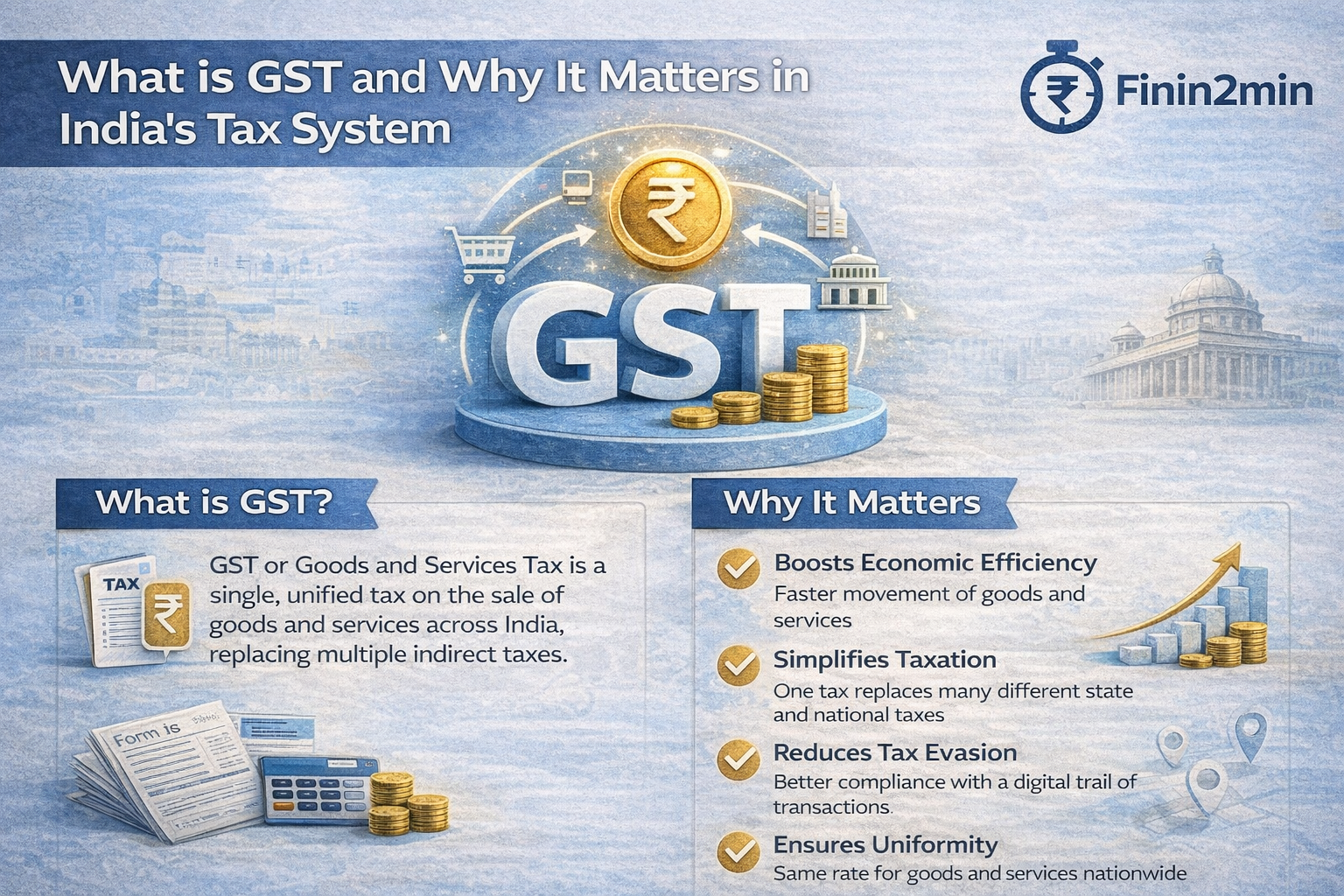
The Goods and Services Tax (GST), launched on 1 July 2017, is one of the biggest tax reforms in India’s history. It unified multiple indirect taxes under a single system, eliminating the complex web of excise, VAT, and service taxes.
1️⃣ Why GST Was Introduced
Before GST, India’s tax structure had multiple cascading taxes:
- Central Excise, Service Tax (Centre)
- VAT, Entry Tax, Octroi (State)
- Different rates in every state
This created confusion and “tax on tax”, leading to inefficiency.
GST replaced them with “One Nation, One Tax”, ensuring a seamless flow of goods and services across India.
2️⃣ What Exactly is GST?
GST is a destination-based indirect tax levied on the supply of goods and services.
It is collected at every stage but credited back through an Input Tax Credit (ITC) system — ensuring no double taxation.
Structure of GST
| Type | Levied By | Example |
|---|---|---|
| CGST | Central Govt | Central share of tax |
| SGST | State Govt | State share of tax |
| IGST | Centre (Inter-State) | Tax on interstate supply |
3️⃣ Constitutional & Legal Basis
- Governed by Article 246A and 122nd Constitutional Amendment Act, 2016.
- Administered by CBIC (Central Board of Indirect Taxes and Customs).
- Policy decisions made by the GST Council chaired by the Union Finance Minister.
4️⃣ Benefits of GST
| For Business | For Consumers | For Government |
|---|---|---|
| Reduced compliance | Lower prices | Higher revenue transparency |
| Seamless ITC flow | No double taxation | Wider tax base |
| Nationwide uniformity | Simple billing | Digital ecosystem |
5️⃣ Key Components of GST
- Taxpayer Identification Number (GSTIN)
- E-invoicing System (2020 onwards)
- E-way Bill for goods movement
- GSTR returns (monthly/annual)
- Input Tax Credit (ITC) mechanism
6️⃣ GST Rate Structure (as of 2025)
| Slab | Goods/Services |
|---|---|
| 0% | Essential items, food grains |
| 5% | Essentials, small services |
| 12% | Processed food, electronics |
| 18% | Most goods/services |
| 28% | Luxury & sin goods |
7️⃣ Impact of GST
- Increased ease of doing business.
- Improved tax compliance via digital tracking.
- Boosted formalisation of the economy.
- Simplified tax credits across states.
8️⃣ Challenges & Reforms Ahead
- High compliance for MSMEs.
- Frequent system updates.
- Need for GST 2.0 with simplified rates.
✅ Summary
GST modernized India’s indirect tax regime. It promotes transparency, eliminates cascading taxes, and contributes significantly to economic growth.
📚 References
- CBIC – GST Council Reports
- Union Budget 2024–25
- www.cbic.gov.in
💬 FAQs
1. What is GST in simple terms?
A unified tax replacing multiple indirect taxes in India.
2. Who collects GST?
Both Central and State Governments share GST revenue.
3. When was GST launched?
1 July 2017.
4. What is GSTIN?
A 15-digit registration number for taxpayers.
5. What are GST slabs?
0%, 5%, 12%, 18%, and 28%.
