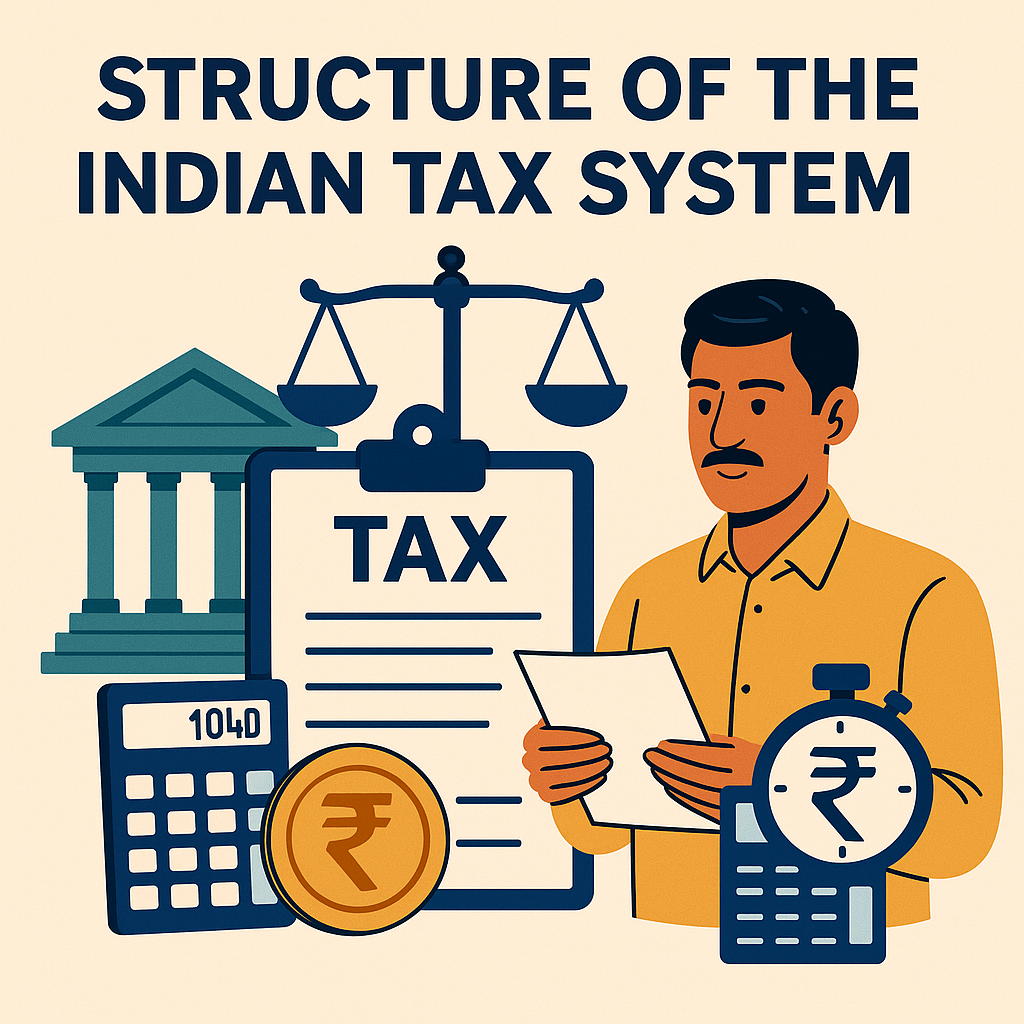
India’s tax system is one of the most comprehensive across developing economies. It supports the country’s infrastructure, welfare schemes, defense, administration, and social development. Over time, it has evolved from a complex, fragmented colonial framework into a modern, digital system backed by faceless assessments, e-filing, and real-time databases.
This article breaks down the entire structure of taxes in India, including classifications, authorities, mechanisms, and recent reforms.
1. Understanding What the Tax System Is
A tax system refers to the way a government collects revenue from individuals and businesses to fund national development.
India’s system is governed primarily by:
- Central Government
- State Governments
- Local Municipal Bodies
Each level administers different taxes as allowed by the Constitution of India (Seventh Schedule).
2. Classification of Taxes in India
India broadly divides taxes into two major categories:
A. Direct Taxes
Paid directly by individuals and businesses to the government.
These taxes are based on income or profits, not on the sale of goods or services.
Key Direct Taxes
| Tax Type | Governed By | Who Pays |
|---|---|---|
| Income Tax | Income-tax Act, 1961 | Individuals, HUFs, Firms, Companies |
| Corporate Tax | Income-tax Act, 1961 | Companies |
| Minimum Alternate Tax (MAT) | Sec 115JB | Companies with low taxable income |
| Equalisation Levy | Finance Act | Digital transactions |
| Securities Transaction Tax (STT) | Finance Act | Traders & investors |
Administered by:
👉 Central Board of Direct Taxes (CBDT)
(Under the Ministry of Finance)
B. Indirect Taxes
Collected indirectly from consumers through goods/services prices.
Before GST:
- VAT
- Service Tax
- Excise Duty
- Octroi
- Entry Tax
(Complex and multi-stage)
After GST (2017):
India now uses a unified system:
👉 GST (Goods and Services Tax) consisting of:
- CGST (Central)
- SGST (State)
- IGST (Inter-State)
Administered by:
👉 Central Board of Indirect Taxes & Customs (CBIC)
3. Constitutional Provisions Related to Taxation
The Seventh Schedule divides taxation rights:
Union List (Central Govt)
- Income Tax
- Corporate Tax
- Customs
- Excise
- GST share (CGST, IGST)
State List
- SGST
- State Excise (alcohol)
- Stamp Duty
- Road tax
- Property tax (via municipalities)
Municipal/Local Bodies
- Water tax
- Property tax
- Garbage collection fees
4. Key Institutions in India’s Tax Structure
1. Ministry of Finance
Responsible for:
- Tax policy
- Budget
- Macroeconomic strategy
Includes two major boards:
2. CBDT (Central Board of Direct Taxes)
Administers:
- Income Tax Act
- PAN system
- TDS administration
- Digital tax platforms
- Taxpayer services
Issues crucial reforms such as:
- Faceless assessments
- AIS/TIS reporting
- New tax regime
3. CBIC (Central Board of Indirect Taxes & Customs)
Handles:
- GST
- Customs
- Anti-evasion
- E-way bill system
- GST portal
- E-invoicing
4. GST Council
Constitutional body for:
- Rate decisions
- Policy changes
- Resolving center-state disputes
Headed by the Union Finance Minister and includes state finance ministers.
5. How Taxes Are Collected in India
A. Income Tax Collection
- TDS (Tax Deducted at Source)
- Advance Tax
- Self-Assessment Tax
- Regular Assessment Tax
B. GST Collection
- Tax collected by businesses → Deposited monthly
- GSTR-1 (sales return)
- GSTR-3B (summary return)
- Annual return & reconciliation
C. Customs
Collected at ports/airports for imports.
6. How Tax Revenue Is Used
The government uses tax revenue for:
- Public infrastructure
- Defence
- Healthcare
- PMAY & welfare schemes
- Education
- Digital India projects
- Railways & highways
- Subsidies for agriculture
- Administrative costs
In Budget 2024–25, tax revenue formed over 70% of total government receipts (source: Union Budget).
7. Digital Transformation in India’s Tax System
India is among the world leaders in digitized tax processing.
Key digital initiatives:
- Online ITR filing (100% electronic)
- PAN–Aadhaar linking
- AIS/TIS reporting for transparency
- Faceless Appeal System
- GST e-invoicing
- E-way bill digital tracking
- Integrated taxpayer database
8. Common Challenges in India’s Tax Structure
- High compliance burden for small businesses
- Frequent GST notifications
- Classification disputes (GST rate fitment)
- Income tax complexity (old vs new regime)
- Tax evasion using undisclosed income
However, reforms like GST rate rationalisation, AIS, and faceless scrutiny have improved the system significantly.
9. Future of India’s Tax System
Expected reforms by 2030:
- GST 2.0 (simpler rate structure)
- Greater use of AI in assessment
- Fully digital dispute resolution
- Single business ID replacing PAN/GSTIN
- Real-time cross-verification of transactions
10. Summary
India’s tax system is a blend of central, state, and local taxation supported by powerful digital infrastructure. From income tax to GST, the system aims to balance fairness, simplicity, and revenue generation.
FAQs
1. How many types of taxes exist in India?
Two main types — Direct and Indirect.
2. Who collects GST?
Both Central and State Governments.
3. What is the main law governing income tax?
The Income-tax Act, 1961.
4. Who administers Income Tax?
CBDT (Central Board of Direct Taxes).
5. Is India’s tax system fully digital?
Yes — from ITR to GST, everything is online.
References
- Income-tax Act, 1961 (Govt. of India)
- CBDT Circulars (2022–2024)
- CBIC – GST Council updates
- Union Budget 2024–25
- https://incometax.gov.in
- https://cbic.gov.in
