Smokers Adjust, Not Quit: Why Higher Taxes May Not Break ITC’s Cigarette EconomicsWill Higher Taxes Dent ITC’s Share Price in the Long Run?
India’s latest tobacco tax changes have once again put ITC’s cigarette business under the scanner. The headline worry is simple: can repeated tax shocks finally break pricing power and volumes?
The answer, as history suggests, is more nuanced than the headlines imply.
🔢 The Numbers — Why This Tax Shock Is Different
At current structures:
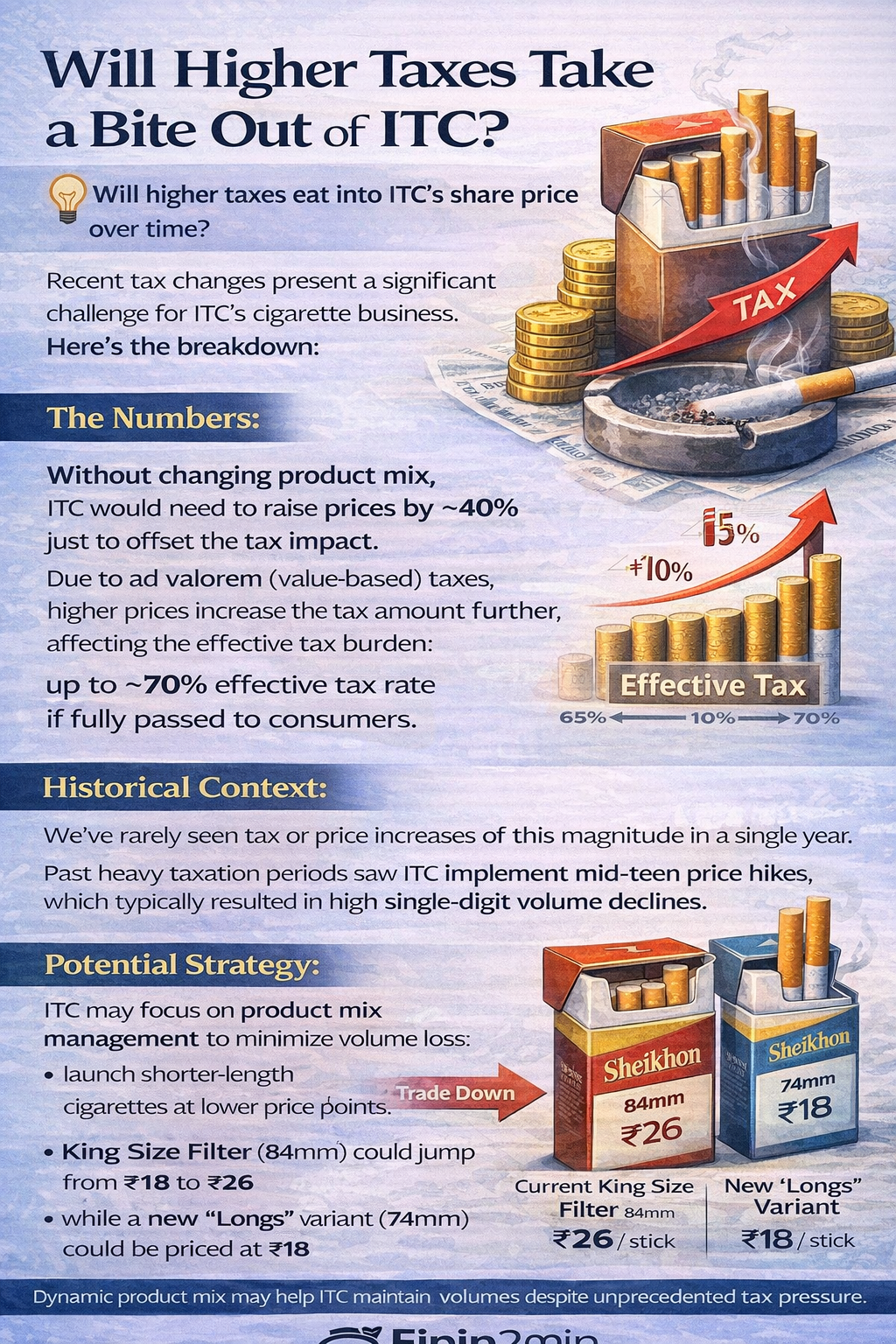
- Without changing product mix, ITC would need to raise cigarette prices by ~40% just to neutralise the tax impact.
- Because India uses a mixed specific + ad valorem tax regime, price hikes themselves inflate the tax base.
- If ITC attempted a full pass-through, the effective tax burden could approach ~70% of MRP.
👉 This creates a non-linear problem:
Higher prices → higher tax → even higher required prices.
This is why blunt price hikes are economically inefficient in the current regime.
📚 Historical Context — What Past Tax Cycles Tell Us
India has seen frequent tobacco tax increases, but rarely of this magnitude in one year.
- In past heavy-taxation phases, ITC typically:
- Took mid-teen price hikes
- Accepted high single-digit volume declines
- The most severe example:
- FY15–FY16: Aggressive excise hikes
- Cigarette volumes fell >15%
Crucially:
- Volumes fell, but the business did not structurally break
- Margins recovered over time through calibrated pricing and mix changes
The lesson: Demand is sticky, but not inelastic.
🚬 Consumer Reality — “Smokers Adjust, Not Quit”
Global and Indian evidence is consistent:
- Smokers cut discretionary consumption first
- They trade down before they quit
- Abrupt cessation happens far less often than policymakers assume
In simple terms:
Smokers will eat less, travel less, but continue to smoke—just cheaper.
This behavioural insight is central to ITC’s likely response.
🧠 Likely Strategy — Product Mix Over Price Shock
Rather than forcing a 15%-40% price hike on existing SKUs, ITC’s more rational play is mix engineering.
Example (illustrative):
- King Size Filter (84mm)
- Current price: ~₹18/stick
- Post-tax neutral price: ~₹26/stick (psychologically disruptive)
- Potential response: Introduce “Longs” (74mm)
- Priced at ~₹18/stick
- Lower tax incidence due to shorter length
- Allows consumers to trade down instead of quitting
This approach:
- Preserves stick volumes
- Softens elasticity shock
- Buys time for gradual price resets
ITC has used similar tactics in earlier cycles—this is not new playbook risk.
📉 Short-Term vs Long-Term — Market Impact
Short-term (6–12 months):
- Volume pressure likely
- Earnings estimates may see downgrades
- Sentiment around cigarettes remains cautious
Medium to long-term:
- Mix optimisation + calibrated pricing restore stability
- Non-cigarette FMCG, hotels, agri exports provide earnings ballast
- Cigarettes remain high-ROCE, cash-generative, even at lower volumes
The market has repeatedly discounted terminal decline, only to be proven wrong by behavioural reality and execution discipline.
📌 Finin2min Lens
- This tax shock is severe, but not unprecedented in spirit
- The real risk is execution, not demand collapse
- Cigarette consumption adjusts down the value ladder, not off the ladder
- ITC’s strength lies in pricing psychology, not brute force
✅ Bottom Line
Higher tobacco taxes will hurt volumes and sentiment in the near term, but they are unlikely to permanently impair ITC’s cigarette economics.
Consumers adapt.
Companies adapt faster.
Markets overreact first.
For long-term investors, the question is not whether ITC survives this tax cycle—but how efficiently it navigates it, as it has many times before.
Disclaimer: This article is for informational and educational purposes only and does not constitute investment advice, a recommendation, or an offer to buy or sell any securities. Views expressed are based on publicly available information and personal analysis as of the date of publication. Readers should conduct their own research or consult a qualified financial advisor before making any investment decisions.
