
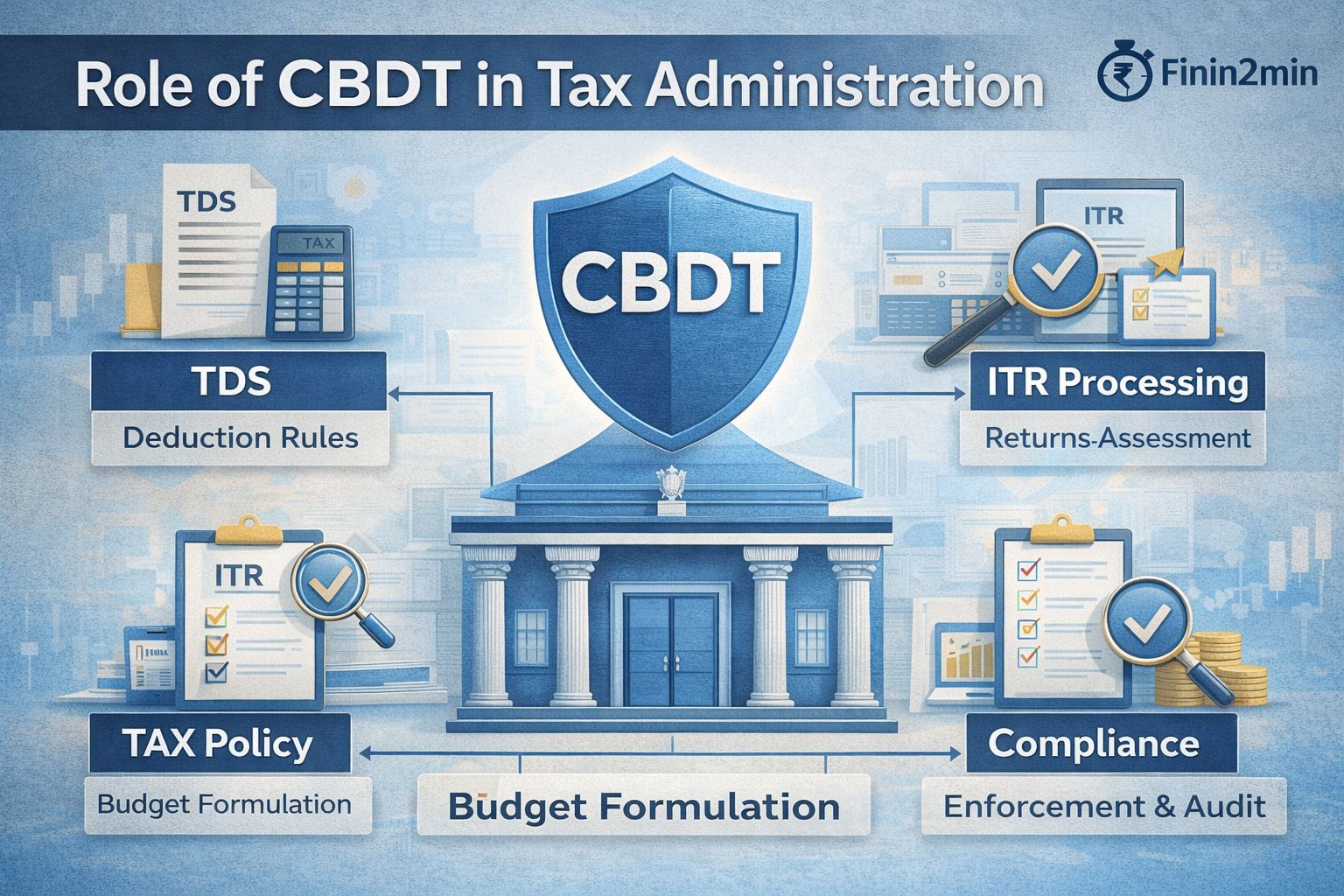
The Central Board of Direct Taxes (CBDT) is the key policy-making and administrative authority for direct taxes in India. Operating under the Department of Revenue, Ministry of Finance, it ensures efficient collection, regulation, and implementation of direct tax laws — primarily the Income-tax Act, 1961.
Let’s explore how CBDT functions, its powers, and why it is crucial to India’s financial ecosystem.
1️⃣ Origin and Legal Framework
CBDT traces its origins to the Central Board of Revenue Act, 1963, which split the Board into two:
- CBDT (Direct Taxes)
- CBIC (Indirect Taxes)
This separation streamlined India’s tax administration as the economy grew complex.
2️⃣ Composition of CBDT
CBDT consists of:
- Chairperson
- Six Members overseeing specialized divisions:
- Legislation & Systems
- Income Tax
- Investigation
- Administration
- Audit & Judicial
- Revenue / TPS (Taxpayer Services)
They operate under the overall supervision of the Revenue Secretary, Ministry of Finance.
3️⃣ Core Functions of CBDT
| Function | Description |
|---|---|
| Policy Formulation | Drafts direct tax policies and amends Income-tax Act through Finance Acts. |
| Administration | Supervises Income Tax Department nationwide. |
| Revenue Collection | Sets and monitors direct tax collection targets. |
| Investigation | Handles anti-tax evasion and black money tracking. |
| Grievance Redressal | Operates taxpayer facilitation centres (Aaykar Seva Kendras). |
| International Cooperation | Coordinates double taxation treaties (DTAA). |
4️⃣ Key CBDT Departments
- Directorate of Investigation → Tracks tax evasion and money laundering.
- Directorate of Systems → Develops e-filing, PAN, AIS & faceless platforms.
- Directorate of Income Tax (HRD) → Training & staffing.
- Directorate of Recovery → Manages arrears collection.
5️⃣ Landmark CBDT Initiatives (2019–2025)
| Year | Reform | Impact |
|---|---|---|
| 2019 | Faceless Assessment & Appeal | Reduced corruption and manual interference |
| 2020 | Introduction of Taxpayer Charter | Enhanced accountability |
| 2021 | AIS (Annual Information Statement) | Transparent income tracking |
| 2022 | E-verification Scheme | Automated data reconciliation |
| 2023–25 | Integrated Business Process Reforms | Seamless taxpayer experience |
6️⃣ CBDT’s Role in Policy and Law
CBDT advises the government on:
- Annual Union Budget tax proposals
- Double Taxation Avoidance Agreements (DTAAs)
- Transfer Pricing rules
- Tax amnesty schemes like Vivad se Vishwas
- Legislative drafting for new Finance Acts
7️⃣ Technological Evolution
CBDT has embraced technology-driven systems:
- E-filing portal (www.incometax.gov.in)
- Centralised Processing Centre (CPC), Bengaluru
- TDS Reconciliation Analysis and Correction Enabling System (TRACES)
- AI-based Compliance Systems (2024 onwards)
These systems enable data-driven compliance, improving accuracy and reducing manual intervention.
8️⃣ Challenges Ahead
- Handling rapid data expansion
- Resolving taxpayer grievances faster
- Ensuring inter-department coordination
- Integrating international data-sharing frameworks (FATCA, CRS)
9️⃣ The Future of CBDT
CBDT’s next leap involves:
- AI-based risk assessment
- Real-time data validation from banks, EPFO, and GSTN
- Expanding Taxpayer Service Centres (Aaykar Seva Kendras 2.0)
- Integrated PAN-based citizen ledger by 2030
✅ Summary
CBDT ensures fairness, efficiency, and transparency in India’s direct tax system. It is not just a policy body — it is the brain of India’s income tax ecosystem, balancing taxpayer convenience with compliance enforcement.
📚 References
- Central Board of Revenue Act, 1963
- Income-tax Act, 1961
- CBDT Annual Report 2023–24
- Union Budget 2024–25
- https://incometax.gov.in
💬 FAQs
1. What is CBDT?
CBDT stands for Central Board of Direct Taxes, India’s apex authority for direct tax administration.
2. Who heads CBDT?
A Chairperson appointed by the Government of India, under the Department of Revenue.
3. Is CBDT part of the Finance Ministry?
Yes, it functions under the Ministry of Finance, Department of Revenue.
4. What laws does CBDT enforce?
Primarily the Income-tax Act, 1961 and related Finance Acts.
5. How does CBDT help taxpayers?
Through digital filing systems, grievance redressal, and transparent assessment frameworks.
