How to Correct Excess Tax on Leave Encashment for AY 2025-26
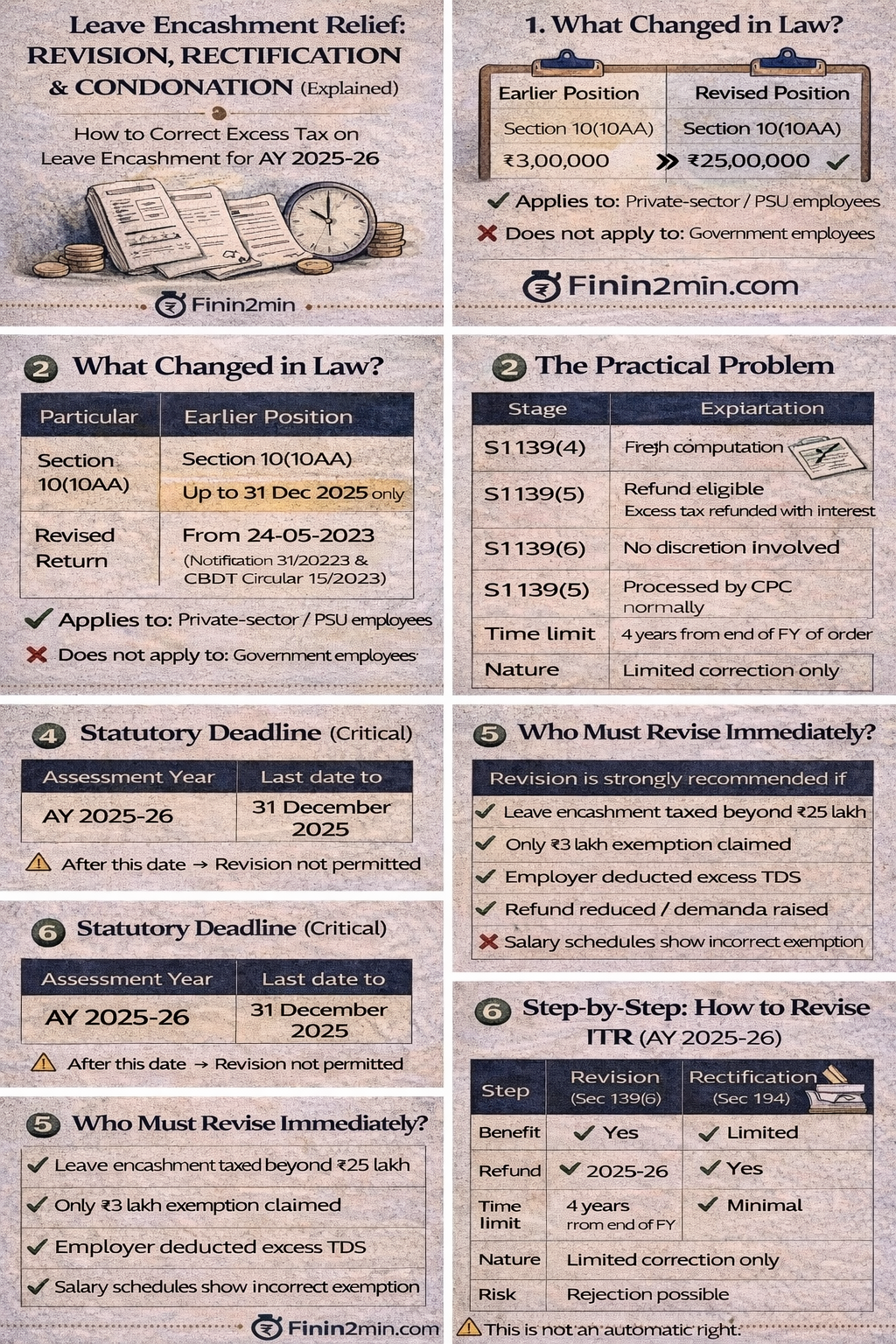
🔷 1. What Changed in Law? (At a Glance)
| Particular | Earlier Position | Revised Position |
|---|---|---|
| Applicable section | Section 10(10AA) | Section 10(10AA) |
| Exemption limit (non-Govt employees) | ₹3,00,000 | ₹25,00,000 |
| Effective date | Till 23-05-2023 | From 24-05-2023 onwards |
| Legal basis | Old ceiling | Notification 31/2023 + CBDT Circular 15/2023 |
✅ Applies to: Private-sector / PSU employees
❌ Does not apply to: Government employees (already fully exempt)
🔷 2. The Practical Problem
Many taxpayers for AY 2025-26 have already:
- Filed ITR using old ₹3 lakh limit
- Paid excess tax / received lower refund
- Faced incorrect TDS deduction by employer
➡ Result: Excess taxation on terminal leave encashment
🔷 3. Best Remedy Before 31 December 2025
✅ Revision of Return (Section 139(5))
Why revision is the first & fastest option
| Benefit | Explanation |
|---|---|
| Automatic correction | Fresh computation allowed |
| Refund eligible | Excess tax refunded with interest |
| No discretion involved | Processed by CPC normally |
| Least litigation risk | No approval / scrutiny stage |
🔷 4. Statutory Deadline (Critical)
| Assessment Year | Last date to revise return |
|---|---|
| AY 2025-26 | 31 December 2025 |
⚠️ After this date → Revision not permitted
🔷 5. Who Must Revise Immediately?
Revision is strongly recommended if:
✔ Leave encashment taxed beyond ₹25 lakh
✔ Only ₹3 lakh exemption claimed
✔ Employer deducted excess TDS
✔ Refund reduced / demand raised
✔ Salary schedules show incorrect exemption
🔷 6. Step-by-Step: How to Revise ITR (AY 2025-26)
| Step | Action |
|---|---|
| 1 | Login to Income-tax e-Filing Portal |
| 2 | e-File → Income-Tax Returns → Revised Return |
| 3 | Select AY 2025-26 |
| 4 | Enter original ITR acknowledgement |
| 5 | Modify salary schedule → restrict taxable leave encashment to amount exceeding ₹25,00,000 |
| 6 | Recompute tax & submit |
| 7 | Verify electronically |
📌 Refund (if any) is processed through CPC automatically.
🔷 7. What Happens If You Miss 31 December 2025?
After the revision window closes, only two fallback remedies exist, both less efficient.
🔷 8. Remedy 2 – Rectification (Section 154)
| Parameter | Details |
|---|---|
| Applicable where | Mistake apparent on record |
| Typical error | ₹3 lakh applied instead of ₹25 lakh |
| Eligible AYs (practically) | AY 2021-22 to AY 2024-25 |
| Time limit | 4 years from end of FY of order |
| Nature | Limited correction only |
| Discretion | Minimal |
📌 Cannot re-examine facts or fresh claims.
🔷 9. Remedy 3 – Condonation of Delay (Section 119(2)(b))
| Parameter | Details |
|---|---|
| Applicable for | Older AYs where revision + rectification barred |
| Typical AYs | AY 2020-21 & earlier |
| Time limit | Up to 6 years from end of AY |
| Nature | Discretionary |
| Requirement | Proof of genuine hardship |
| Risk | Rejection possible |
⚠️ This is not an automatic right.
🔷 10. Remedy Comparison Table (Quick Decision Guide)
| Criteria | Revision | Rectification | Condonation |
|---|---|---|---|
| Legal basis | Sec 139(5) | Sec 154 | Sec 119(2)(b) |
| Automatic | ✅ Yes | ⚠️ Limited | ❌ No |
| Refund possible | ✅ Yes | ✅ Yes | ✅ Yes |
| Discretion | ❌ | ⚠️ Minimal | ❌ High |
| Best use case | AY 2025-26 | AY 2021-22 to 2024-25 | Older AYs |
| Complexity | Low | Medium | High |
🔷 11. Key Takeaway (Finin2min View)
31 December 2025 is not just a deadline — it is the last clean exit.
- Revision is fastest, safest, and legally secure
- Rectification & condonation are fallback tools, not substitutes
- Delay converts a simple correction into a discretionary battle
📌 Final Recommendation
✔ If AY 2025-26 → Revise immediately
✔ If revision closed → Check rectification eligibility
✔ If both closed → Explore condonation carefully
📍 Finin2min Summary Box
Enhanced leave encashment exemption = ₹25 lakh
Missed it? Revise before 31-12-2025
After that → remedies narrow, risk increases
