
Introduction
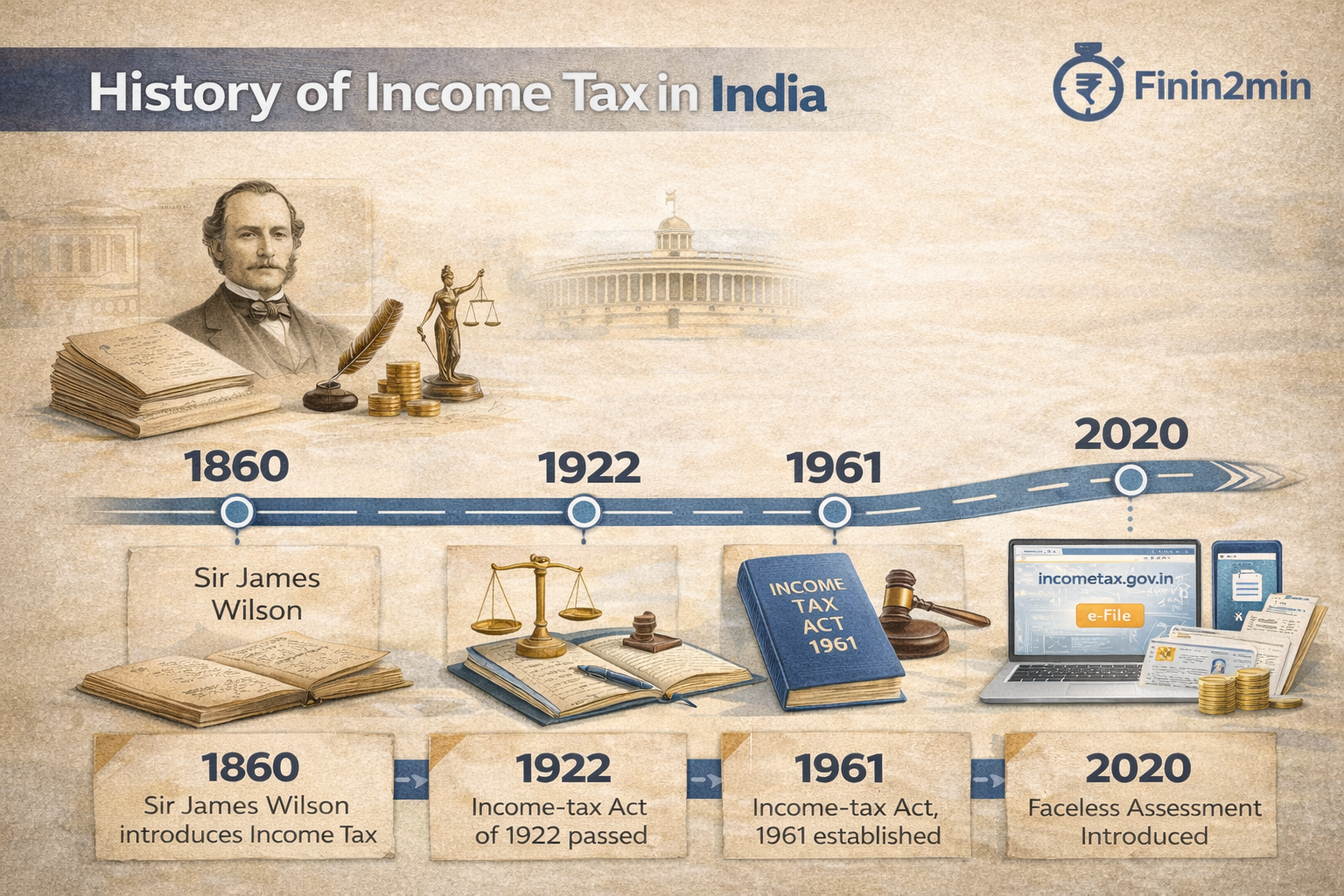
India’s taxation framework has undergone a fascinating journey spanning over 160 years. From Sir James Wilson’s initial tax system in 1860 to the e-filing and faceless assessment era of today, the evolution of Income Tax reflects India’s economic maturity, fiscal reforms, and governance modernization.
Colonial Origins (1860–1947)
- The first Income-tax Act was introduced in 1860 to recover losses after the 1857 Revolt.
- Repealed and re-enacted multiple times, culminating in the Act of 1918 and then Act of 1922, which became the cornerstone of modern taxation.
- British-era taxation targeted trade profits, property income, and salaries.
Post-Independence Reforms
- The Income-tax Act, 1961 replaced the 1922 Act.
- Introduced progressive tax rates and broader coverage of income sources.
- CBDT (Central Board of Direct Taxes) was established to administer policy.
- Early 1990s liberalization further restructured rates and incentives.
Key Milestones
| Year | Reform | Impact |
|---|---|---|
| 1976 | Introduction of PAN concept | Unique taxpayer tracking |
| 1995 | Computerization begins | Faster processing |
| 2006 | Online filing enabled | Accessibility |
| 2019 | Faceless assessment | Transparency |
| 2020 | New tax regime introduced | Optional lower rates |
Digital Transformation
With the launch of incometax.gov.in, e-verification, and AI-based scrutiny, compliance has become simpler. The government’s Vision 2047 aims for near-complete automation of tax administration.
Conclusion
The Indian Income-tax system has transformed from a colonial revenue tool to a sophisticated, citizen-centric framework. Continuous reforms ensure transparency, efficiency, and fairness.
Sources:
Income-tax Act, 1961
CBDT Annual Report 2023
