Finin2min Weekly Brief — October 30, 2026
India recovers as oil and global AI risks reshape November The five-session India market journey, global crude and metals, the latest GIFT Nifty, the Fed, Reliance earnings, GST and the financial compliance calendar.
FININ2MIN · WEEKLY FINANCE INTELLIGENCE · 26-30 OCTOBER 2026
India recovers as oil and global AI risks reshape November
The five-session India market journey, global crude and metals, the latest GIFT Nifty, the Fed, Reliance earnings, GST and the financial compliance calendar. Weekend developments through 1 November 2026.

Two-minute summary
- Nifty 50 closed at 23,053.10, gaining 453.10 points or 2.00% from the preceding Friday; Sensex rose 1.83%.
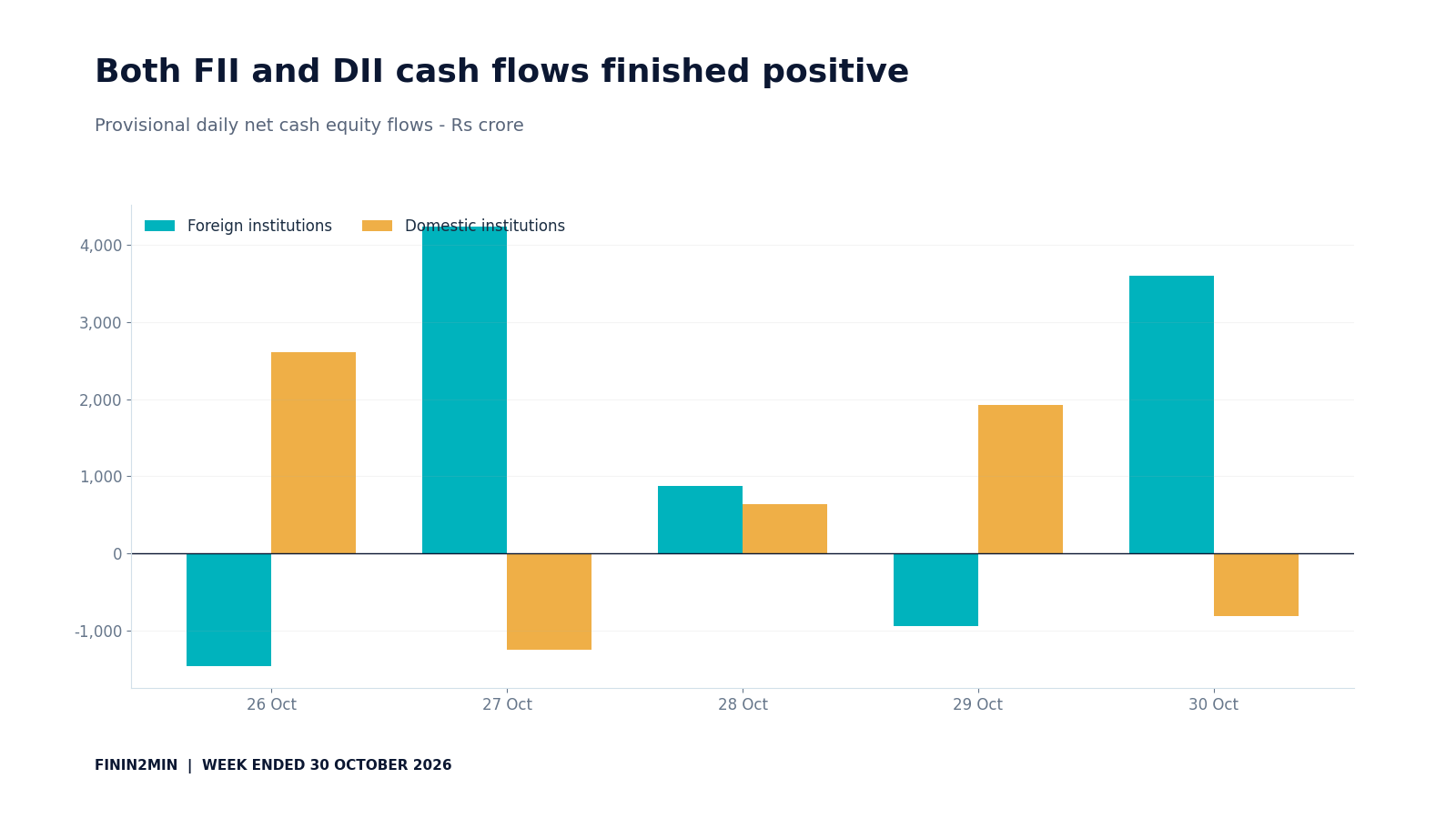
- Foreign institutions bought a provisional net Rs 6,304.67 crore in cash equities; domestic institutions bought Rs 3,109.79 crore over five sessions.
- Latest completed GIFT Nifty November-futures reading was 23,242.50 at about 02:29 IST on 31 October.
- December Brent ended at US$117.64/bbl and December WTI at US$104.12/bbl; comparable weekly gains were 0.79% and 0.82%.
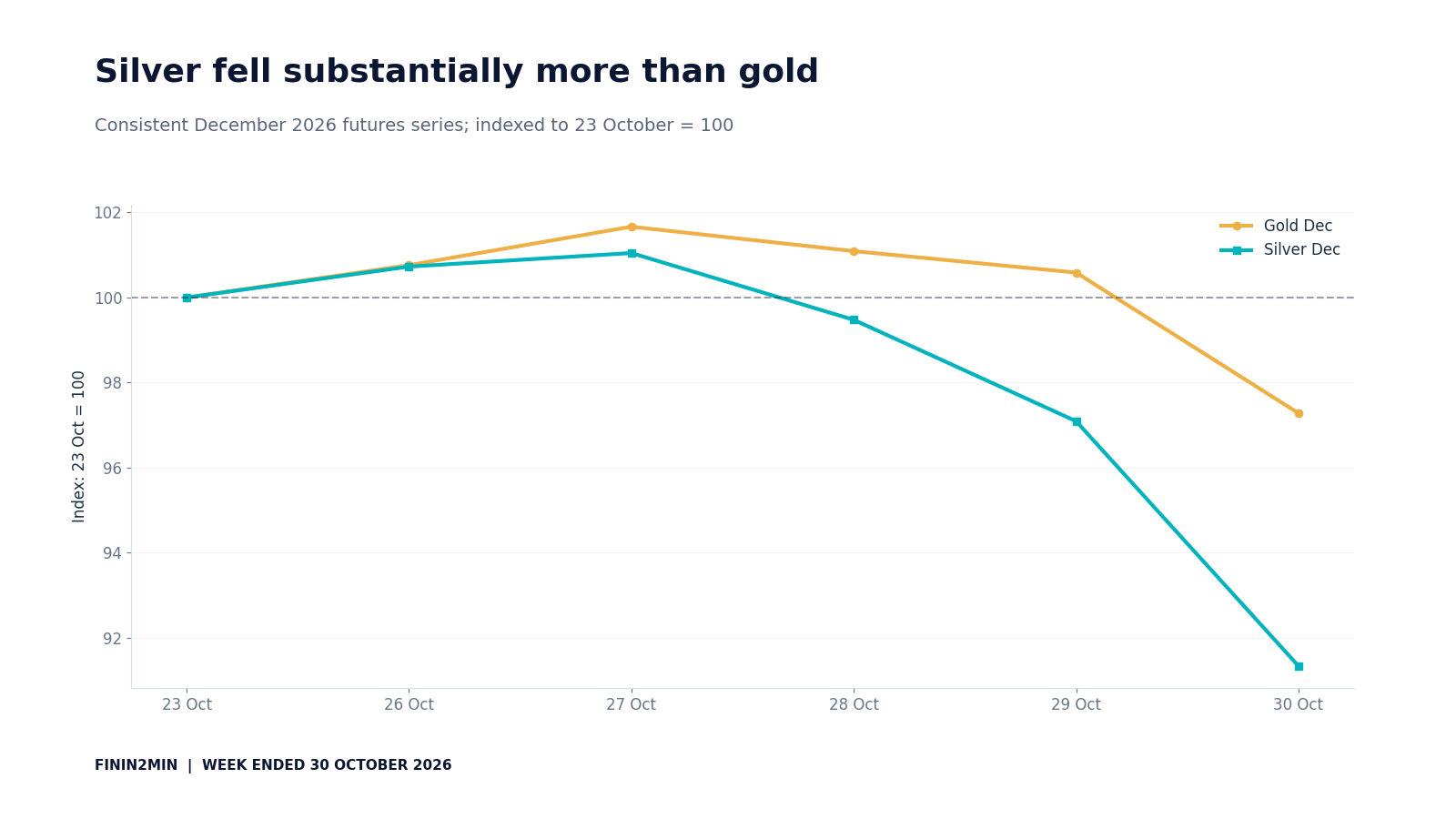
- December gold futures settled at US$3,898.90/oz (-2.72% weekly); December silver futures at US$49.276/oz (-8.66% weekly).
- The Federal Reserve held rates at 3.75%-4.00%, while US Q3 GDP grew 3.4% annualised and September PCE inflation hit 3.6% YoY.
- Reliance reported Q2 FY27 consolidated gross revenue of Rs 3,62,268 crore, EBITDA of Rs 62,409 crore and PAT including JVs of Rs 29,550 crore.
- India September IIP rose 6.7% YoY; October GST collections, released Sunday, were Rs 2.31 lakh crore gross and Rs 2.03 lakh crore net.
- GST amendments on discounts, credit notes and refunds commenced on 1 November; MCA announced FY26 annual-return and cost-audit filing fee relief.
Five-session India market dashboard

| Date | Nifty close | Sensex close | Nifty change | FII cash (Rs cr) | DII cash (Rs cr) |
|---|---|---|---|---|---|
| 26 Oct | 22,753.20 | 73,606.75 | +0.68% | -1,462.49 | +2,609.57 |
| 27 Oct | 22,749.75 | 73,598.67 | -0.02% | +4,240.39 | -1,250.03 |
| 28 Oct | 22,698.85 | 73,246.03 | -0.22% | +871.83 | +643.35 |
| 29 Oct | 22,936.75 | 74,151.04 | +1.05% | -943.60 | +1,924.41 |
| 30 Oct | 23,053.10 | 74,459.53 | +0.51% | +3,598.54 | -817.51 |
Crude, gold and silver: daily closing series

| Date | Brent Dec ($/bbl) | WTI Dec ($/bbl) | Gold Dec ($/oz) | Silver Dec ($/oz) |
|---|---|---|---|---|
| 23 Oct | 116.72 | 103.27 | 4,007.90 | 53.949 |
| 26 Oct | 115.81 | 101.76 | 4,038.40 | 54.341 |
| 27 Oct | 113.88 | 99.90 | 4,074.60 | 54.513 |
| 28 Oct | 115.32 | 102.78 | 4,051.60 | 53.666 |
| 29 Oct | 114.88 | 102.00 | 4,031.40 | 52.380 |
| 30 Oct | 117.64 | 104.12 | 3,898.90 | 49.276 |
Two-minute weekly briefing
India ended October with a broad benchmark recovery, yet Friday revealed a narrower market beneath the green index close. The Nifty finished above 23,000 while bank, auto, energy and several other groups remained under pressure. Domestic and foreign institutional buying both turned positive for the week, although daily flows were uneven.
Globally, crude oil rose sharply on Friday as traders priced additional Middle East maritime and infrastructure risk. Precious metals suffered an even more dramatic reversal as the technology-led sell-off triggered risk reduction across assets. The Federal Reserve kept policy rates unchanged and US inflation remained elevated, leaving investors with competing signals from growth, yields and risk appetite.
India equity markets: the five-session journey
The Nifty climbed from 22,600.00 on Friday, 23 October to 23,053.10 on Friday, 30 October: a 453.10-point gain, or 2.00%. The Sensex advanced from 73,123.83 to 74,459.53, an increase of 1,335.70 points, or 1.83%. Monday brought a recovery; Tuesday was flat; Wednesday declined; Thursday delivered the week's strongest benchmark advance; Friday added another 0.51% to the Nifty.
The pattern matters because the five daily moves were not interchangeable. On 30 October the Nifty IT index rose about 2.32% and pharma gained about 1.55%, while Bank Nifty slipped about 0.41%. A positive closing index therefore did not mean most listed shares rose. Investors should assess sector breadth and earnings before treating the rebound as confirmation of a broad uptrend.
For business owners and treasury teams, the more useful question is whether valuations and funding conditions are improving across the market or only for a few resilient sectors. Equity-market performance alone does not establish that credit conditions have become easier.
FII and DII: who financed the move?
Five-day provisional exchange cash data show foreign institutional investors as net buyers of Rs 6,304.67 crore and domestic institutions as net buyers of Rs 3,109.79 crore. Friday had FII buying of Rs 3,598.54 crore while domestic institutions sold a net Rs 817.51 crore. Tuesday's exceptionally large FII inflow was partly offset by net selling on Monday and Thursday.
These numbers refer to exchange cash transactions and must not be confused with depository FPI investment figures or derivatives positioning. A positive one-week cash tally can coexist with monthly outflows, currency hedging and sector-specific selling. Flows are useful context, not a stand-alone direction signal.
GIFT Nifty: the latest overnight futures picture
The latest completed GIFT Nifty November 2026 futures reference was 23,242.50 at approximately 02:29-02:30 IST on Saturday, 31 October. The corresponding Nifty 50 cash index had closed at 23,053.10 on Friday. Their difference is 189.40 index points, reflecting an offshore futures-to-cash basis at different observation times, not a guaranteed Monday opening gap.
GIFT Nifty trades for extended hours and responds to overseas events, currency moves, futures carry and contract liquidity. The November expiry should be compared with its own futures history. Investors monitoring Monday, 2 November should refresh the active futures quote before the Indian cash session and watch the first half-hour of domestic trading rather than anchoring to a weekend-only reference.

Crude oil: Friday shock versus whole-week change
December Brent settled at US$117.64/bbl on 30 October after US$116.72 on 23 October, a matching-contract gain of US$0.92 or 0.79% for the week. December WTI rose from US$103.27 to US$104.12, a US$0.85 or 0.82% weekly increase. Friday itself was much more dramatic: Brent rose 2.40% and WTI rose 2.08% on the session.
Escalating threats to Gulf oil infrastructure and a reported tanker attack near the Strait of Hormuz revived the premium for disruption. Elevated benchmark prices can affect India through the crude import bill, fuel and freight costs, aviation, chemicals, fertilisers and the rupee. But landed prices depend on grade discounts, shipping, currency and contract terms; no single Brent tick captures every domestic cost.
The expiring December Brent contract closed at US$117.64; January 2027 Brent was US$113.43. The US$4.21 difference is a term-structure signal, not a US$4.21 weekend fall in the price of the same contract. Buyers evaluating oil-linked exposure should compare like-for-like tenors and consider hedging decisions against actual procurement schedules.
Weekend energy policy: OPEC+ holds December targets
On Sunday, 1 November, seven OPEC+ countries including Saudi Arabia and Russia decided to maintain their September 2026 required production levels for December 2026. Their next scheduled monthly review is 29 November. The decision was made after Friday oil settlements and should be considered a weekend development, not a reason attributed to Friday's market move.
Production targets and physical cargo supply are different. Sanctions, shipping access, outages and compliance affect how much oil arrives at refineries. For India, the combination of supply uncertainty and expensive freight is as important as the headline quota decision.
Gold: risk hedging can produce short-term selling
December gold futures went from US$4,007.90/oz on 23 October to US$3,898.90/oz on 30 October, a weekly decline of US$109.00 or 2.72%. The Friday international spot observation was approximately US$3,880.97/oz, which is a different instrument and timestamp from the futures settlement.
The sharp Friday decline unfolded alongside US technology losses and concerns about large AI capital expenditure. Gold is often described as a safe haven, but it can fall when investors seek cash, meet margin calls or price higher-for-longer interest rates. Indian buyers should distinguish the international spot price from rupee-denominated retail prices that incorporate USD/INR, tax, duties and dealer margins.
Silver: industrial exposure amplifies volatility
December silver futures fell from US$53.949/oz on 23 October to US$49.276/oz on 30 October, a weekly decline of US$4.673 or 8.66%. Friday's drop was far steeper than gold's, consistent with silver's dual character as a precious metal and an industrial input.
Demand from electronics, solar manufacturing and industrial activity can be sensitive to economic-growth expectations, while investment demand is influenced by yields and risk appetite. In physical Indian silver, the international futures quotation cannot be substituted for a local bullion-dealer price. Weekly swings of this size argue for explicit exposure limits and realistic liquidity assumptions.
Rupee and government bonds
The rupee ended Friday near Rs 94.95 per US dollar, stronger than about Rs 95.26 on Thursday. Measures to ease spot-dollar demand and support exchange-rate stability were significant factors. The Indian 10-year sovereign benchmark yield was near 7.41% on Friday in the referenced market series.
A stronger rupee can partly cushion imported oil and gold costs; a higher sovereign yield can increase borrowing benchmarks and mark-to-market sensitivity for bond portfolios. Neither should be extrapolated from one session. Companies with foreign-currency liabilities should monitor their natural hedges, debt maturities and actual bank quotations.
RBI foreign-exchange reserves and liquidity
India's foreign-exchange reserves slipped by US$1.27 billion to approximately US$719.75 billion for the week ended 23 October, the seventh consecutive weekly decline in the reported series. The movement includes valuation effects; the reported value of gold reserves declined, while foreign-currency assets increased.
The RBI can influence currency liquidity through spot operations, swaps, regulations and transactions with large importers. Reserve changes alone cannot reveal the exact amount spent defending a particular exchange-rate level. Treasurers should review forward cover and liquidity under both a high-oil and risk-off scenario.
US stock market: the AI investment reckoning
On Friday, the Nasdaq Composite fell about 2.9%, the S&P 500 lost about 1.8% and the Dow declined about 1.1%. For the week, the Nasdaq fell roughly 2.0%, S&P 500 about 0.6% and Dow about 0.9%. Investors questioned whether the huge capital expenditure of cloud and AI infrastructure businesses will convert into adequate cash flow on expected timetables.
A technology sell-off in the US can affect Indian IT service valuations, global risk appetite, startup financing and institutional allocation. It does not imply a uniform fall in Indian technology-sector earnings: client budgets, contract renewals, currency and individual business exposure remain decisive.

Federal Reserve: 3.75%-4.00% unchanged
The Federal Open Market Committee voted 10-2 on 28 October to keep the federal-funds target range at 3.75%-4.00%. Two dissenters preferred a 25-basis-point increase. The decision came against resilient demand and still-elevated inflation; it was a hold, not a policy-rate reduction.
For India, US monetary settings influence dollar funding, foreign portfolio preferences, currency valuation and global discount rates. Strong US growth does not automatically mean stronger Indian equities if yields or the dollar rise at the same time.
US GDP and PCE: growth strong, inflation still uncomfortable
BEA's advance estimate put US real GDP growth at a 3.4% annualised rate in the third quarter, up from 2.2% in the second quarter. September headline personal-consumption-expenditures inflation was 3.6% year-on-year, compared with 3.4% in August.
This pairing explains why the Fed may remain cautious: resilient demand can support corporate revenues, while inflation above target limits the room for easier monetary policy. Businesses with dollar debt and foreign investors holding emerging-market assets should track subsequent inflation, payroll and Treasury-market releases rather than a single strong GDP headline.

India industrial activity: September IIP up 6.7%
MoSPI reported September Index of Industrial Production growth of 6.7% year-on-year. Manufacturing rose 7.6%, electricity and gas supply 11.2%, while mining and quarrying contracted 6.2%. The revised series uses a 2022-23 base year. Capital goods rose 10.4% and intermediate goods 12.2% on the use-based classification.
The industrial data show investment-related strength but uneven conditions across sectors. For lenders and suppliers, aggregate IIP should be read alongside company order books, working-capital cycles, debt-servicing ability and customer demand. The September figures are quick estimates and will follow the official revision calendar.
Reliance Industries Q2 FY27: earnings in detail
Reliance Industries reported consolidated gross revenue of Rs 3,62,268 crore for the September quarter, up 27.8% year-on-year. EBITDA was Rs 62,409 crore, up 23.9%, and profit after tax including the share of associates and joint ventures was Rs 29,550 crore, up 33.8%. The company reported its strongest quarterly oil-to-chemicals EBITDA of Rs 25,203 crore (+67.9% YoY) and digital-services EBITDA of Rs 22,223 crore (+17.7% YoY).
The higher O2C contribution benefited from tight energy markets and refining/product economics; digital services continued to scale. Still, stronger earnings do not by themselves settle the valuation of the listed Reliance parent, especially after Jio Platforms' separate market debut. Investors should distinguish group EBITDA, operating cash flow, debt, net debt and the portion of business value attributable to outside shareholders.
At quarter-end, Reliance reported outstanding debt of Rs 3,84,952 crore, cash and cash equivalents of Rs 2,67,812 crore and net debt of Rs 1,17,140 crore. The net debt figure is not the same as gross borrowings. Assess the group on a cash-flow and sum-of-parts basis without counting Jio's publicly traded equity value twice.

Jio Platforms: the first listed-company week
Jio Platforms began exchange trading on 28 October after its heavily subscribed public offering. Its market debut made the valuation of a major Reliance subsidiary directly visible to public-market investors. That is useful for price discovery, but the parent retains an economic interest that must be accounted for correctly in any sum-of-the-parts valuation.
For retail investors, an IPO opening premium is not a sustainable earnings-growth forecast. Monitor post-listing volumes, free float, quarterly revenue growth, margins, cash conversion, governance and related-party transactions. The parent-company share can move in a different direction from the newly listed subsidiary as portfolios rebalance.
GST receipts: strong October collections reported Sunday
Government information released on Sunday, 1 November showed gross GST collections of about Rs 2.31 lakh crore in October 2026, up 22.9% year-on-year. Net collections after refunds were about Rs 2.03 lakh crore, up 25.6%. Import-linked GST collections increased markedly, a point that should be interpreted alongside elevated imported energy prices.
Collections indicate tax receipts, not directly real GDP growth: import costs, compliance, refunds, tax bases and timing all affect the numbers. For businesses, the operational focus remains accurate invoices, input-tax-credit reconciliation, timely returns and lawful credit-note treatment.

GST changes effective from 1 November
Notification 03/2026-Central Tax dated 26 October brought Sections 153-155 of the Finance Act 2026 into force on 1 November. The provisions concern the treatment of post-supply discounts, related credit notes and conditions around GST refunds. For discounts, the statutory framework links invoice adjustments and eligible recipient input-tax-credit reversal.
Finance teams should revisit sales-credit-note processes, agreements, GST return mapping and ITC reconciliation. The legal treatment depends on the operative statutory wording and accompanying rules; an accounting credit note alone does not establish the GST tax adjustment. Separate changes in GST registration, e-invoicing and scrap-sector requirements also warrant business-specific review.
Direct tax: the 31 October TDS reporting cycle
For the July-September 2026 quarter, Forms 138, 140 and 144 apply to salary and specified bank TDS, resident non-salary TDS and non-resident non-salary TDS respectively, with the prescribed Q2 filing date of 31 October. The renamed 2026-27 forms correspond broadly to earlier Forms 24Q, 26Q and 27Q.
The Income Tax Department's existing extension applies to eligible AY 2026-27 income-tax returns now due 21 November, while applicable tax-audit reports were due 21 October. These are distinct obligations; an ITR extension is not an automatic extension of a quarterly TDS statement. Deductors should reconcile challans, PANs, deductions and recipients before submission.
MCA: annual forms and cost-audit fee relief
MCA General Circular 05/2026 provides FY 2025-26 additional-fee relief for filing applicable AOC-4 variants through 31 December 2026 and MGT-7/MGT-7A through 31 January 2027. The relief does not extend the statutory deadline for holding annual general meetings.
General Circular 06/2026 also allows applicable FY 2025-26 CRA-4 cost-audit reports to be filed through 31 December 2026 without additional fees. These relaxations should not be interpreted as permanent exemption from filing, auditor responsibilities or other statutory requirements. Company secretaries and finance teams should map each entity's AGM, approval and filing dates separately.
SEBI: FPI KYC, accessibility and market conduct
SEBI issued a 30 October circular and press release rationalising the periodicity of KYC review for foreign portfolio investors. It also published a separate extension relating to digital-accessibility compliance. Intermediaries should read the relevant circular's applicability, timing and transition terms rather than assume that every KYC or accessibility requirement has been removed.
Investor protection remains material: SEBI warned about investment tips circulated in invitation-only messaging groups. Guaranteed returns, urgency, fake credentials and payments to unrelated entities are warning signals. Confirm registration and authorisation through official channels before acting on market recommendations.
Other legal, banking and compliance developments
The week also featured regulatory changes in market infrastructure, debenture trustee compliance and the implementation sequence for the closing auction. Each of these affects a specific subset of intermediaries and issuers; headline publication dates do not always equal immediate effective dates.
Banking and financial firms should maintain an obligation register covering RBI, SEBI, MCA and tax updates, with a responsible owner and effective date for each item. Insolvency and court decisions are best read from their signed orders before changing financial statements or legal positions.
Week ahead: scenarios to monitor
The first November trading sessions will test whether India's index rebound broadens into banks and domestically oriented sectors, or remains concentrated in IT and pharmaceuticals. Key outside signals include the reopening of crude trading after the OPEC+ decision, technology-stock sentiment, the active GIFT Nifty quote, US Treasury yields and the rupee.
For CFOs, the practical plan is scenario-based: review oil-linked procurement, dollar-payable cover, working-capital headroom, covenant sensitivity and month-end tax filings. For investors, separate short-lived futures-to-cash basis movements from changes in business earnings. These are monitoring priorities, not return forecasts or trading recommendations.
Compliance calendar
| Date | Regulator | Action / event | Audience |
|---|---|---|---|
| 31 Oct 2026 | Income Tax Department | Form 138 - Q2 salary and specified TDS statement | Employers / applicable banks |
| 31 Oct 2026 | Income Tax Department | Form 140 - Q2 resident non-salary TDS statement | Applicable deductors |
| 31 Oct 2026 | Income Tax Department | Form 144 - Q2 non-resident TDS statement | Applicable deductors |
| 1 Nov 2026 | CBIC / GST | Finance Act 2026 Sections 153-155 begin | Registered GST businesses |
| 21 Nov 2026 | Income Tax Department | AY 2026-27 ITRs for specified audit-linked category | Eligible taxpayers only |
| 29 Nov 2026 | OPEC+ | Next scheduled production-policy review | Energy market participants |
| 31 Dec 2026 | MCA | Applicable FY26 AOC-4 variants / CRA-4 without additional fees | Specified companies |
| 31 Jan 2027 | MCA | FY26 MGT-7 / MGT-7A without additional fees | Specified companies |
Sources
- NSE India / NSE indices — Nifty 50 closes, trading calendar and market breadth
- BSE and historical index series — Sensex five-session closing series
- NSE cash-flow report (corroborating archive) — Daily and five-day FII/DII provisional cash figures
- 5paisa GIFT Nifty — Overnight 31 October 02:30 IST quotation
- GIFT Nifty archived feed — Late overnight 31 October 02:29 IST quotation
- ICE Brent December futures data — Daily December-contract Brent settlements
- CME WTI December futures data — Daily December-contract WTI settlements
- ICE Brent futures contract curve — December expiry and January settlement
- Reuters global energy coverage — Friday rally and maritime-security developments
- OPEC — Seven OPEC+ members November 1 decision
- Gold futures daily series — Five-session December gold futures closes
- Silver futures December 2026 — Five-session December silver futures closes
- Reuters global metals coverage — Friday international spot gold and silver movements
- Reuters foreign-exchange coverage — Indian rupee Friday closing and RBI measures
- Reuters and RBI forex reserves — Reserves for week ended 23 October
- Federal Reserve — FOMC decision on October 28
- U.S. BEA — Third quarter 2026 US real GDP advance estimate
- U.S. BEA — September 2026 PCE inflation
- Reuters U.S. equity coverage — October 30 technology sell-off
- Reliance Industries Limited — Q2 FY27 consolidated results and segment data
- Jio Platforms investor relations — Q2 financial result disclosures
- MoSPI / PIB — September 2026 Index of Industrial Production
- Government GST collections / public broadcaster — October 2026 gross and net GST collection
- CBIC GST statutory text — Sections 15 and 34 and GST implementation framework
- CBIC notification register — Notification 03/2026 Central Tax, 1 November commencement
- Income Tax Department — Form 138 (formerly 24Q) Q2 due date
- Income Tax Department — Form 140 (formerly 26Q) Q2 due date
- Income Tax Department — Form 144 non-resident Q2 due date
- Income Tax Department — ITR 21 November eligible extension and audit date
- Ministry of Corporate Affairs circular 05/2026 — FY26 AOC-4 / MGT-7 relief
- Ministry of Corporate Affairs circular 06/2026 — FY26 CRA-4 additional-fee relief
- SEBI — 30 October FPI KYC review circular and PR 67
- SEBI — Digital-accessibility timeline circular October 30
- SEBI — Public warning against invitation-only stock-tip groups
- Indian government bond yield history — India 10-year secondary-market yield
FinNews is educational and professional reference material, not financial, tax or legal advice. Confirm the current official position from the primary source before acting on any figure, rate, provision or deadline mentioned here.