
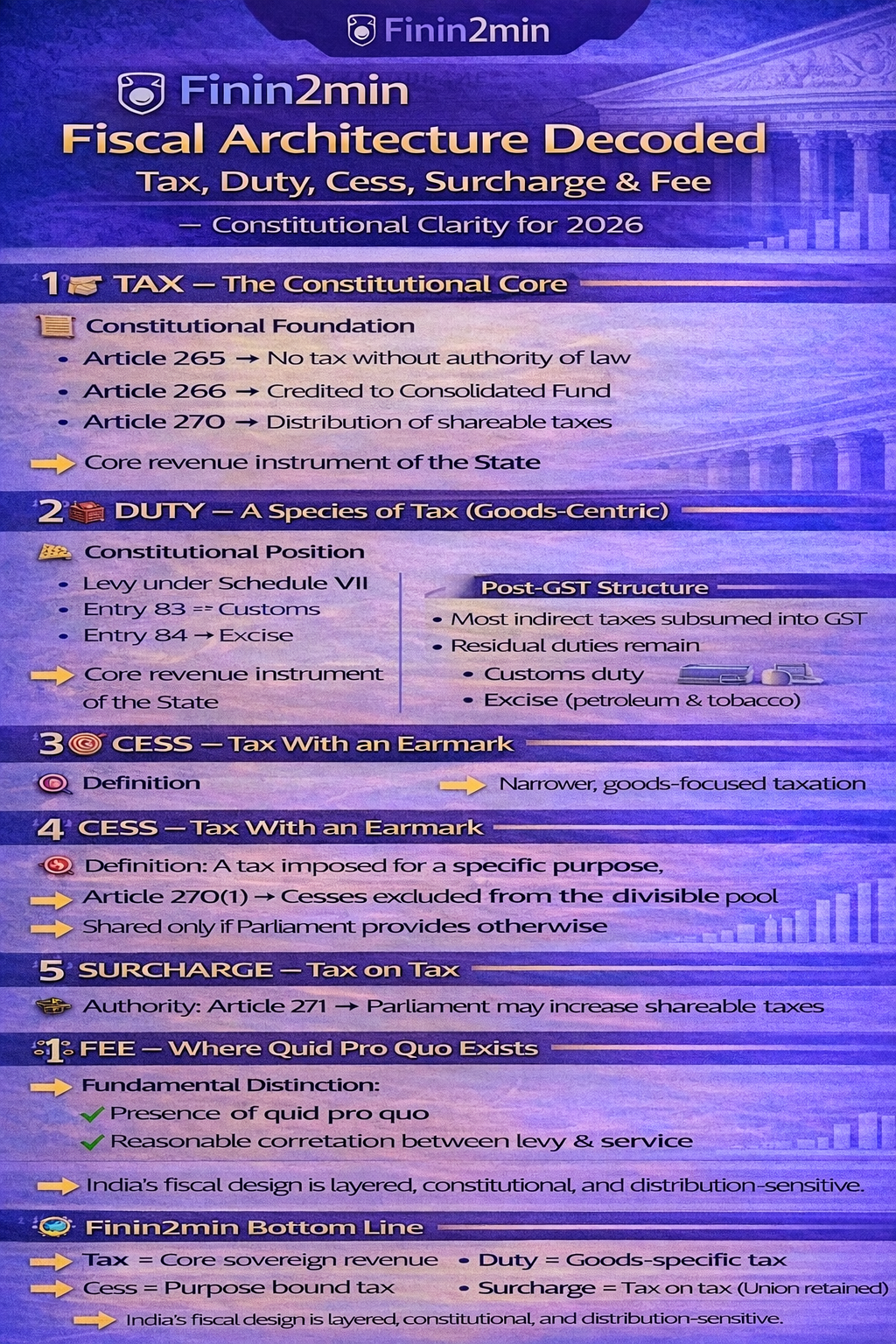
1️⃣ Tax — The Constitutional Core
The foundation lies in Constitution of India:
- Article 265 → No tax without authority of law
- Article 266 → Proceeds credited to Consolidated Fund
- Article 270 → Distribution of shareable taxes
What is a Tax?
A tax is:
- ✔ Compulsory extraction
- ✔ Enforceable by statute
- ✔ For public purposes
- ❌ No direct quid pro quo
Judicial Definition
In Commissioner, Hindu Religious Endowments v. Sri Lakshmindra Thirtha Swamiar, the Supreme Court clarified:
A tax is imposed for public purposes without reference to any specific benefit to the payer.
Key Implication
Taxes (other than surcharges and cesses unless specified) form part of the divisible pool shared with States under Article 270.
🔎 Finin2min Insight:
Tax is the umbrella. Everything else (except fee) largely operates within this structure.
2️⃣ Duty — A Species of Tax (Goods-Centric)
A duty is constitutionally a tax under specific entries of Schedule VII, primarily the Union List (e.g., Entry 83 – Customs; Entry 84 – Excise).
Post-GST Position
After the Constitution (One Hundred and First Amendment) Act:
- Most indirect taxes were subsumed into GST.
- Residual duties remain (e.g., customs duty, excise on petroleum & tobacco).
Principle
✔ Every duty is a tax.
❌ Not every tax is a duty.
Revenue Sharing
- GST components → shareable
- Non-GST duties (e.g., customs) → governed separately
🔎 Finin2min Insight:
Duty = Tax triggered by manufacture, import, or export of goods.
3️⃣ Cess — Tax with an Earmark
Cess is a tax imposed for a specific purpose.
Constitutional Position
Under Article 270(1), cesses are explicitly excluded from the divisible pool, unless Parliament provides otherwise.
Examples
- Health & Education Cess
- GST Compensation Cess
- Swachh Bharat Cess
Important Exception
The GST Compensation Cess, enacted under the 101st Amendment framework, was designed to compensate States for GST revenue loss. Proceeds were used for that purpose and the levy was extended until March 2026 to service borrowings raised for compensation.
Thus:
- Generally → Cess is not shareable
- GST Compensation Cess → Used for state compensation (functional exception)
🔎 Finin2min Insight:
Cess = Tax + Purpose Tag + Usually Non-shareable.
4️⃣ Surcharge — Tax on Tax
Authority flows from Article 271 of the Constitution.
Parliament may increase any shareable tax by imposing a surcharge for Union purposes.
Structure
- Calculated as % of tax payable
- Retained fully by Centre
- Not part of divisible pool
Judicial Recognition
In Union of India v. Modi Rubber Ltd., the Court recognized surcharge as an additional component of tax.
Fiscal Impact
Growing reliance on surcharges:
- Raises Centre’s net revenue
- Reduces effective fiscal devolution to States
🔎 Finin2min Insight:
Surcharge = Fiscal lever without federal sharing.
5️⃣ Fee — Where Quid Pro Quo Exists
A fee differs fundamentally from tax.
Defining Feature
✔ Presence of quid pro quo
✔ Reasonable correlation between levy and service
Landmark Principle
In Kewal Krishan Puri v. State of Punjab, the Supreme Court emphasized the need for a reasonable relationship between fee collected and services rendered.
Absolute mathematical equivalence is not required — but nexus must exist.
Examples:
- Court fees
- Regulatory fees
- Licensing charges
🔎 Finin2min Insight:
Fee = Pay for Service.
Tax = Pay for Governance.
📊 Clean Constitutional Comparison
| Instrument | Compulsory | Specific Purpose | Quid Pro Quo | Divisible Pool Status |
|---|---|---|---|---|
| Tax | Yes | No | No | Yes (Art 270) |
| Duty | Yes | Goods-linked | No | Depends (GST vs non-GST) |
| Cess | Yes | Yes | No | No (Art 270 exclusion) |
| Surcharge | Yes | No | No | No (Art 271) |
| Fee | Yes | Service-based | Yes | Not Applicable |
🏛 Legislative Competence Framework
Authority flows from Schedule VII of the Constitution:
- Union List → Customs, Income Tax, etc.
- State List → State GST (post-101st Amendment structure adjusted)
- Concurrent dynamics through GST Council mechanism
Understanding which list a levy falls under determines:
- Validity
- Jurisdiction
- Litigation outcome
📈 2026 Fiscal Relevance
Post-GST Compensation Cess expiry (March 2026):
- Rising cess & surcharge collections
- Shrinking shareable tax proportion
- Renewed Centre–State fiscal debate
- Heightened attention from Finance Commission
Cesses and surcharges materially affect effective devolution percentage, even if headline devolution ratios remain unchanged.
🧠 Finin2min Bottomline
- Tax → Core compulsory levy
- Duty → Goods-triggered tax
- Cess → Earmarked, usually non-shareable tax
- Surcharge → Tax enhancement retained by Centre
- Fee → Service-linked levy
In India’s federal tax design, terminology is not semantic — it determines who legislates, who collects, and who retains.
And in fiscal law — structure is strategy.
⚠️ Disclaimer
For informational purposes only. Based on Income-tax Act, 1961, GST law, CBDT instructions, and prevailing rules.
Article related to –
difference between tax and fee
tax vs cess in India
surcharge under Article 271
divisible pool of taxes India
what is cess in India
constitutional provisions for tax India
tax vs duty difference
GST compensation cess explained
Article 270 Constitution of India
Article 265 tax authority
Finin2min
