
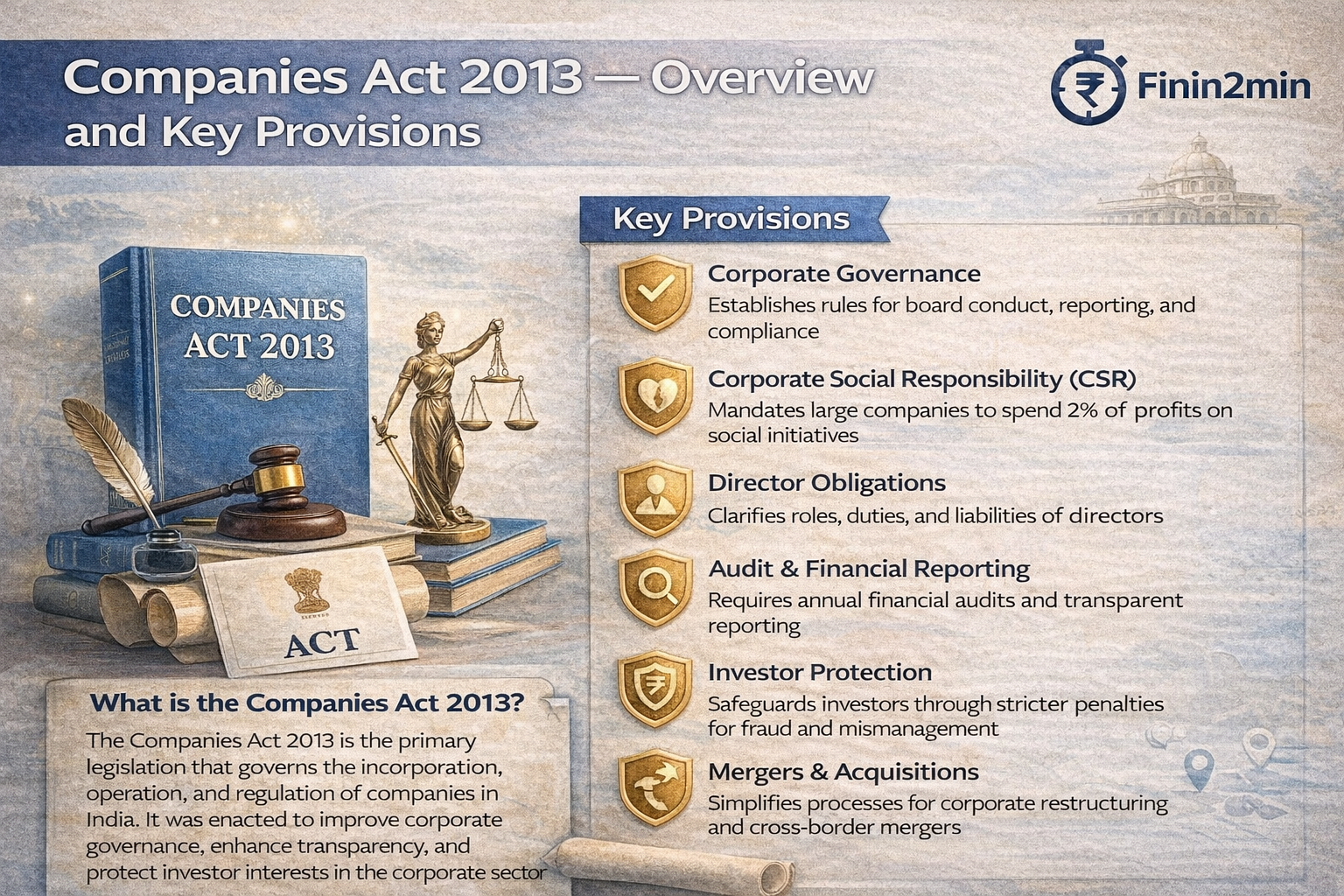
Title: Companies Act 2013 Overview | Key Provisions & Objectives | Finin2min
Description: Understand the Companies Act 2013 — its objectives, major provisions, and impact on corporate governance and business in India.
Overview of the Companies Act 2013
The Companies Act 2013 is the primary law governing company formation, management, and operations in India.
It replaced the Companies Act 1956 to modernise corporate governance and align with global standards.
1️⃣ Objectives
- Improve corporate transparency.
- Protect investors and stakeholders.
- Promote ease of doing business.
- Strengthen CSR and audit oversight.
2️⃣ Key Provisions
| Area | Highlights |
|---|---|
| Incorporation | Simplified via SPICe+ form. |
| Capital | Clear rules on share capital & debentures. |
| Management | Duties & responsibilities of directors. |
| CSR | Mandatory 2% spending for eligible companies. |
| Audit | Rotation of auditors every 5 years. |
| Investor Protection | NCLT / NCLAT setup for disputes. |
3️⃣ Governing Bodies
- Ministry of Corporate Affairs (MCA)
- Registrar of Companies (ROC)
- NCLT / NCLAT
- Serious Fraud Investigation Office (SFIO)
4️⃣ Major Reforms (2020-2025)
- Decriminalisation of minor offences.
- Online compliance portal (MCA21 3.0).
- One Person Company (Amendment 2021).
- ESG and Sustainability Reporting mandated for top companies.
✅ Summary
The Companies Act 2013 serves as India’s corporate constitution — balancing growth, transparency, and stakeholder protection.
