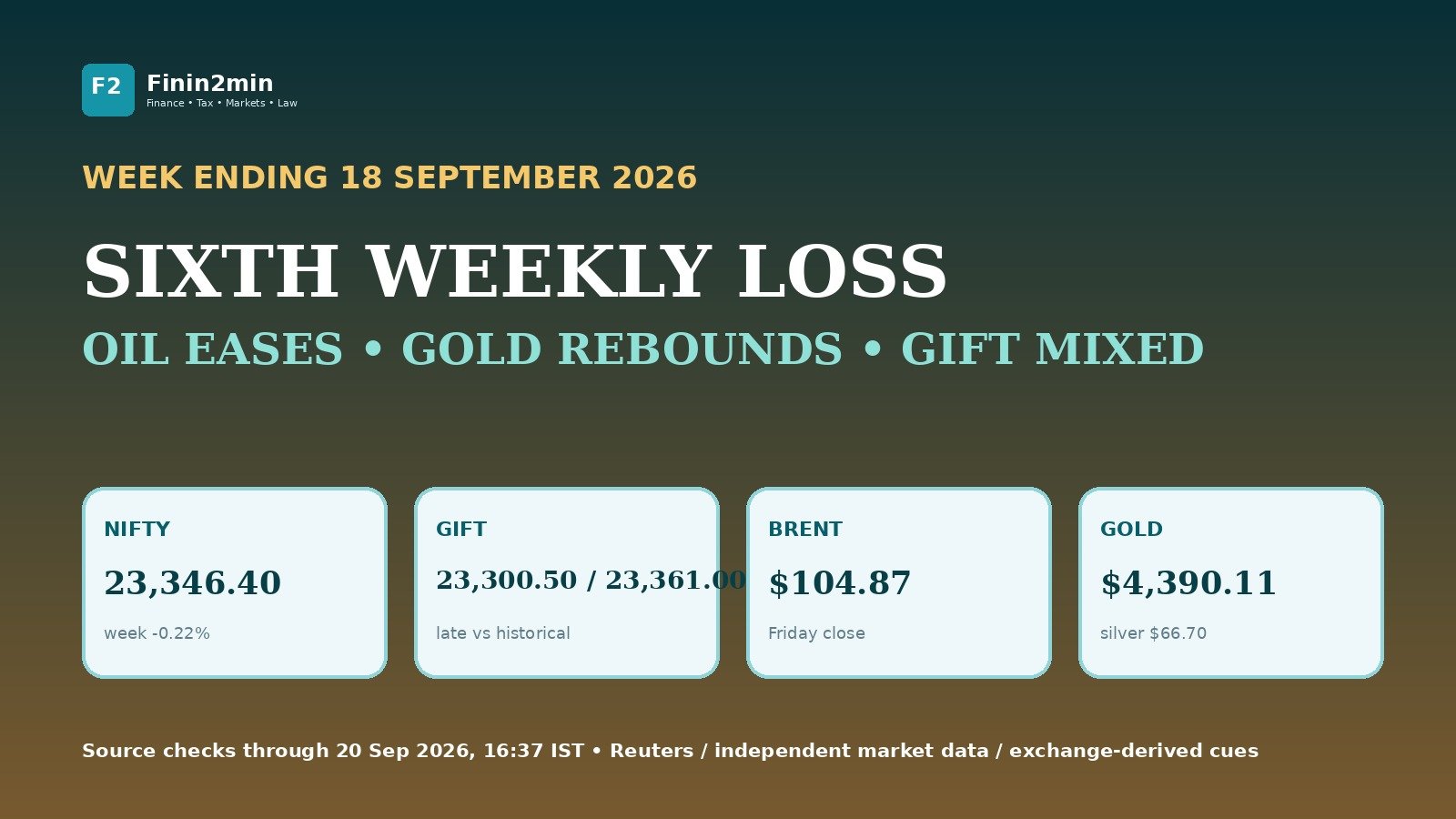
NIFTY 23,346.40 week -0.22% |
GIFT CUE 23,300-23,361 public feeds differ |
BRENT / WTI $104.87 / $100.30 Friday close |
GOLD / SILVER $4,390.11 silver $66.70 |
USD/INR 95.8750 96 defended |
1. Weekly thesis: India fell for a sixth week

Reuters reported Indian equities posted their sixth consecutive weekly decline, the longest since 2020. The Nifty closed at 23,346.40, up +0.33% on Friday but down -0.22% for the week; Sensex closed at 74,294.96, down -0.03% Friday and -0.65% weekly. The week was defined by oil above $100, tighter global rates, FII caution and IPO liquidity absorption. Reuters - India weekly market close
2. Breadth: Friday bounce, weekly weakness
The Friday rise was described as bargain buying after recent selling, not a broad conviction reset. For the week, 10 of 16 key sectors key sectors declined, and small- and mid-cap indices slightly down. Insurance stocks outperformed, while Tata group volatility and IPO liquidity weighed on parts of the market. Reuters - weekly sectors and drivers
3. GIFT Nifty: use a range, not false precision

Latest accessible public GIFT Nifty feeds were not identical. GiftCityNifty showed 23,300.50, down -0.26%, at Sep 19, 02:30 IST. Investing.com's 18 September historical row showed 23,361.00, open 23,333.00, high 23,396.00, low 23,287.00, change +0.12%. Downstox showed a live snapshot of 23,324.50. Finin2min therefore uses a 23,300-23,361 directional cue range for Monday, not a single-point open forecast. GiftCityNifty late-session cue Investing.com GIFT historical row Downstox market snapshot
4. Crude: Friday relief, weekend risk still open
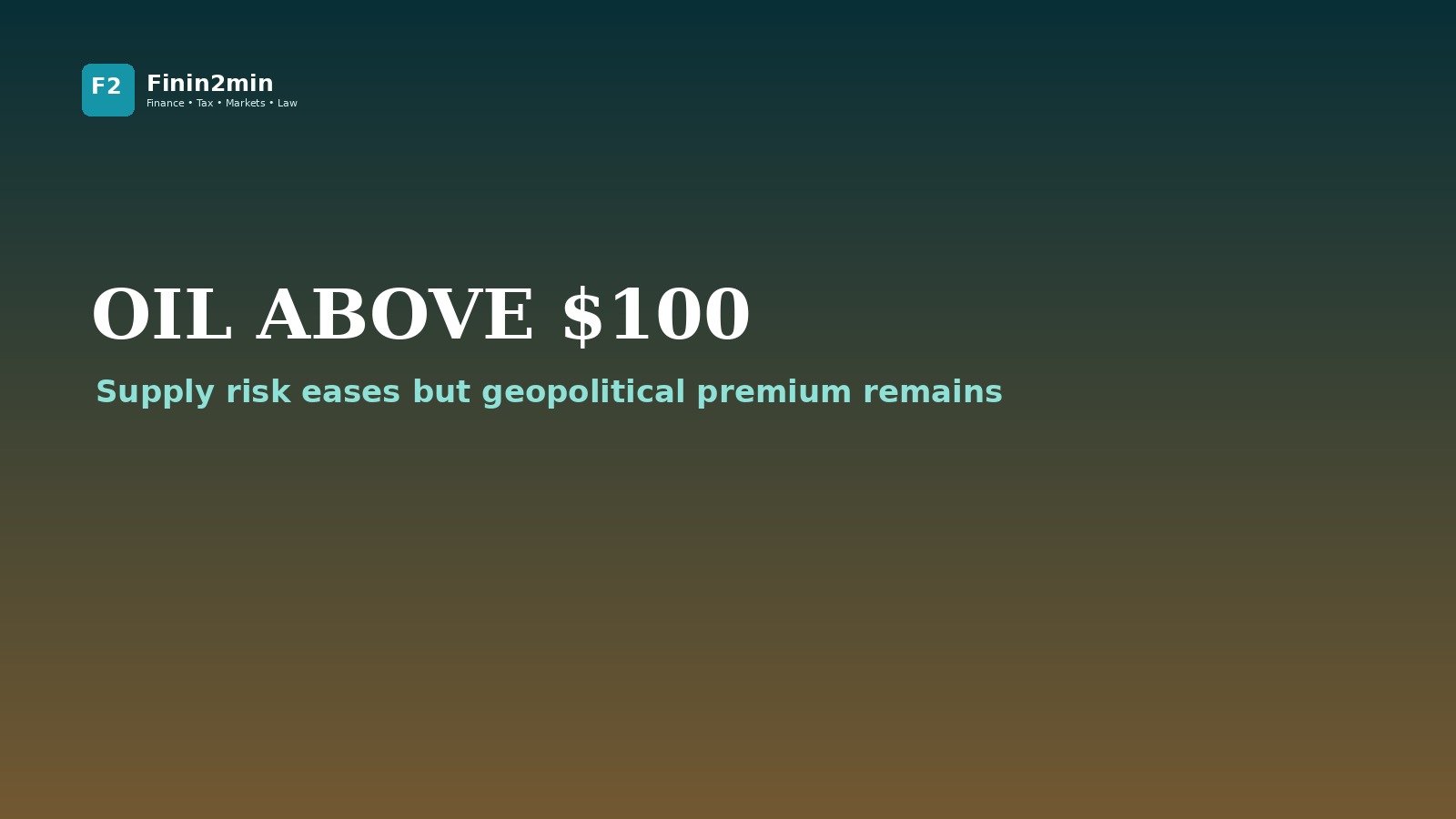
Reuters reported oil prices fell Friday after China urged Iran to help limit Houthi attacks on Saudi oil infrastructure. Brent closed at $104.87/bbl and WTI at $100.30/bbl. The relief came because disruption fears eased, but Reuters weekend reports on Saudi/Gulf market pressure and a Moscow refinery hit by drones keep energy geopolitics active. Reuters - oil Friday close Reuters - Saudi/Gulf weekend risk Reuters - Moscow refinery strike
5. Gold and silver: first weekly gain in four weeks

Gold moved to a one-week high and headed for its first weekly gain in four weeks as easing oil prices reduced inflation worries. Reuters reported spot gold at $4,390.11/oz, up +1.2%, while U.S. gold futures rose +0.6% to $4,424.90. Silver rose +2.3% to $66.70, with platinum and palladium also higher. Reuters - gold and precious metals
6. Rupee: 96/$ remains the RBI line in sand

Reuters reported the rupee declined -0.3% over the week and closed Friday at 95.8750/$. Traders said the RBI appeared to defend the 96/$ threshold, while NSE IPO-linked inflows helped create breathing room after oil retreated. Reuters - rupee weekly close
7. RBI liquidity and funding conditions

RBI liquidity operations were an important weekly theme. Reuters reported an auction-based OMO sale of ₹500 billion, the first such auction-based open-market sale in nine years, while surplus liquidity was around ₹7.4 trillion. For banks and rate-sensitive sectors, this means liquidity is still being disciplined even as equities look for relief. Reuters - RBI OMO and liquidity
8. NSE IPO and primary-market liquidity

The NSE IPO became the week's main domestic liquidity event. Reuters reported the $2.3 billion issue was fully subscribed on day two, with listing expected around the following week. A large OFS can absorb attention and liquidity during a fragile macro week, even when it supports rupee sentiment through inflows. Reuters - NSE IPO
9. Digital payments and direct taxes
Payment economics stayed active after Reuters reported pushback to merchant fees on UPI transactions above the threshold, while fiscal data offered a positive macro offset: India's net direct tax collections rose +13% to ₹12.1 trillion between April 1 and September 17, and gross direct tax collections rose over +15% to ₹14.3 trillion. Reuters - UPI fee pushback Reuters - direct tax collections
10. Global policy and weekend watch

China kept benchmark lending rates unchanged at 3.00% / 3.50%, reflecting limited easing room after the Fed hike. Weekend global watch includes U.S.-China talks on AI, trade and critical minerals, Canada-India trade optimism, Saudi/Gulf volatility and Russia-related energy infrastructure strikes. Reuters - China LPR Reuters - U.S.-China talks Reuters - Canada-India trade
11. Monday decision map
For Monday, the Finin2min screen is: GIFT Nifty range 23,300-23,361; Brent above $100; USD/INR near 96/$; NSE IPO listing/subscription follow-through; FII versus DII flow balance; and weekend geopolitics around Saudi and Russian energy infrastructure. Domestic flows can cushion volatility, but oil and rates still decide the risk regime.