
Jio Soars 27%, Reliance Falls 3.19%: India Markets, Oil, Fed and Compliance | 28 October 2026
Indian markets, Jio's debut, Brent and precious metals, Federal Reserve policy, industrial growth, tax and regulatory developments.
In two minutes
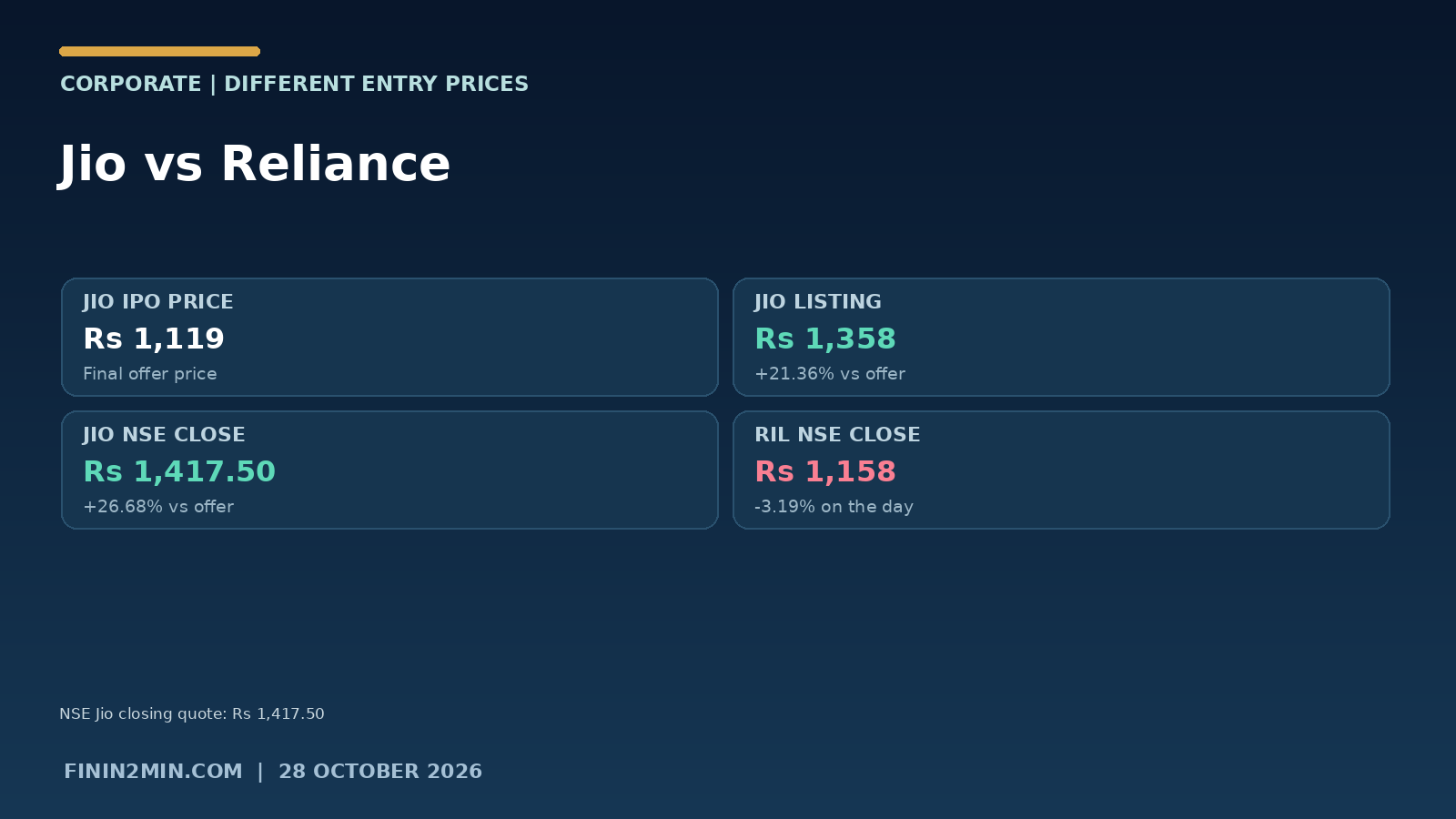
- Jio Platforms opened at Rs 1,358 against its Rs 1,119 issue price and finished at Rs 1,417.50 on NSE, even as Reliance Industries declined 3.19%.
- Nifty 50 fell 0.22% to 22,698.85 and Sensex lost 0.48% to 73,246.03. Bank Nifty and small caps outperformed headline benchmarks.
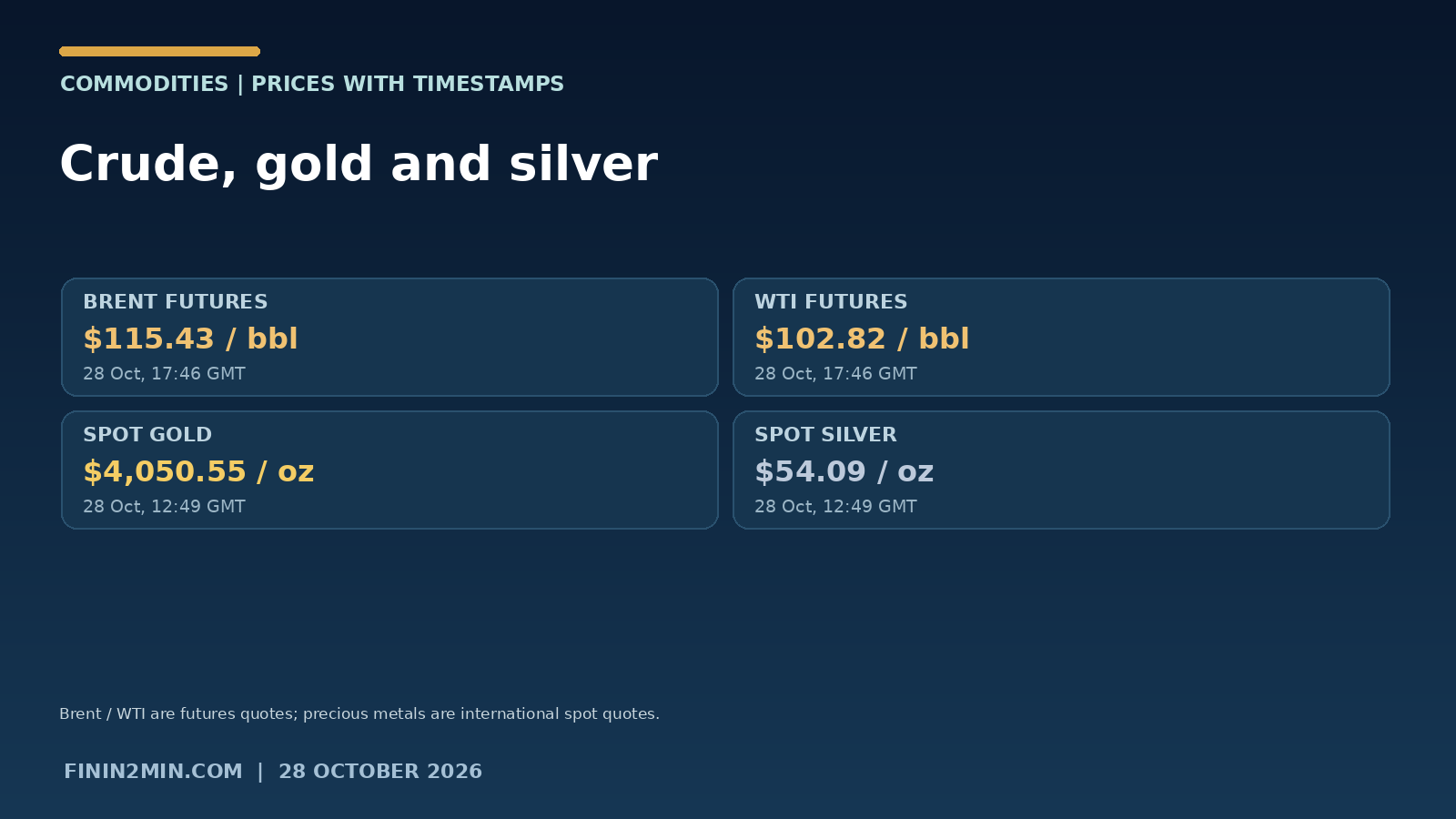
- Brent crude traded at $115.43 and WTI at $102.82 per barrel at 17:46 GMT as renewed Saudi supply concerns lifted energy risk premiums.
- Spot gold stood at $4,050.55/oz and silver at $54.09/oz at 12:49 GMT, with oil-linked inflation and US real yields shaping sentiment.
- GIFT Nifty futures indicated 22,725 at 01:09 IST on 29 October, 8 points lower than the provider’s previous futures close.
- The US Federal Reserve held its target rate range at 3.75%-4.00% by a 10-2 vote, with two members seeking a 25-basis-point increase.
- India’s September industrial production grew 6.7% year-on-year; manufacturing expanded 7.6%, while electricity and gas supply rose 11.2%.
- The Union Cabinet cleared a Rs 10,000-crore container manufacturing scheme and a 3-percentage-point DA/DR rise effective 1 July.
- Q2 salary and resident non-salary TDS statements are due 31 October; specified AY 2026-27 ITR filers have until 21 November.
| Instrument | Value | Move / status | As of |
|---|---|---|---|
| Nifty 50 | 22,698.85 | -50.90 (-0.22%) | 28 Oct, NSE cash close |
| Sensex | 73,246.03 | -352.64 (-0.48%) | 28 Oct, BSE cash close |
| Bank Nifty | 54,267.40 | +0.54% | 28 Oct, NSE close |
| Nifty Midcap 100 | +0.43% | 28 Oct, NSE close | |
| Nifty Smallcap 100 | +0.90% | 28 Oct, NSE close | |
| Nifty IT | -1.98% | 28 Oct, NSE sector close | |
| Nifty Oil & Gas | -2.27% | 28 Oct, NSE sector close | |
| Nifty Auto | +1.45% | 28 Oct, NSE sector close | |
| Jio Platforms NSE close | Rs 1,417.50 | +26.68% vs IPO | 28 Oct, NSE EQ close |
| Reliance Industries | Rs 1,158.00 | -3.19% | 28 Oct, NSE close |
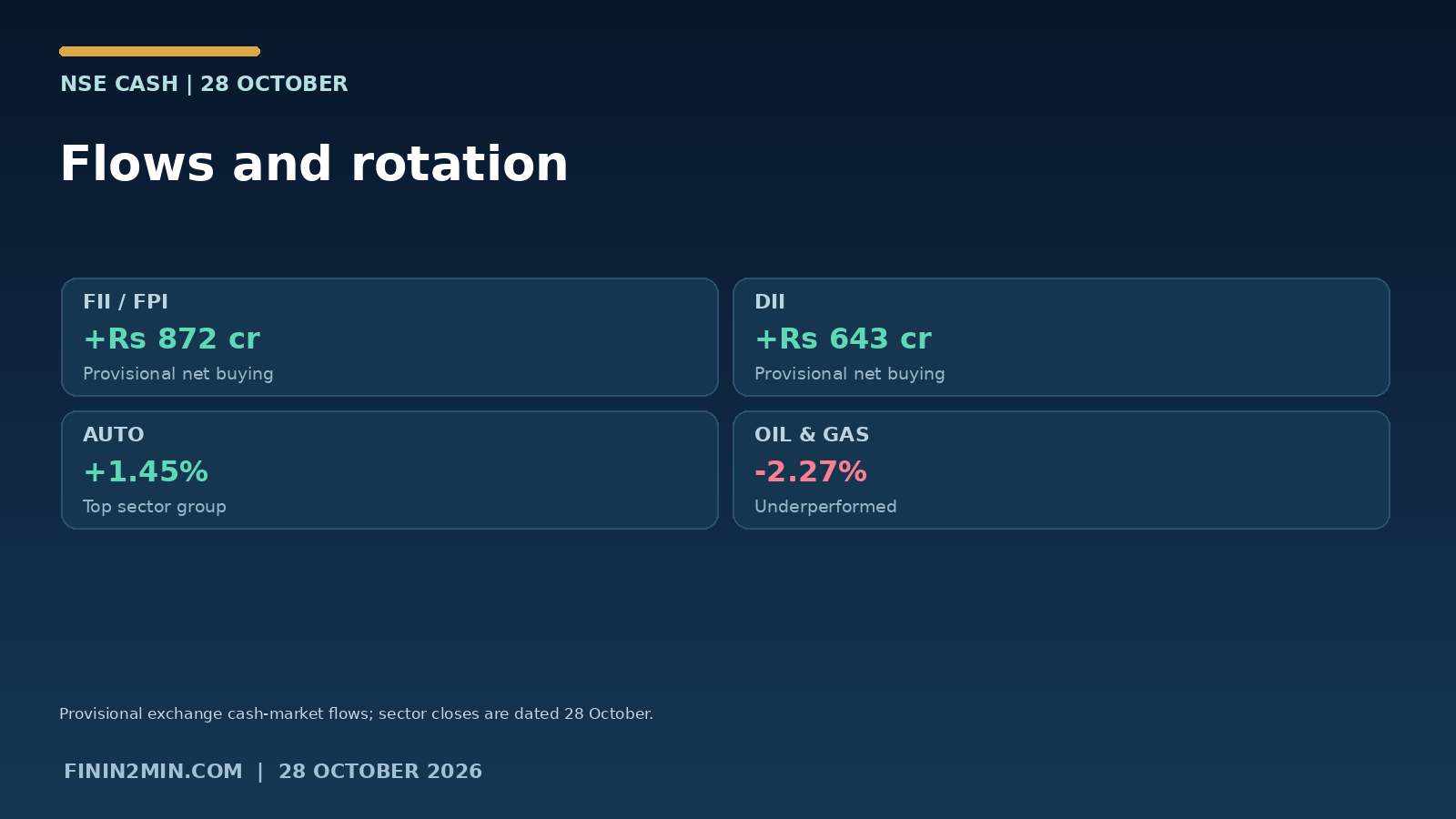
| FII/FPI cash | +Rs 872 cr | Provisional net buying | 28 Oct, NSE cash |
| DII cash | +Rs 643 cr | Provisional net buying | 28 Oct, NSE cash |
| Brent crude futures | $115.43/bbl | +1.4% vs prior | 28 Oct 17:46 GMT |
| WTI crude futures | $102.82/bbl | +2.9% vs prior | 28 Oct 17:46 GMT |
| Spot gold | $4,050.55/oz | -0.2% | 28 Oct 12:49 GMT |
| Spot silver | $54.09/oz | -0.5% | 28 Oct 12:49 GMT |
| GIFT Nifty futures | 22,725.00 | -8.00 (-0.04%) | 29 Oct 01:09 IST |
| USD/INR | 95.2200 | Rupee weaker | 28 Oct, interbank close |
| US Fed funds target | 3.75%-4.00% | Held unchanged | 28 Oct 14:00 EDT |
| US Dollar Index | 102.40 | Near 2-week high | 28 Oct overseas morning |
| US 10Y Treasury yield | 5.0112% | 28 Oct overseas morning | |
| India IIP (September) | +6.7% | YoY | 28 Oct release |
| India CPI (September) | 5.54% | YoY | 12 Oct release |
| India WPI (September) | 11.39% | YoY | 14 Oct release |
The two-minute briefing
Indian equities finished the session softer even as the largest initial public offering in India’s history delivered a strong public-market debut. Jio Platforms’ listing created a striking contrast: the newly quoted telecom and digital-services subsidiary gained nearly 27% over its issue price at the NSE close, whereas Reliance Industries, its parent, lost more than 3%. That contrast is the central lesson of the day: a successful listing does not mechanically translate into a rise in the parent company’s stock.
Oil remained a powerful outside constraint. Brent futures traded near $115 a barrel following fresh conflict-related disruptions and refinery-attack claims. Meanwhile, the Federal Reserve kept its policy corridor at 3.75%–4.00%, leaving a data-dependent inflation outlook. For India, expensive imported oil, a weaker rupee and high US yields can collide with otherwise resilient domestic industrial output.
On the policy desk, India published September IIP growth of 6.7%; the Cabinet authorised a Rs 10,000-crore container manufacturing programme and a 3-percentage-point DA/DR increase; and SEBI signed a cooperation memorandum with the Bank of England. Tax, GST and company-law deadlines remain especially important for businesses entering November.
India market close: why headline indices fell
Nifty 50 closed at 22,698.85, down 50.90 points or 0.22%; Sensex settled at 73,246.03, down 352.64 points or 0.48%. Intraday losses had been much deeper, but the benchmarks recovered as selective buying appeared in financial, industrial and consumer-related names. That recovery should not be confused with a broad return of risk appetite.
The sector split explains the headline weakness. Nifty IT declined about 1.98% as US-facing software companies faced renewed scrutiny over technology spending and global demand; Nifty Oil & Gas fell roughly 2.27%. Nifty Auto, by contrast, gained around 1.45%. Bank Nifty rose approximately 0.54%, while the Midcap 100 and Smallcap 100 added 0.43% and 0.90% respectively.
A cap-weighted index can decline while a large number of individual stocks advance if heavily weighted companies fall. The practical measure for portfolio managers is therefore exposure by sector and market-cap weight, not just whether the Nifty is red. A risk report should separately show benchmark return, equal-weight exposure, sector concentration and individual-stock contributions.

Jio IPO: spectacular debut, different implications for Reliance
Jio Platforms listed at Rs 1,358 against the final public-issue price of Rs 1,119, an opening premium of about 21.36%. It finished at Rs 1,417.50 on NSE, approximately 26.68% above issue price. The distinction between issue-price gain, opening premium and intraday trading return matters. Investors allotted stock at issue price had a different economic experience from buyers who entered after listing.
Reliance Industries fell 3.19% to Rs 1,158. The drop occurred amid heavy selling in oil and gas stocks, higher Brent prices, market-wide caution ahead of the Fed decision and possible portfolio rebalancing following Jio’s standalone listing. The parent owns a substantial stake in Jio, but the group also includes energy, retail and other businesses and carries separate debt, capital expenditure, valuation and cash-flow exposures.
For readers comparing Jio and Reliance, adding the two quoted market capitalisations together would double-count the parent’s investment in its subsidiary. A defensible sum-of-the-parts valuation starts from attributable stake value, eliminates double counting, applies holding-company and tax considerations and adds net debt and the value of other businesses. Jio’s listing gives the market a new price reference, not a guaranteed immediate parent-company rerating.
What to monitor: Jio’s first-week traded volume and delivery, institutional ownership disclosures, post-listing analyst coverage, Reliance’s forthcoming earnings, parent-level debt, telecom ARPU and subscriber mix, and capital-allocation decisions. A listing gain measures demand at a moment in time; a durable valuation depends on operating cash generation.
FII and DII cash flows: both sides net buyers
Provisional exchange cash-market figures showed foreign investors as net buyers of approximately Rs 872 crore and domestic institutional investors as net buyers of about Rs 643 crore on 28 October. These are net executed cash trades within the exchange’s provisional framework; they should not be equated with total foreign portfolio investment flows or daily changes in FPI assets under custody.
The combination of positive institutional buying and falling benchmarks is not contradictory. Flows can be concentrated in stock-specific transactions, primary-market activity or selected sectors, while heavily weighted index constituents decline on a larger set of other orders. Nor is every rupee of buying an automatic new inflow to mutual funds: portfolio churn, settlements and participant classifications can also matter.
For analysis, compare a rolling sequence of like-for-like cash-market data, and distinguish exchange provisional activity from later depository statements. This week’s changing sign of flows underscores why single-day numbers should inform, but not dominate, investment decisions.
References: S05
Crude oil above $115: the economic transmission to India
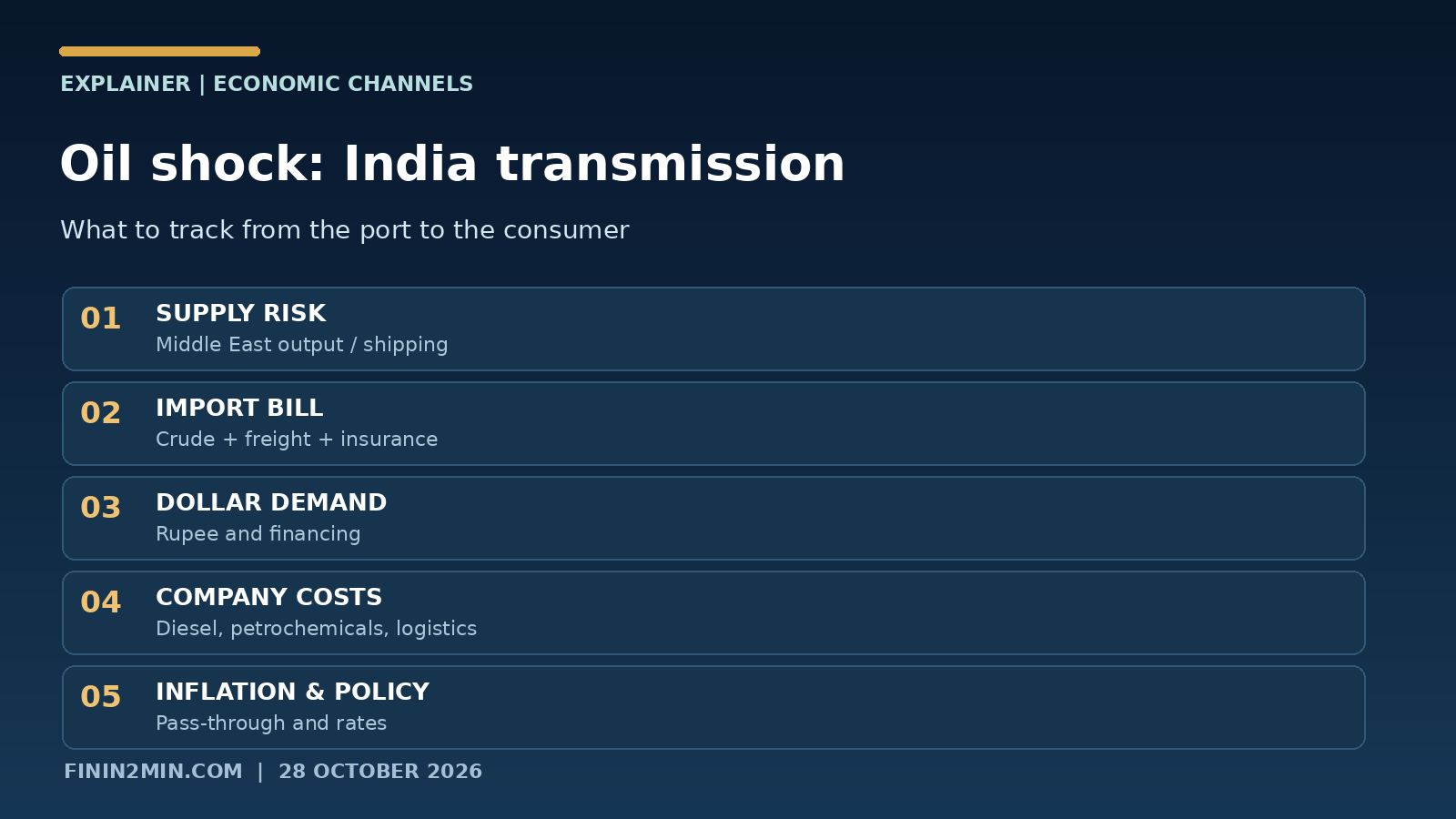
At 17:46 GMT on 28 October, Brent futures traded at $115.43 a barrel, up roughly 1.4% on the session, while WTI was $102.82, up about 2.9%. These are dated futures quotations; they should not be treated as a final settlement. The premium reflected renewed supply risk after Yemen’s Houthis said they had struck a major Saudi refinery and fighting around Aden intensified. Separately, a diplomatic process involving regional actors continued, making the outlook sensitive to competing headlines.
India is structurally exposed because imported crude supplies most domestic oil requirements. The chain is not instantaneous: higher Brent can raise the landed cost of oil, strain refining and petrochemical working capital, intensify dollar demand and affect transport, aviation, fertiliser and logistics pricing. Domestic retail fuel prices, duties, inventory gains and losses, product cracks and the rupee determine how much of the global change reaches consumers or corporate margins.
A useful CFO stress test separates a short-lived price spike from a sustained three-month move. For each $10-per-barrel change in the benchmark, multiply affected imported barrels by $10, then adjust for product yield, hedges, contractual pricing and FX; do not assume this is the same as a rupee change in retail petrol prices. Corporate procurement teams should monitor freight, insurance, diesel cracks and cash conversion cycles alongside outright crude.
Claims of physical infrastructure damage require confirmation distinct from market pricing. Oil can incorporate a geopolitical risk premium without an equally large, verified reduction in barrels produced or delivered. Focus next on official Saudi operating updates, EIA inventories, tanker movements and OPEC+ output announcements.
Gold and silver: why high oil does not always mean higher bullion
Spot gold was $4,050.55 per troy ounce at 12:49 GMT on 28 October, down roughly 0.2% at that observation. Spot silver was $54.09 per ounce, lower by about 0.5%. Both figures relate to international spot markets rather than MCX futures. The Federal Reserve’s subsequent decision should be read separately from these pre-decision quotations.
Gold may function as a crisis hedge in some circumstances, but the route from an oil shock to bullion is not one-way. An energy-driven inflation rise can push US Treasury yields and expected policy rates higher; that increases the opportunity cost of owning non-yielding gold. Currency movements and central-bank or investment demand can counter those pressures. Silver also has industrial-demand exposure, so it can respond more sharply to manufacturing prospects and risk appetite.
Indian gold buyers face a second variable: USD/INR. Even when the international gold price falls, a weaker rupee can hold local prices relatively firm before duties, taxes and dealer premiums. Consumers should compare the same purity, tax treatment and gram weight, while investors should keep SGB redemption taxation separate from physical-gold trading considerations.
GIFT Nifty: overnight futures reference before the next cash session
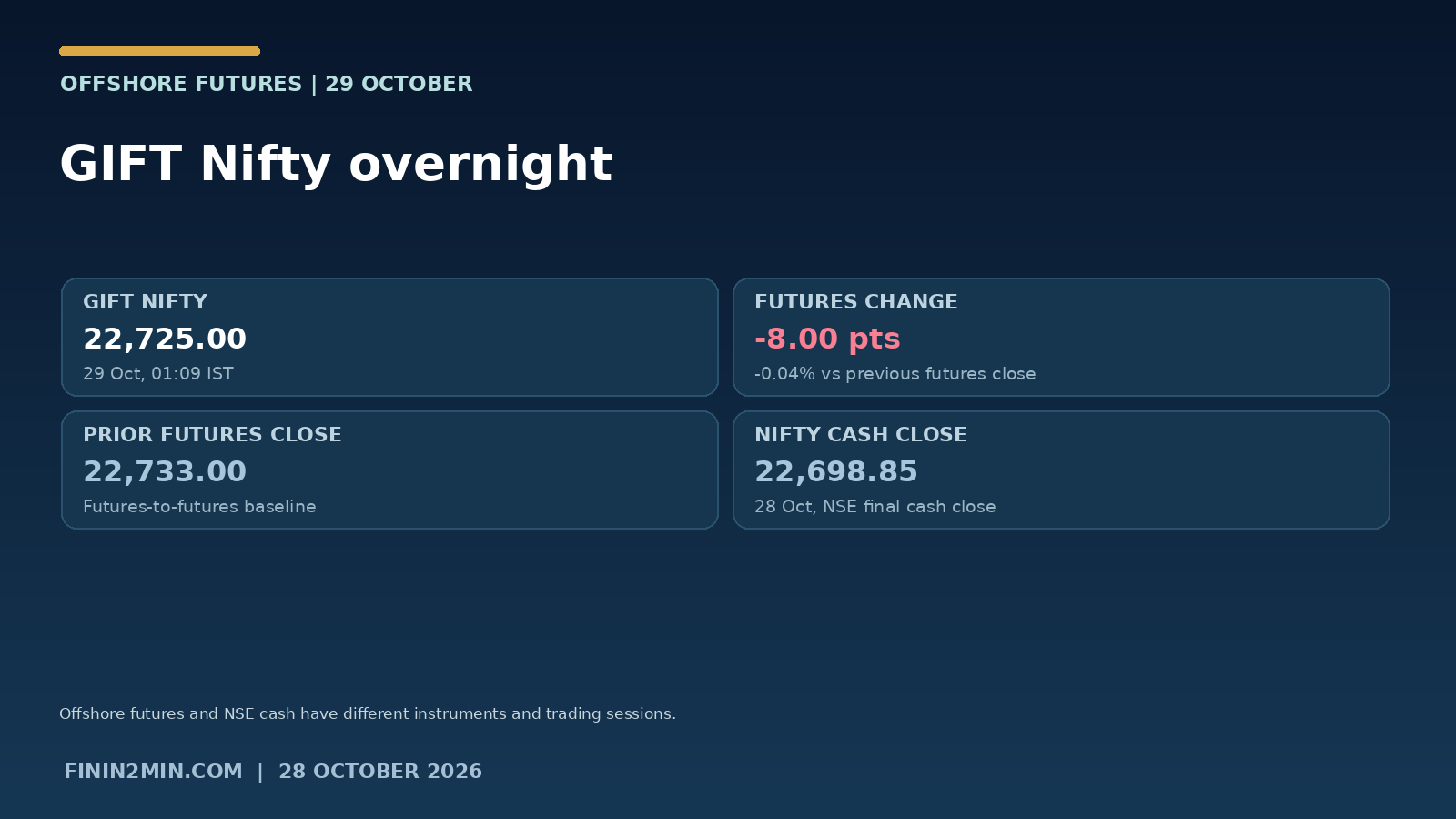
GIFT Nifty futures were quoted at 22,725.00 at 01:09 IST on 29 October, down 8 points or 0.04% against the quoted previous futures close of 22,733.00. The contract is an offshore derivative linked to the Nifty, not the official NSE cash index; its price can include carry, dividend assumptions and time to expiry.
For the next Indian cash session, use the GIFT quotation as one piece of context together with overnight US and Asian equities, Brent, USD/INR and domestic corporate announcements. The raw difference between GIFT futures and the previous NSE cash close is a futures basis; it is not a deterministic opening-gap forecast.
The right operational sequence is to check the exact contract being traded, compare it with its own prior futures close, note the IST timestamp, and then observe the NSE pre-open auction and subsequent cash trade.
Rupee and bond yields: the double squeeze from oil and rates
USD/INR closed at approximately 95.2200 on 28 October versus 95.1150 previously, indicating modest rupee depreciation. Oil-import demand for dollars and high global yields can reinforce each other. Traders cited dollar sales by state-run banks during the session, but such trading observations do not by themselves establish the RBI’s exact intervention amount.
In the US, the dollar index was near 102.40 during the overseas session and the benchmark 10-year Treasury yield near 5.0112% in the morning. Those were time-specific market observations. Higher US yields can affect global equity discount rates, reduce the relative appeal of emerging-market debt and change offshore funding costs for Indian issuers.
Importers should model FX alongside commodity exposure rather than hedge only one leg. Exporters benefit from a weaker domestic currency only if pricing, overseas demand and imported inputs support margin expansion. Borrowers with dollar liabilities should quantify sensitivity to both reference rates and exchange rates.
Federal Reserve holds rates: what the 10–2 decision says
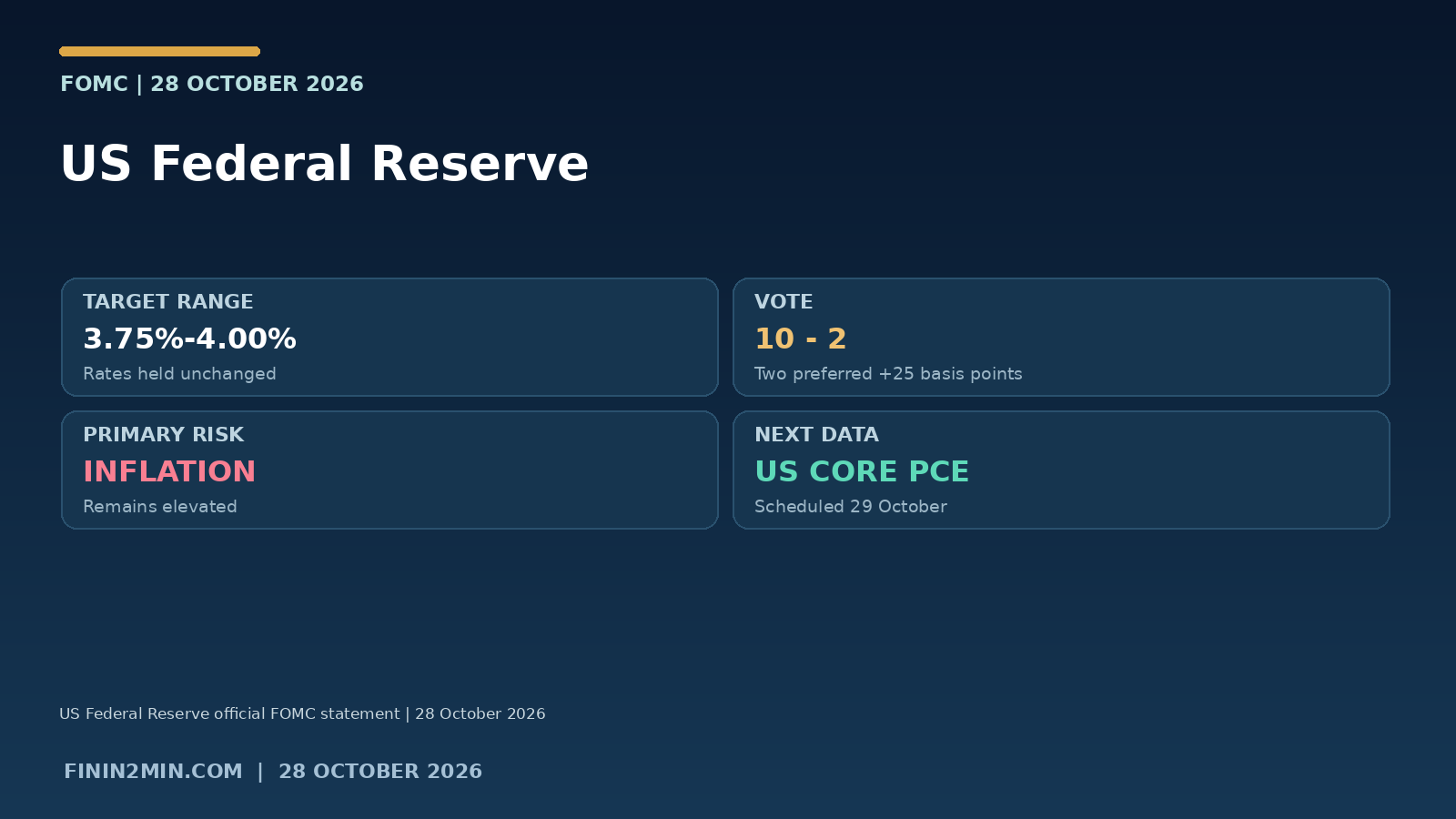
The Federal Open Market Committee maintained the federal funds target range at 3.75%–4.00% on 28 October 2026. The decision passed 10–2; two participants preferred an immediate 25-basis-point increase. The Committee described economic activity as expanding strongly while inflation remained elevated and said additional information would guide its policy stance.
For Indian markets, a hold is not equivalent to a policy easing. A sustained period of high US short rates and elevated bond yields can keep global capital selective, raise the dollar cost of funding and pressure equity multiples, particularly for long-duration growth companies. Conversely, stable rates reduce the risk of immediate repricing relative to an unexpected increase.
The next decision variables are US core PCE inflation, employment trends, Treasury auctions, credit conditions and Fed communications. Treat December rate-hike odds as market-derived probabilities that move throughout the day, not as a promise by the central bank.
India IIP grows 6.7%: strength with a sector-level caveat
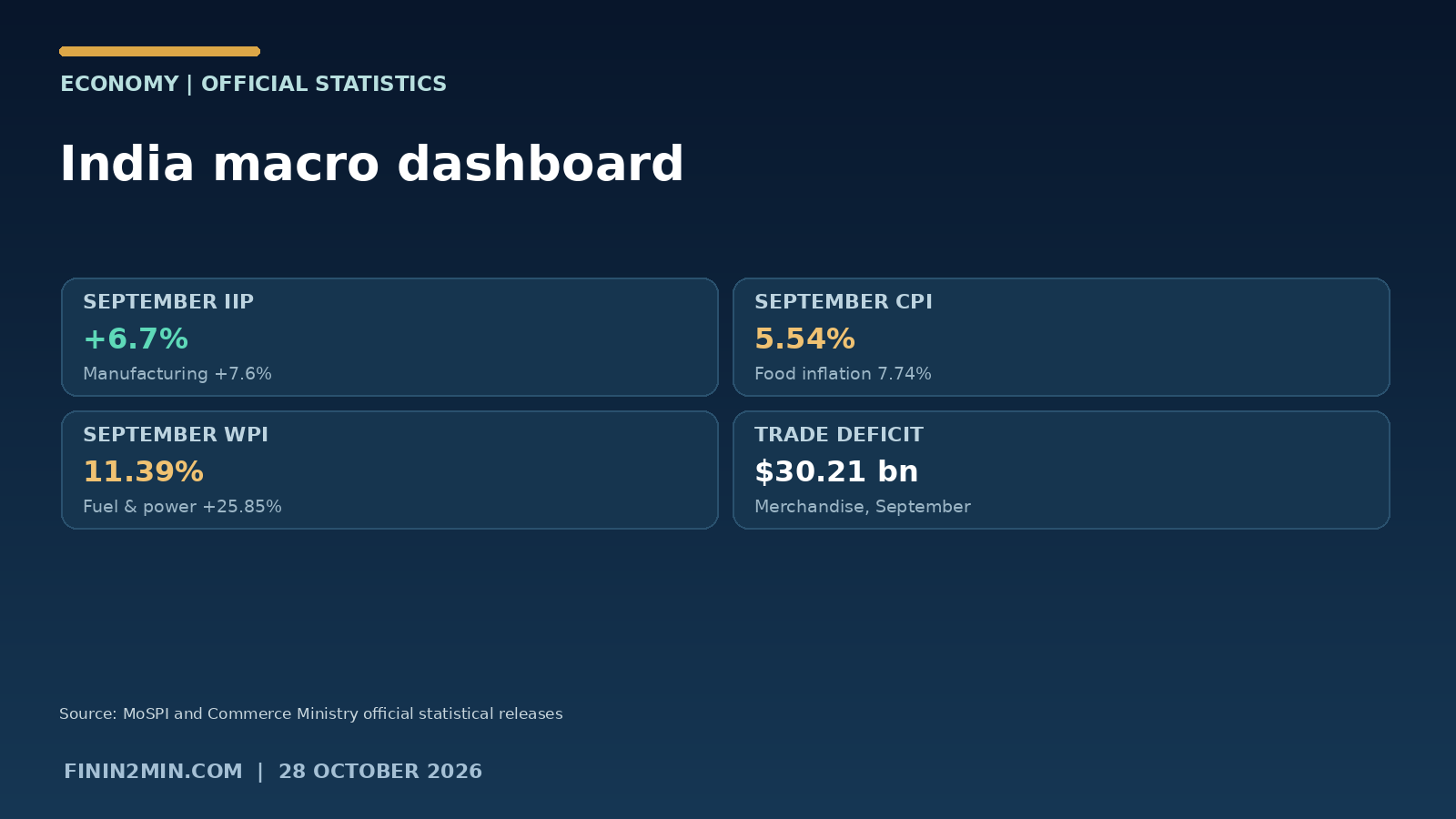
India’s September 2026 Index of Industrial Production increased 6.7% year-on-year, compared with August’s 8.0% growth reading. Manufacturing expanded 7.6%, and electricity and gas supply rose 11.2%. The release is compiled under the 2022–23 base and is a provisional high-frequency volume indicator, not a direct measure of corporate profits.
The more useful detail lies in end-use categories: intermediate goods rose 12.2%, capital goods 10.4%, infrastructure/construction goods 7.2%, consumer durables 6.0%, primary goods 4.0% and consumer non-durables 1.4%. Stronger investment-linked categories can support engineering and industrial demand, while weaker non-durables imply uneven household consumption conditions.
Managers should compare IIP momentum with company order books, capacity utilisation, PMI, power consumption, credit growth and real wage trends. An improvement in industrial volumes may not translate proportionately into earnings when energy and logistics costs are elevated.
References: S11
Inflation and trade: India’s policy dilemma in numbers
September CPI inflation was 5.54% year-on-year and food inflation was 7.74%, while wholesale inflation reached 11.39%. WPI fuel-and-power inflation was 25.85%. These readings use different price baskets and different economic stages; one cannot convert a WPI increase into a precise future CPI forecast without additional assumptions.
Merchandise exports were $44.40 billion in September against imports of $74.61 billion, producing a $30.21 billion merchandise trade deficit. Stronger exports alone do not eliminate vulnerability to an energy import shock: high crude costs can raise the import bill even with healthy underlying non-oil trade.
The RBI’s inflation-growth challenge is therefore asymmetric. A weaker rupee and higher oil can pressure headline inflation, yet sharp policy tightening could reduce domestic demand and financing activity. Households should separate food-driven inflation from asset-price changes; businesses should quantify cost pass-through and working-capital sensitivity.
RBI and banking: liquidity, gold bonds and supervisory actions
RBI’s operational releases around 28 October included Treasury-bill auction outcomes, money-market activity and regulatory directions concerning individual cooperative banks. Individual bank restrictions and extensions apply to the named institutions; they should not be generalised to the wider banking system.
A specific investor-relevant release was the premature redemption price of Rs 14,159 per unit for SGB 2020–21 Series I, scheduled on 28 October. The calculation uses a three-business-day average of 999-purity gold prices for 23, 26 and 27 October. Redemption eligibility, redemption window, the original purchase route and applicable capital-gains provisions matter independently of the headline price.
For banks and treasury teams, persistently high crude and US yields keep the link between liquidity, FX funding, deposit pricing and loan demand important. Do not infer a new policy-rate decision from routine auction or liquidity-operation announcements.
SEBI and Bank of England deepen clearing cooperation
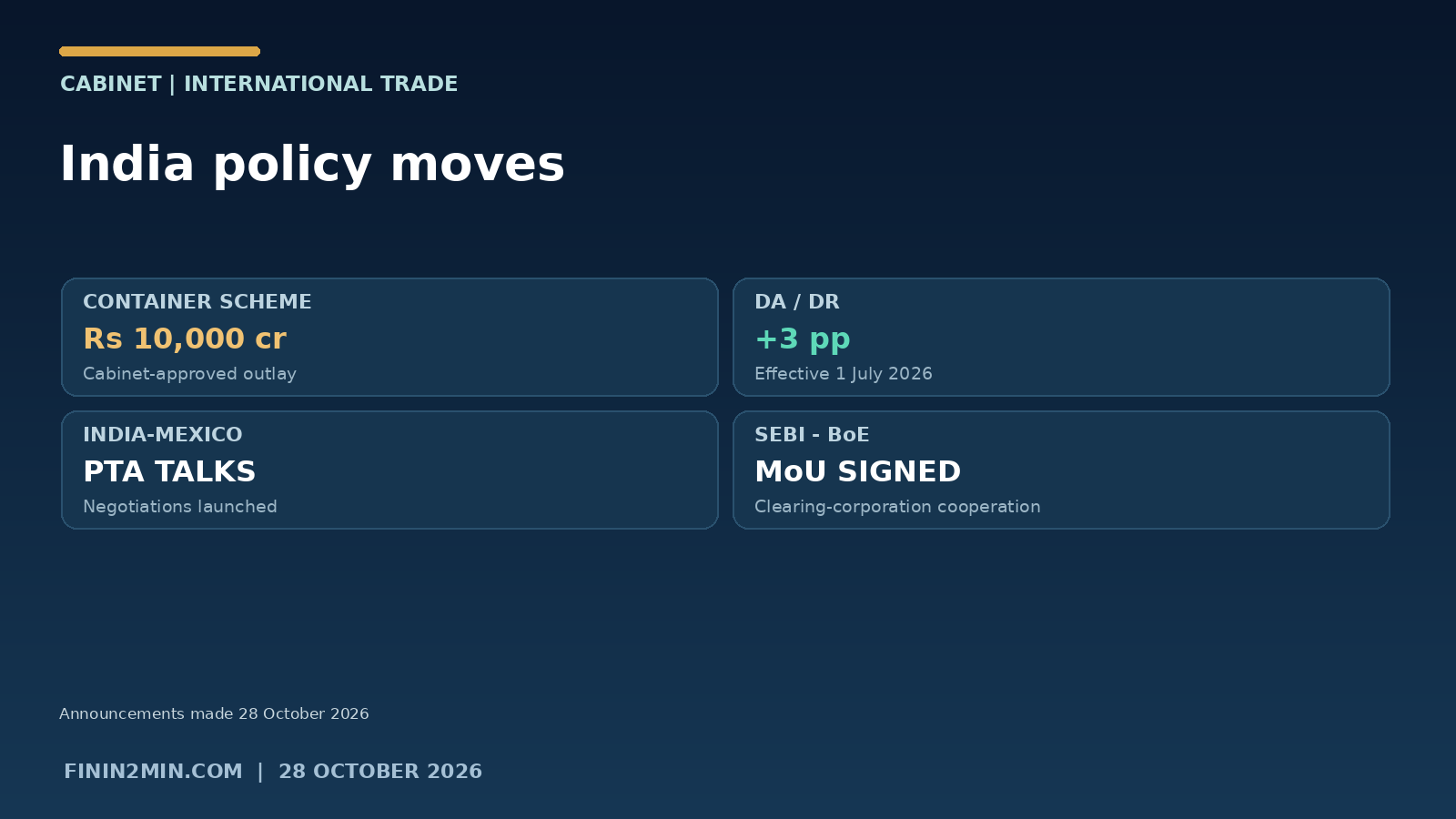
SEBI announced on 28 October that it had signed a memorandum of understanding with the Bank of England concerning cooperation and information exchange related to SEBI-recognised clearing corporations. This is a cross-border supervisory arrangement, not an immediate change to brokerage margins or an approval of any particular new market product.
Clearing corporations sit at the centre of the settlement and collateral network. Coordination between supervisors can improve information sharing about risk management, governance and the resilience of infrastructures with international participants. The relevant practical questions are operational resilience, access arrangements and the implementation of any later binding rules.
Intermediaries should continue to follow the applicable SEBI circulars, exchange notices and clearing-corporation operating instructions. A memorandum of understanding should not be represented as a fully effective amendment to any underlying regulation.

GST from 1 November: discounts and inverted-duty refunds
Government-notified GST changes are scheduled to take effect from 1 November 2026, including provisions relating to post-supply discounts and provisional refunds under inverted-duty structures. A discount agreed or recorded after a supply may require a careful linkage between commercial terms, credit-note documentation and the recipient’s tax-credit treatment.
For businesses with inverted duty structures, an accelerated provisional refund mechanism may improve working capital, but eligibility is not automatic. Tax teams should match product classification, input-versus-output rates, accumulated credit, supporting invoices and the applicable refund application procedures before projecting cash inflows.
Practical action this week: review customer and distributor agreements, tax-credit note workflows, ERP configuration, receipt of vendor documents and outstanding refund applications. Separate commencement on 1 November from the substantive operational rules that apply to a specific taxpayer.
References: S25
Direct-tax compliance: October close and November ITR date
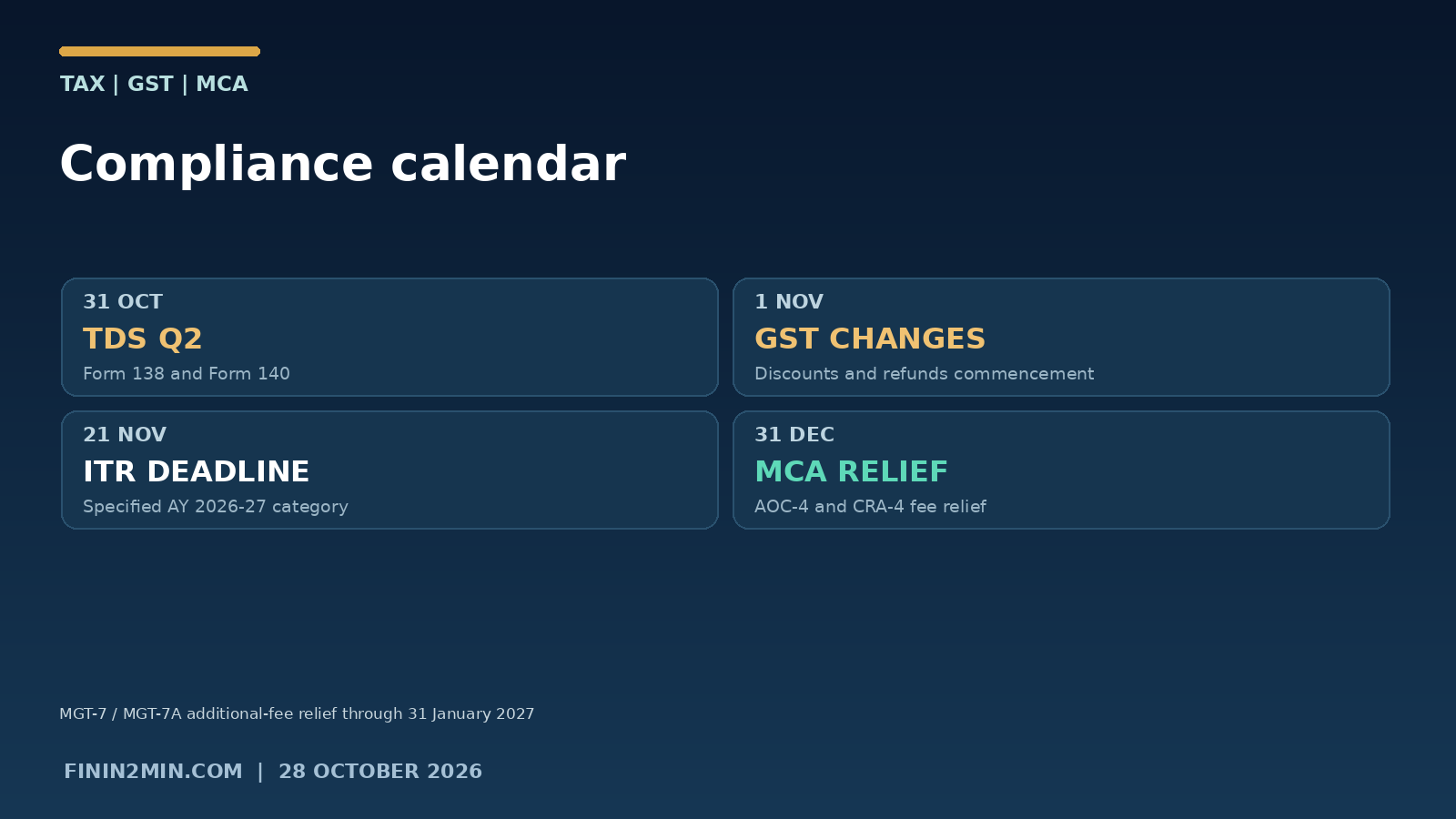
For the July–September 2026 quarter, the Income Tax Department’s Form 138 manual lists 31 October as the deadline for salary/pension-related TDS statements; Form 140 lists the same date for resident non-salary payment statements. These are the current named forms under the 2025 Act reporting environment, corresponding to the earlier 24Q and 26Q labels.
For the specified AY 2026–27 category covered by CBDT Circular 07/2026, the ITR deadline moved from 31 October to 21 November 2026, while the relevant audit-report due date was 21 October. The extension does not establish a blanket change for every taxpayer, nor does it automatically extend every withholding or information-reporting obligation.
Finance departments should reconcile TDS ledgers to challans, PAN/TAN, deductee masters, interest and late-fee exposure, and form validation before uploading returns. A dated compliance calendar is more dependable than carrying forward last year’s old form names.
MCA fee relaxations: AOC-4, MGT-7 and CRA-4
MCA General Circular 05/2026 permits specified FY 2025–26 financial-statement e-forms, including the applicable AOC-4 variants, to be filed through 31 December 2026 without additional fees. Annual-return e-forms MGT-7 and MGT-7A may be filed through 31 January 2027 without additional fees. The circular does not extend the statutory deadline for holding annual general meetings.
Separately, General Circular 06/2026 provides additional-fee relief for filing the FY 2025–26 CRA-4 cost audit report in XBRL format up to 31 December 2026. A waiver of additional fees is not permission to disregard Companies Act obligations, the normal filing cycle or governance decisions that must precede the form.
Company secretaries and finance teams should map obligations by entity type and filing form, check AGM and board approvals, match financial statement attachments, and confirm that the latest MCA portal instructions apply to the company’s particular filing status.
Container manufacturing: a Rs 10,000-crore domestic supply-chain bet
The Union Cabinet approved the Container Manufacturing Promotion Scheme with a budgetary outlay of Rs 10,000 crore up to FY 2039–40. The programme is intended to build a more competitive domestic manufacturing ecosystem, support greenfield and brownfield investment, and reduce dependence on imported shipping containers.
The official announcement includes an interest-subvention component of Rs 859 crore and a 3% annual interest subsidy on qualifying term loans under prescribed conditions. Policy approval establishes the programme framework, but a business’s eligibility and disbursement depend on subsequent scheme guidelines, approvals and qualifying expenditure.
For the wider economy, containers link factories to ports, rail logistics and export execution. Domestic capacity may reduce some procurement vulnerabilities, but economics will depend on container-grade steel availability, testing and certification, demand cycles, factory utilisation, logistics costs and international pricing. Investors should avoid treating the headline outlay as assured revenue for any single supplier.
References: S15
DA/DR increase: payroll and household cash-flow effect
The Cabinet approved a 3-percentage-point increase in Dearness Allowance for central government employees and Dearness Relief for pensioners, effective from 1 July 2026. The announcement raises the applicable percentage from 60% to 63% of the relevant basic pay or pension under the stated formula.
The government estimates an annual fiscal impact of about Rs 10,016.10 crore, benefiting roughly 48.54 lakh employees and 68.71 lakh pensioners. For an employee with a qualifying basic pay of Rs 50,000 per month, three percentage points would imply Rs 1,500 additional DA per month before other payroll consequences; actual arrears and calculations depend on the employee’s details.
The change affects personal cash flows, government expenditure and payroll processing, but should not be treated as a general wage increase across the private sector. Employers and payroll processors should identify the correct effective date, allowances base and arrear calculation.
References: S16
India and Mexico open preferential trade talks
India and Mexico signed terms of reference to begin negotiations for a proposed preferential trade agreement. This marks the start of negotiations rather than a completed agreement or a newly effective tariff schedule. The published roadmap is intended to explore trade, investment, market access, rules of origin and customs-related cooperation.
The financial opportunity lies in diversifying export destinations and supply chains across sectors such as manufacturing, pharmaceuticals, engineering and components. However, the actual benefits will depend on negotiated product coverage, tariff concessions, non-tariff barriers, rules of origin, logistics and implementation dates.
Exporters considering Mexico should first map their HS classifications, current applied duties, product standards, local taxes and payment terms. No company should book hypothetical preference savings until a signed and operative agreement specifies them.
References: S17
Global markets: AI earnings versus energy inflation
Global equities reacted in two directions. Selected Asian semiconductor and technology shares strengthened on earnings momentum, while Indian US-facing IT shares came under pressure. This is not inconsistent: semiconductor demand can benefit from data-centre capital spending even when software services and their clients are reassessing technology budgets.
Following the Federal Reserve’s hold, US shares and global indices were relatively steady in the initial reaction, while Treasury yields remained sensitive to the inflation message. Investors were watching earnings from large AI-expenditure beneficiaries and the next US personal-consumption-expenditure inflation release.
For India, global AI demand has a dual impact: infrastructure and engineering export opportunities on one side, and valuation competition for foreign capital on the other. Indian IT companies require company-level analysis of bookings, pricing, utilisation and margins rather than a single global technology narrative.
Corporate earnings and industrial orders: read beyond the headline EPS
Larsen & Toubro’s investor-relations portal published the results and analyst material for the quarter and half-year ended 30 September 2026 on 27 October. The stock was among the stronger large-cap performers on 28 October. The relevant earnings questions are the quality of order inflows, execution schedules, project margins, cash conversion and any concentration in government or international work.
Banking and autos outperformed IT and oil-gas in the session. Differences in business models explain why a single macro shock produces different equity reactions: higher crude can hurt transport input costs yet improve some upstream producers’ realised pricing; interest rates can support a bank’s asset yields but also raise funding and credit costs.
When compiling earnings comparisons, distinguish standalone and consolidated figures, one-time tax adjustments, segment margins and management guidance. Headline price reactions are useful signals of expectations but not substitutes for company disclosures.
The monitoring map for 29 October
Watch three market-sensitive variables in order: new oil-related security and production announcements, the post-Fed US Treasury-yield and dollar response, and any overnight movement in GIFT Nifty futures. These are observable inputs, not automatic trading signals. Equity breadth matters because the prior Indian session showed positive performance in selected smaller shares despite negative large-cap benchmarks.
On the policy and compliance calendar, the US PCE inflation release scheduled for 29 October could affect the rate outlook; the 31 October TDS statement deadlines are approaching; relevant GST changes are set for 1 November; and late-year MCA form-specific additional-fee relief should be implemented without confusing it with AGM extensions.
For businesses, refresh oil and FX assumptions in procurement budgets, confirm customer credit-note processing before 1 November, check October withholding-ledger reconciliations and revisit year-end cash-flow scenarios. For investors, use portfolio-specific exposure and risk tolerance rather than index-level predictions.
Publication references and investor disclaimer
This edition brings together exchange-market closes, dated commodity and currency observations, corporate announcements, official Indian government releases, central-bank policy and regulatory publications. Market prices refer to the instrument and observation time shown in each table; cash-market levels and offshore derivatives are not interchangeable.
The information is for general financial education. It is not personalised investment advice or a substitute for professional tax, legal or accounting advice. Returns and market prices may change, and legal applicability depends on the taxpayer, financial year, transaction and operative regulatory instrument.
Primary references and data sources
- S01 · DD India / official market close (28 Oct 2026)
- S02 · Reuters, India equities close (28 Oct 2026)
- S03 · Reuters, Jio listing (28 Oct 2026)
- S04 · National Stock Exchange of India, market indices (28 Oct 2026)
- S05 · National Stock Exchange of India, FII/DII report (28 Oct 2026)
- S06 · Reuters, India FX close (28 Oct 2026)
- S07 · Reuters, crude oil trading (28 Oct 2026)
- S08 · Reuters, precious metals (28 Oct 2026)
- S09 · GIFT Nifty delayed quote (29 Oct 2026 01:09 IST)
- S10 · US Federal Reserve / FOMC statement (28 Oct 2026)
- S11 · MoSPI / PIB, September IIP (28 Oct 2026)
- S12 · MoSPI / PIB, September CPI (12 Oct 2026)
- S13 · DPIIT / PIB, September WPI (14 Oct 2026)
- S14 · Commerce Ministry / PIB, September trade (2026-10)
- S15 · Cabinet / PIB, container manufacturing (28 Oct 2026)
- S16 · Cabinet / PIB, DA/DR (28 Oct 2026)
- S17 · Commerce Ministry / PIB, India-Mexico PTA (28 Oct 2026)
- S18 · SEBI / Bank of England MoU (28 Oct 2026)
- S19 · RBI, SGB redemption price (27 Oct 2026)
- S20 · Income Tax Department / Form 138 manual (2026)
- S21 · Income Tax Department / Form 140 manual (2026)
- S22 · Income Tax Department / due-date circular (28 Sep 2026)
- S23 · Ministry of Corporate Affairs, General Circular 05/2026 (24 Oct 2026)
- S24 · Ministry of Corporate Affairs, General Circular 06/2026 (27 Oct 2026)
- S25 · Reuters, GST commencement (27 Oct 2026)
- S26 · Reuters, global markets after Fed (28 Oct 2026)
- S27 · Reuters, US dollar / Treasury yields (28 Oct 2026)
- S28 · L&T investor relations / Q2 results (27 Oct 2026)
- S29 · EIA Weekly Petroleum Status Report (28 Oct 2026)
- S30 · NSE IX GIFT Nifty market (2026)
- S32 · RBI press release tracker (28 Oct 2026)
- S33 · SEBI official updates directory (28 Oct 2026)