Finin2min • 27 October 2026 • Data through 28 October 2026, 05:15 AM IST

India flat, crude eases, gold rebounds: Finance Intelligence for 27 October 2026
A one-stop daily report for investors, CFOs, CAs and business owners, with Indian market data, global commodities, RBI developments and practical legal and tax guidance.
Read the full 27 October newsletter PDF
The 2-minute briefing: ten numbers and the decisions behind them
India’s large-cap benchmarks were almost unchanged, but small-cap shares rose sharply. Oil fell, gold recovered into the US afternoon, and November GIFT Nifty futures traded below the cash Nifty benchmark before Wednesday’s Indian open.
1) Nifty 50 closed at 22,749.75 and Sensex at 73,598.67. 2) Nifty Smallcap 100 rose roughly 2.69% as the Nifty Bank fell 0.72%. 3) Provisional cash FII buying was ₹4,240.39 crore; DII selling was ₹1,250.03 crore. 4) Brent settled at $113.88 and WTI at $99.90 per barrel. 5) Spot gold traded at $4,055.14 and spot silver at $54.20 per troy ounce at 17:44 GMT. 6) The November GIFT Nifty reference was 22,699 at 02:47 IST on 28 October.
7) US markets ended higher: Nasdaq +1.18%, S&P 500 +0.60%, Dow +0.03%. 8) US October consumer confidence improved to 91.7. 9) Finance Act 2026 GST changes covering discounts and refunds begin 1 November. 10) SEBI extended the separate-business-unit deadline for debenture trustees to 27 April 2027, while Jio Platforms shares are scheduled to list on 28 October.
For finance teams, three immediate workstreams matter: test revised GST credit-note and refund procedures before 1 November, complete applicable Q2 TDS statements by 31 October, and review currency, fuel and borrowing-cost exposures before the Federal Reserve communicates its decision.
Indian market close: calm indices, strong broader-market rotation
The headline market appeared flat; stock-level participation told a different story.
Nifty lost only 3.45 points, or 0.02%, to close at 22,749.75. Sensex slipped 8.08 points, or 0.01%, to 73,598.67. By comparison, Nifty Midcap 100 rose around 1% and Nifty Smallcap 100 gained approximately 2.69%. Nifty Bank dropped 391.80 points to 53,974.90, down 0.72%.
Banking and large IT names faced profit-taking before the US Federal Reserve meeting. Domestic interest in automobiles, pharmaceuticals, real estate, media and smaller companies helped stabilise overall market breadth. Tata Consumer Products advanced after quarterly results, while Bharti Airtel, Trent and Maruti Suzuki were among prominent large-cap gainers.
This divergence changes the interpretation of risk. A flat index does not mean all portfolios experienced a flat day. A small-cap-heavy investor may have seen stronger performance, while portfolios concentrated in major banks may have struggled. It also means index-only analysis can understate or overstate the risk in specific sectors.
Watch whether the broader-market rebound survives after the Fed statement and whether banks regain leadership; a market sustained only by smaller stocks can remain vulnerable to sudden shifts in liquidity.

FII and DII flows: a reversal of the recent pattern
Foreign institutions bought Indian equities on a day when domestic institutions were net sellers.
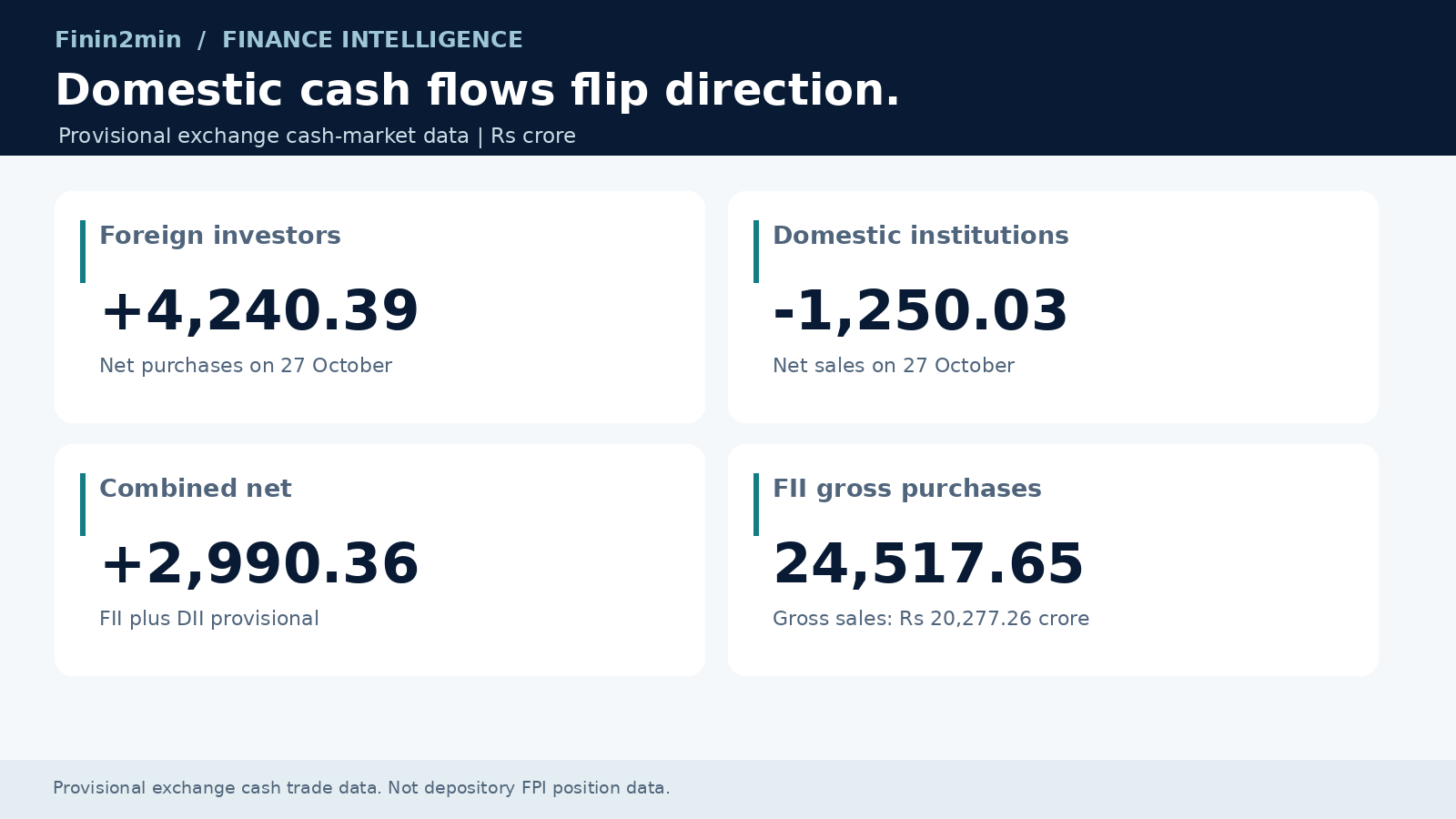
Exchange provisional cash-market data show FII gross purchases of approximately ₹24,517.65 crore and gross sales of ₹20,277.26 crore, producing net purchases of ₹4,240.39 crore. DIIs bought approximately ₹15,702.74 crore and sold ₹16,952.77 crore, producing net sales of ₹1,250.03 crore.
The combined institutional net was therefore positive by about ₹2,990.36 crore. That is a useful indicator of cash-market supply and demand, but it is not the same as final depository FPI flows, and it does not include all derivatives positioning. One positive session should not be read as the end of multi-month outflows.
For treasury teams and financial advisers, the better signal is the consistency of flows over several sessions alongside currency behaviour, earnings breadth and bond yields. Foreign inflows can support liquidity without guaranteeing a higher closing index.
Sources: [3]
GIFT Nifty: the November futures reference for 28 October
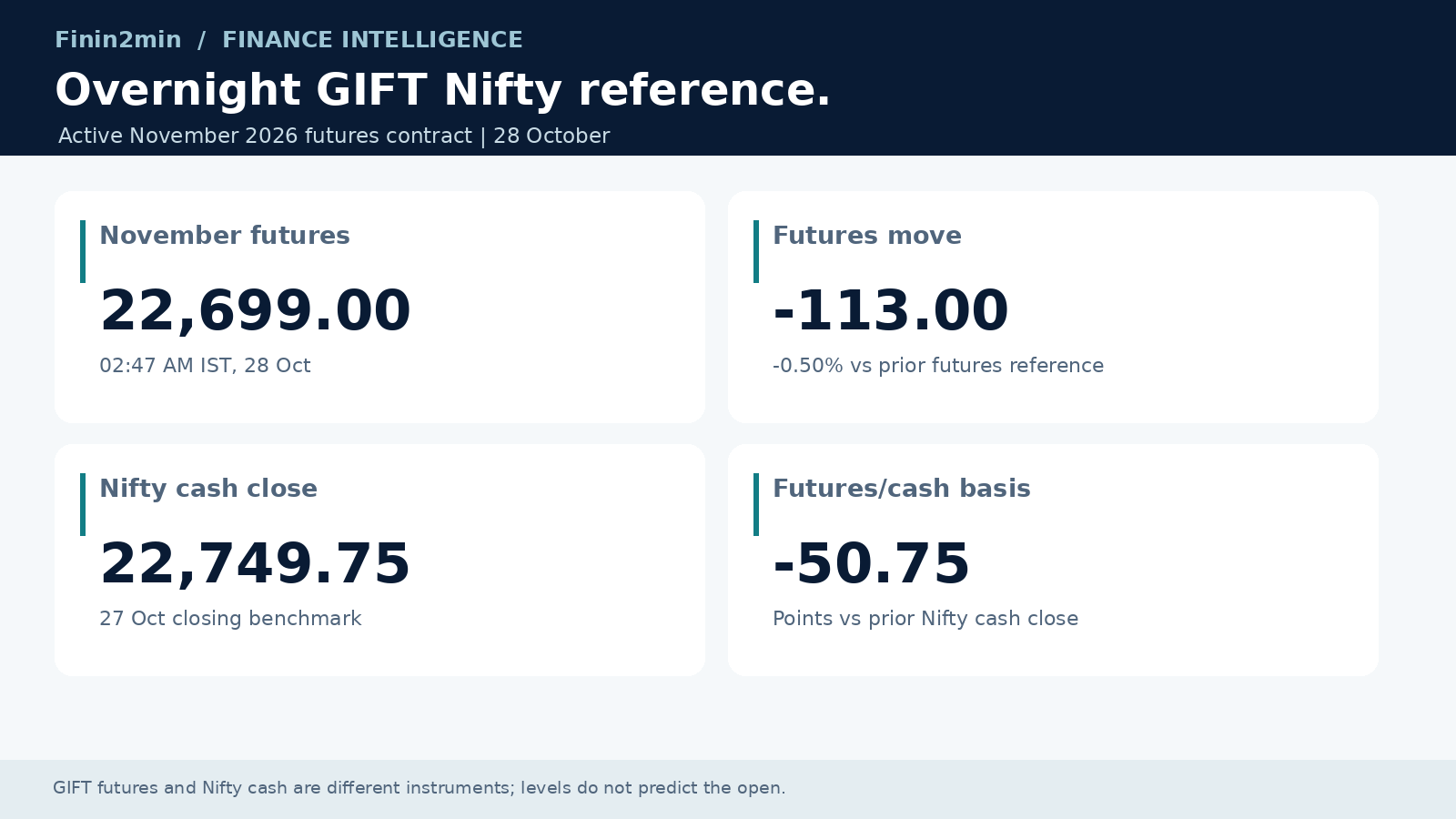
GIFT Nifty November futures were quoted at 22,699.00 at 02:47 AM IST on 28 October, down 113.00 points, or 0.50%, against the referenced prior futures close.
The contract is a futures instrument traded on NSE International Exchange at GIFT City. The quotation is not the domestic Nifty 50 cash close. The October-to-November contract rollover matters: comparing two different expiries can introduce a basis difference unrelated to an actual overnight market move.
The reading was about 50.75 points below Tuesday’s Nifty cash close of 22,749.75. That spread is a futures-versus-cash observation, not a guaranteed opening gap. Overnight US technology strength, Brent’s decline and the upcoming Fed statement can all shift sentiment before 9:15 AM IST.
For the next Indian session, compare the active November contract with its own prior reference and monitor currency, Asia-market direction and pre-open orders rather than relying on one futures tick.
Crude oil: Brent drops $1.93, but the structural risk persists
Brent December crude settled at $113.88 a barrel, down $1.93 (1.67%). US WTI settled at $99.90, down $1.86 (1.83%).
Energy prices declined as Iran, Saudi Arabia, Turkey and Pakistan continued discussions on regional security. However, attacks on Saudi infrastructure and ships around the Strait of Hormuz keep supply risks elevated. A one-day decline in futures does not necessarily translate into immediate relief for imported fuel invoices, marine insurance or freight rates.
For India, a sustained high oil benchmark can enlarge the import bill and widen the current-account deficit, pressure the rupee and raise input costs for aviation, chemicals, paints, tyres, transport and manufacturing. Oil marketing companies, meanwhile, face a different mix of refining margins, inventory changes and regulated or market-linked product prices.
Practical illustration: an importer buying 100,000 barrels at $113.88 faces a crude invoice of $11.388 million before freight, insurance and duties. A $5 per barrel change translates to $500,000 of invoice variation at that volume, excluding currency changes. This shows why oil and USD/INR hedges should be evaluated together, rather than independently.
Watch confirmed cargo movements, Gulf shipping incidents, insurance premiums, OPEC+ output and refinery runs. Claims of strikes on specific facilities should be distinguished from independently confirmed physical disruption.
Sources: [4]

Gold and silver: a volatile session ends with a precious-metal rebound
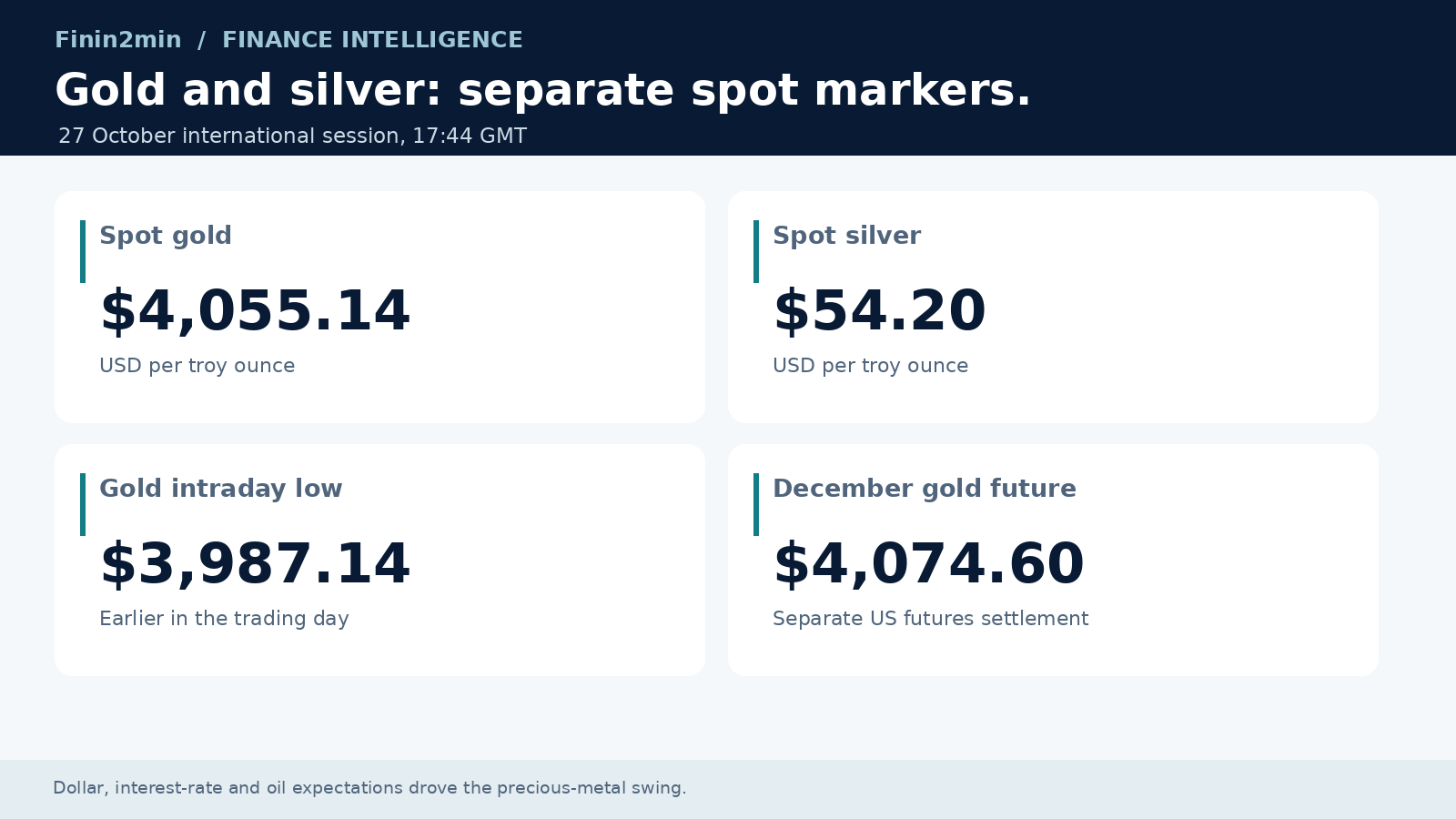
Spot gold was $4,055.14 per ounce and spot silver $54.20 per ounce at 17:44 GMT on 27 October; spot gold had traded as low as $3,987.14 earlier in the day.
Precious metals initially weakened as the dollar firmed and US yields remained elevated, then recovered as oil prices retreated and traders reconsidered how much further US interest rates may rise. The US December gold futures settlement was reported at $4,074.60, a separate contract and figure from spot gold.
Gold provides no coupon, so the opportunity cost of holding it generally rises when risk-free yields move higher. Silver combines the safe-haven narrative with industrial demand exposure: it may be more sensitive than gold to manufacturing and liquidity expectations. Consequently, the two metals do not always move by the same percentage.
Indian buyers should distinguish international spot dollars per troy ounce, MCX futures and local physical gold or silver rates. Exchange-rate fluctuations, duties, local premiums and contract expiry can cause sizeable differences. The newsletter uses the international spot benchmark consistently in its headline dashboard.
For investors and jewellers, monitor US dollar strength, US Treasury yields, the Fed statement, physical premiums and silver’s industrial demand; avoid turning technical reference levels into unconditional price forecasts.
Sources: [5]
The rupee and bond market: why a near-₹95 dollar matters
The RBI daily reference for USD/INR on 27 October was approximately ₹95.16 per US dollar, while elevated US yields continued to influence global funding conditions.
A weaker rupee increases the domestic-currency cost of dollar-denominated imports, including energy and electronics. It can also lift the rupee value of export receipts and overseas earnings. The net effect on a company depends on natural offsets, the tenor of payables and receivables, and its actual hedge book.
Former RBI Governor Raghuram Rajan said on 27 October that India should not exhaust foreign reserves defending a single exchange-rate level. This is a public-policy viewpoint, not an announcement of a change in RBI intervention strategy. India’s currency outlook remains linked to high crude prices, foreign equity flows and US rate expectations.
A useful treasury dashboard combines open USD payable and receivable buckets by due date, expected oil-linked payments, hedge cover and stress tests for both currency and fuel. Reporting a single USD/INR number without settlement date or exposure context is insufficient for cash planning.
Sources: [9]
Wall Street: AI enthusiasm returns before the Federal Reserve decision
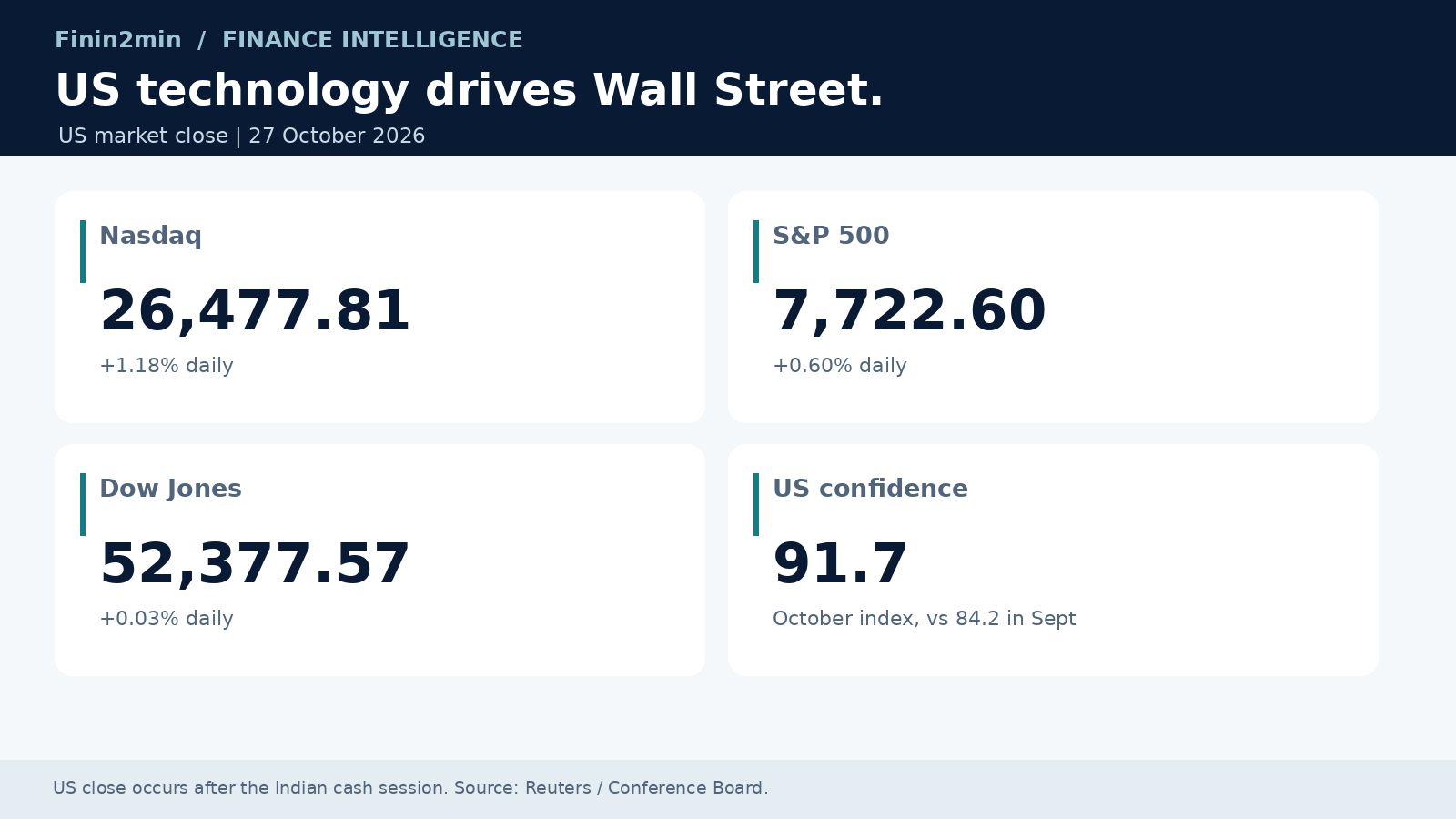
US equities ended 27 October higher: Nasdaq Composite 26,477.81 (+1.18%), S&P 500 7,722.60 (+0.60%) and Dow Jones 52,377.57 (+0.03%).
Chip companies and other AI-linked technology shares led the rally as investors responded to renewed AI funding activity and enterprise demand for computing equipment. The enthusiasm is taking place alongside debates about the sustainability of debt-financed AI infrastructure, rising capital expenditure and high borrowing costs.
Company results were mixed. Stronger outlooks from UPS and Royal Caribbean helped sentiment, while Boeing and some industrial names fell on weaker quarterly results or guidance. US mega-cap technology results, including Microsoft and Alphabet, were scheduled for the following session, with Amazon later in the week.
The transmission to India runs through IT-services demand, foreign portfolio risk appetite and technology valuations. US equity strength can support emerging-market sentiment, but a concentrated rally in a few heavyweight stocks does not automatically mean broad global growth is accelerating.
Sources: [10]
Global macro: US consumer confidence climbs to 91.7
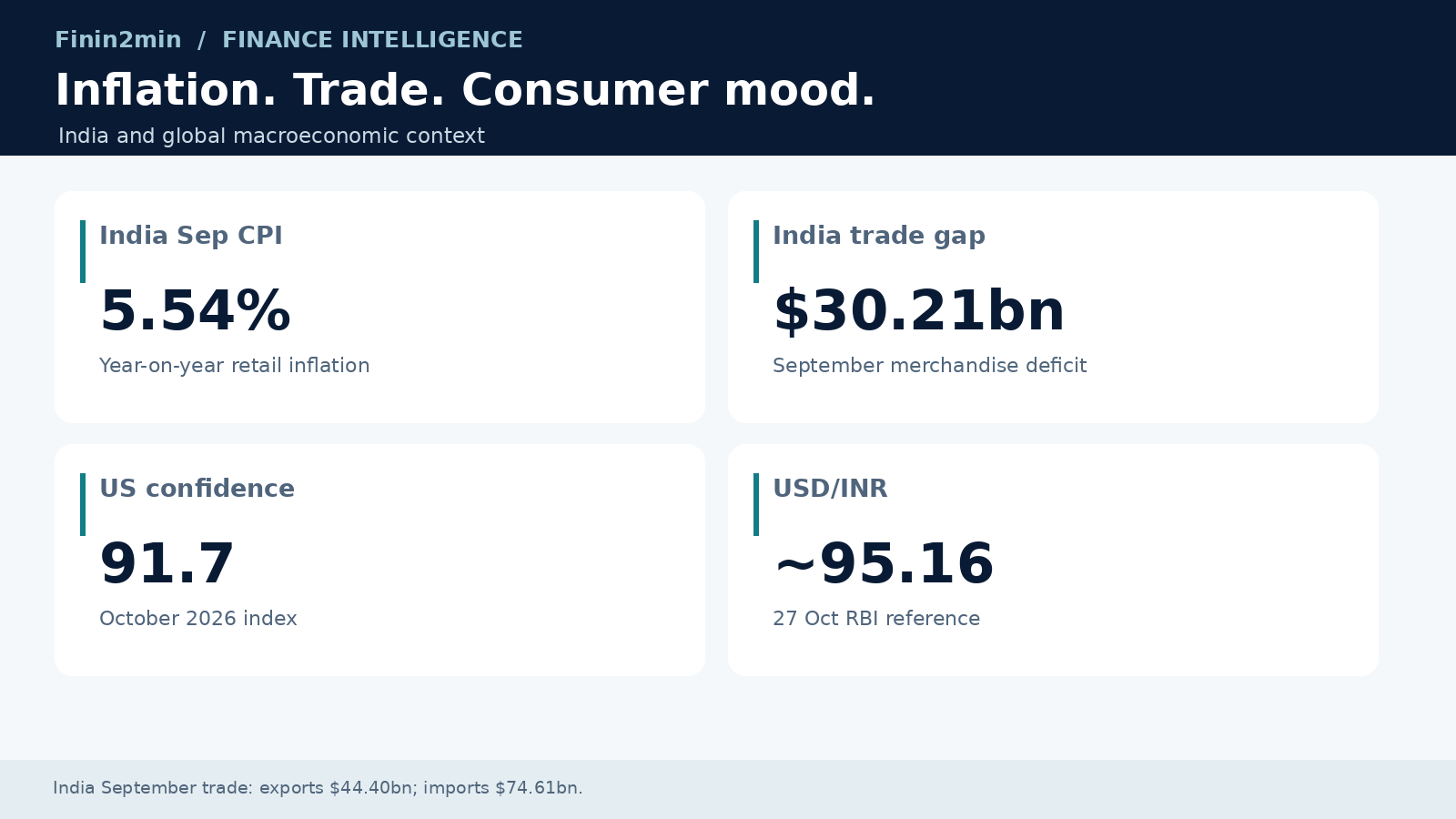
The Conference Board’s US Consumer Confidence Index rose to 91.7 in October from an upwardly revised 84.2 in September.
Present-situation confidence rose to 120.4 and the expectations index to 72.6. The improvement was linked to somewhat lower gasoline prices and a better assessment of business conditions, although households continued to express concern about food and other living costs.
Consumer confidence can signal how households may spend, but it is not a direct forecast of retail sales. Strong demand alongside elevated inflation may encourage the Fed to keep monetary conditions restrictive. Weak demand alongside costly energy can instead create a more difficult growth-inflation trade-off.
The US FOMC meeting concludes on 28 October. Its decision, press briefing and projections, together with subsequent US inflation and activity releases, matter to global bond yields, dollar liquidity, precious metals and the valuation of emerging-market equities.
India macro: inflation and trade data still define the policy backdrop
India’s September CPI inflation was 5.54%. September merchandise exports reached $44.40 billion and imports $74.61 billion, leaving a merchandise trade deficit of $30.21 billion.
Official trade data also showed growth in engineering products, petroleum products and chemical exports. Strong export performance supports industrial activity, but larger import costs can reduce the net benefit for the current account. The difference between merchandise trade and total goods-plus-services trade must be maintained when comparing headline deficits.
Industrial production growth in August was approximately 8.0% year on year. At the same time, expensive crude and a relatively weak rupee can create input-cost pressure that appears with a lag in wholesale prices, logistics contracts and household expenditures.
For CFOs, monitor inventory exposure and tariff-sensitive imports. For investors, the important question is whether industrial momentum can absorb costs without sustained margin erosion, not whether one CPI print mechanically predicts the next RBI rate decision.
RBI banking and liquidity: upcoming SGB redemption price
RBI fixed the 28 October 2026 premature redemption price of Sovereign Gold Bond 2020–21 Series I at ₹14,159 per unit.
The price represents the simple average of IBJA 999-purity gold prices for 23, 26 and 27 October 2026. The relevant tranche was issued in April 2020, and the scheduled early redemption falls on an eligible interest-payment date after the minimum holding period.
Investors should verify whether their bank or depository processing instruction was submitted within the prescribed window, the recorded holdings and any tax implications specific to the acquisition and redemption route. The published price is not a quoted market price for all gold-bond issues.
RBI also reported on state-finance discussions and government-securities auctions on 27 October. For banks and bond investors, the broader focus remains government borrowing, system liquidity, credit costs and how oil-driven inflation affects the rate outlook.
Sources: [25]

Direct tax: proposed Form 173A for Government-securities exemptions
On 27 October, the Income Tax Department announced a proposal for Income-tax (Seventh Amendment) Rules, 2026, including proposed Rule 281A and Form 173A.
The proposal concerns information reporting for taxpayers claiming specified exemption on interest income or capital gains from Government securities under Schedule IV of the Income-tax Act, 2025. A proposal is not an operative requirement until the prescribed legal instrument takes effect.
Entities managing securities portfolios should map potentially affected instruments and beneficial owners, assess what information a proposed form would require and prepare comments if a formal consultation window is available. Do not begin filing an unnotified form or treat a draft condition as current law.
For AY 2026–27, the Income Tax Department continues to show 21 November 2026 as the extended ITR deadline for the specified audited category under Circular 07/2026; the tax-audit report date for that class was 21 October.
GST major development: discounts and refunds change from 1 November
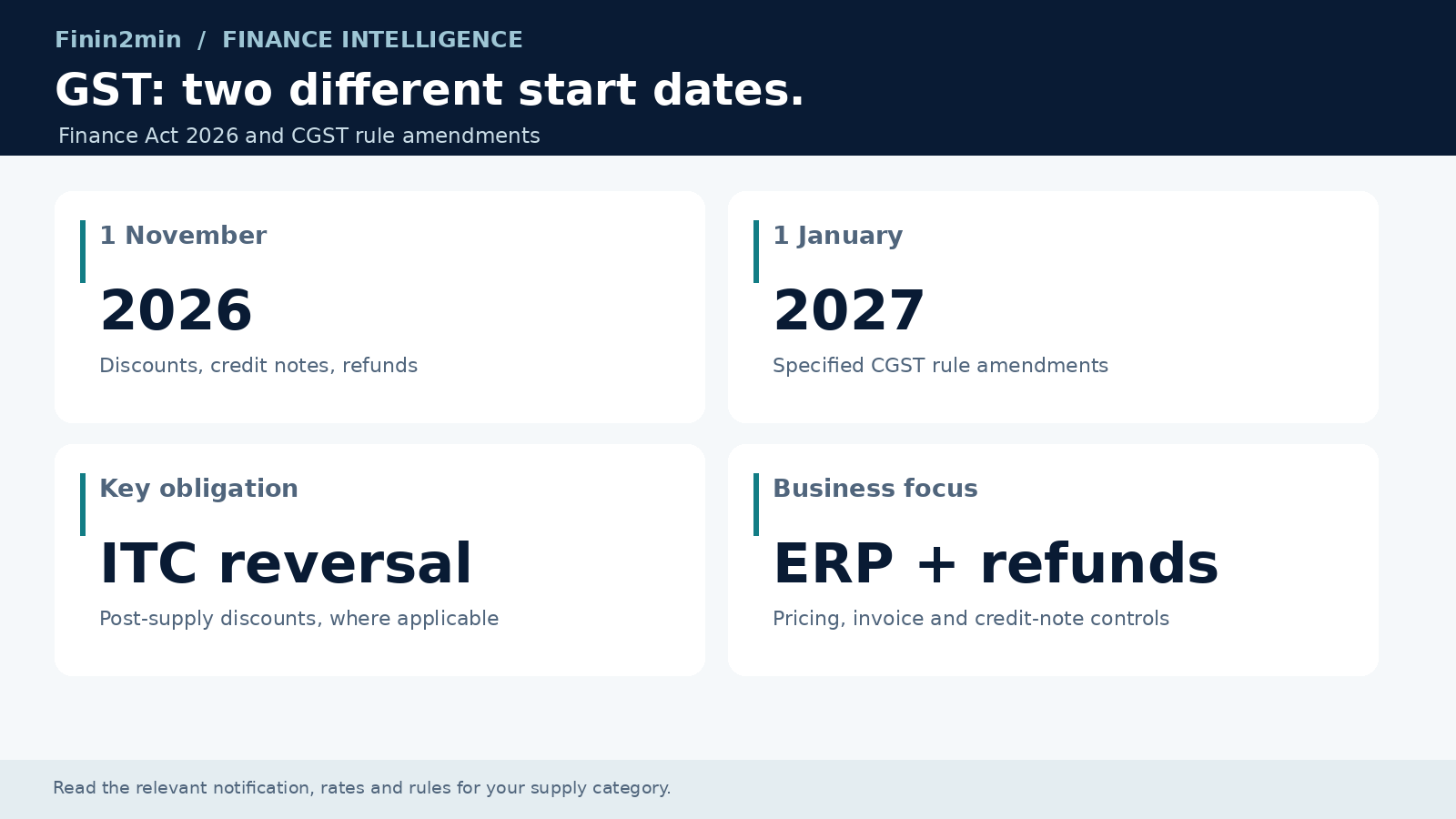
Central Tax Notification 03/2026 dated 26 October appoints 1 November 2026 for the commencement of Sections 153 to 155 of the Finance Act, 2026.
The changes affect post-supply discounts and credit notes under CGST Sections 15 and 34, and specified refund provisions under Section 54. For business-to-business sellers, post-supply discounts are commercially common, but tax treatment depends on valid credit-note documentation and the corresponding input-tax-credit adjustment required by the amended provisions.
For exporters and businesses with inverted-duty structures, the refund changes may affect cash-flow timing and eligibility for particular refund claims. The enabling amendment should be read together with the applicable CGST Rules and prescribed conditions; a change in commencement date does not dispense with proof, reconciliations or return requirements.
Practical checklist: identify discount contracts that run across 1 November, reconcile credit notes to tax invoices, communicate purchaser ITC-adjustment obligations, review ERP mappings and reconcile refund claims to ledger balances. Finance teams should also update commercial teams so promotional discount policy and tax accounting use the same treatment.
Separate rate notifications published on 27 October implement selected decisions from the 57th GST Council meeting. The correct tax rate remains product- or service-specific: verify classification, applicable notification entry and effective date before changing pricing or invoicing.
GST operations: e-invoicing and registration procedures on the horizon
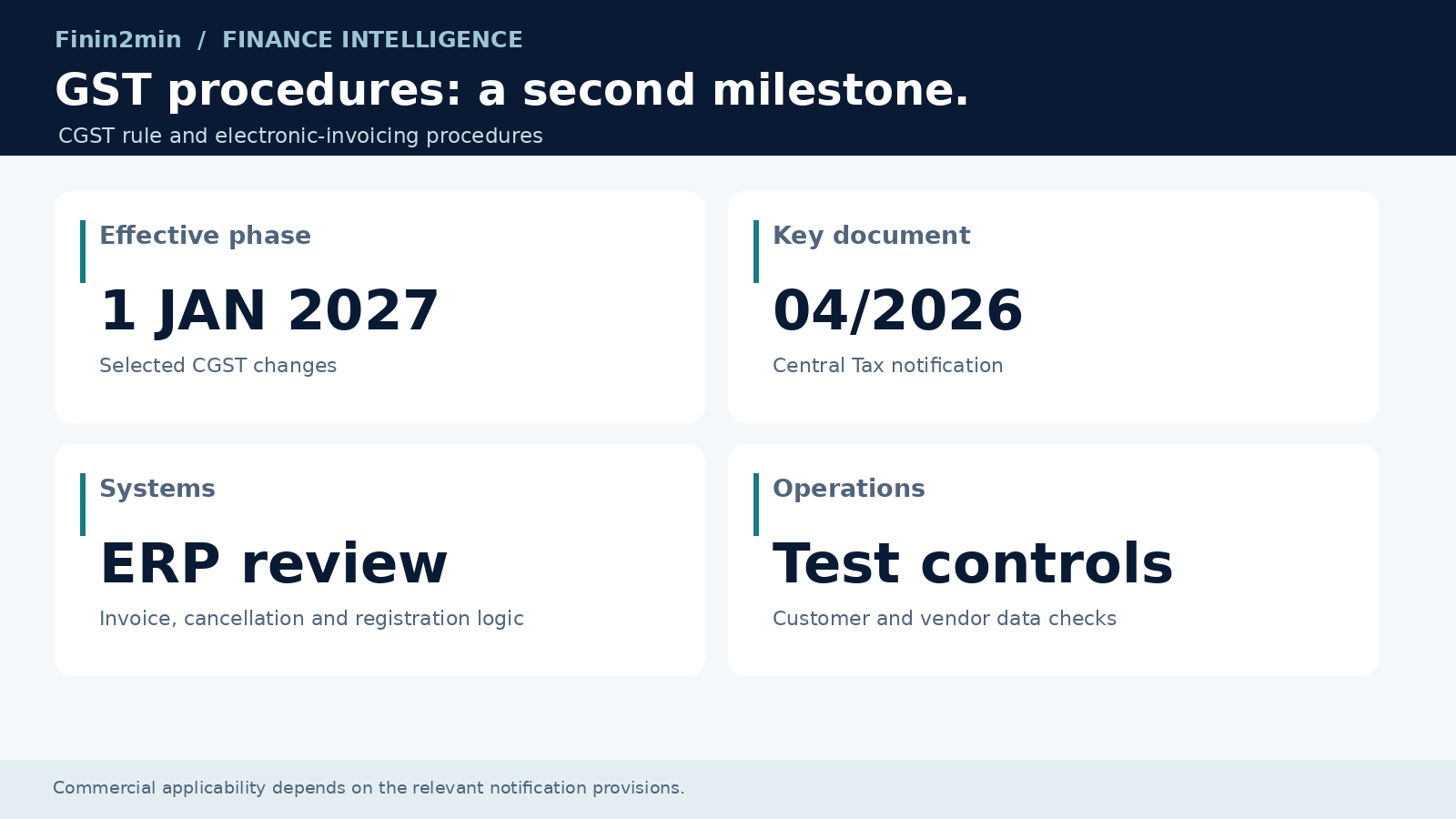
Central Tax Notification 04/2026, published 27 October, amends CGST Rules and the e-invoicing framework, with provisions scheduled from 1 January 2027.
The package of procedural changes involves the scope of electronic invoices and processes for registration through electronic-commerce platforms, as well as cancellation, suspension and revocation of GST registrations. Affected businesses should read the notification and subsequent technical instructions before configuring automatic invoice generation.
The operational risk is not only legal: an ERP that generates a document in the wrong format, applies the wrong tax treatment, or fails to capture a registration state change can create customer ITC mismatches and later reconciliation costs. Teams should identify affected supply categories and perform controlled tests well before January.
Changes flowing from GST Council recommendations should be treated as operative only when the relevant notifications and effective-date provisions apply. A rate or compliance proposal alone does not immediately change a business’s filing obligations.
CBIC issues eight GST circulars: registration, appeals, ITC and exports
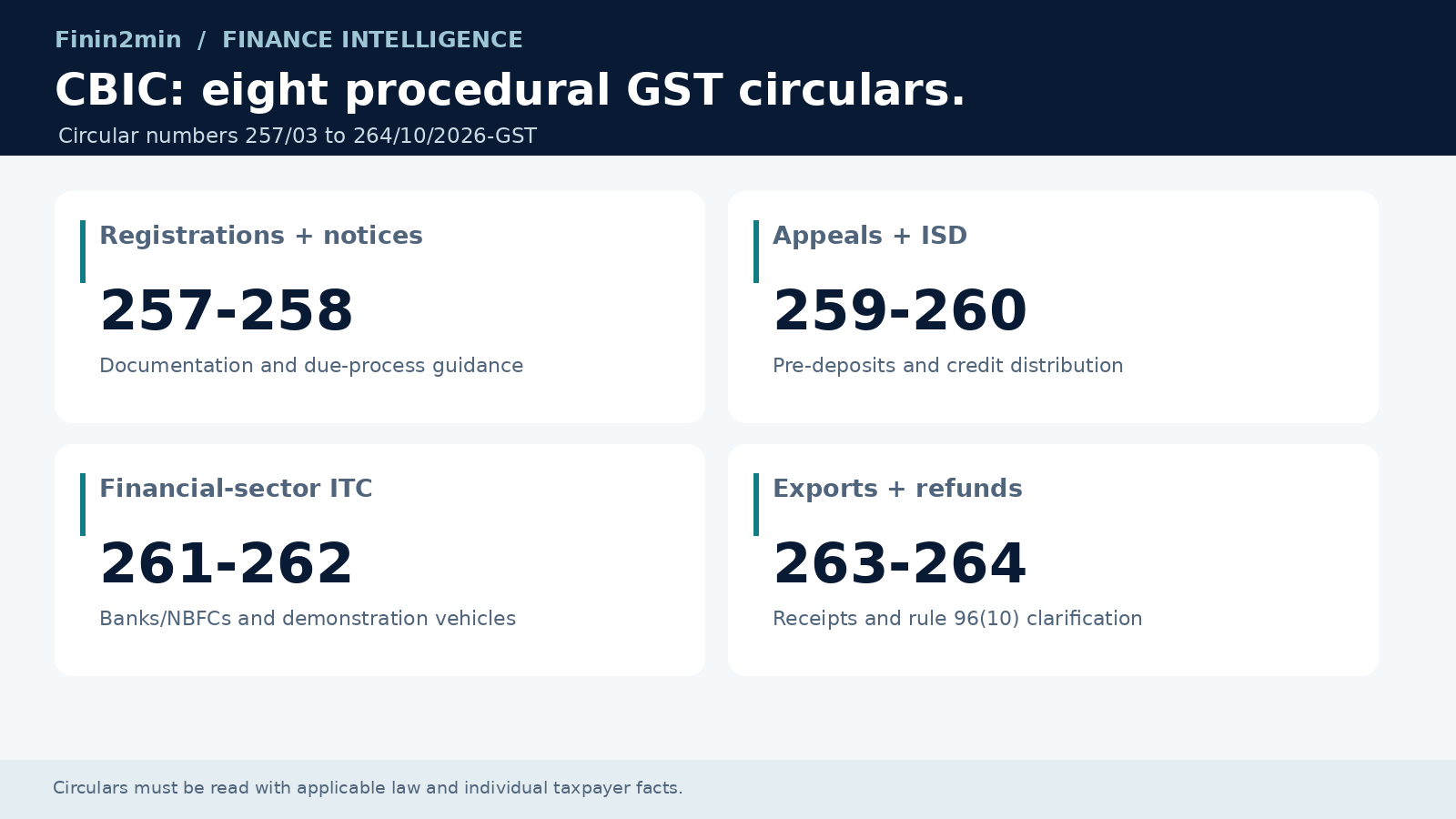
CBIC’s eight circulars numbered 257/03/2026-GST through 264/10/2026-GST, dated 26 October and circulated in the 27 October news cycle, explain important GST procedures and interpretations.
The guidance addresses eight practical topics: documents for registration applications; quality and clarity of demand notices and adjudication; appeal pre-deposit calculations and refunds; Input Service Distributor (ISD) allocation; the 50% input-tax-credit mechanism for banks, financial institutions and NBFCs; demonstration motor vehicles; realisation of export proceeds including permitted Indian-rupee settlements; and issues associated with omission of rule 96(10).
Circular 259/05/2026-GST examines aspects of appellate pre-deposit and refunds, while Circular 260/06/2026-GST clarifies ISD rules. Circular 261/07/2026-GST deals with the Section 17(4) credit option for banks and financial institutions, including NBFCs. These circulars are clarifications and implementation guidance, rather than a blanket fresh GST rate change.
Action for the tax department: classify each live dispute, registration application, ISD allocation and credit/refund process against the relevant circular; compare its precise wording to the taxpayer facts and the operative statute; and retain proof of whether a circular is applicable to a past period or a prospective process. For banks, reconcile ITC reporting and reversals in GSTR-3B and the relevant invoice-management records. For exporters, ensure invoices, realisation evidence and RBI/FEMA documentation agree.
Do not treat all decisions recommended at the GST Council meeting as automatically effective. A Council recommendation, an explanatory circular, a statutory amendment and a tax-rate notification are different legal instruments, and their operation depends on the corresponding law and stated dates.
Sources: [33]
SEBI: six additional months for debenture trustees
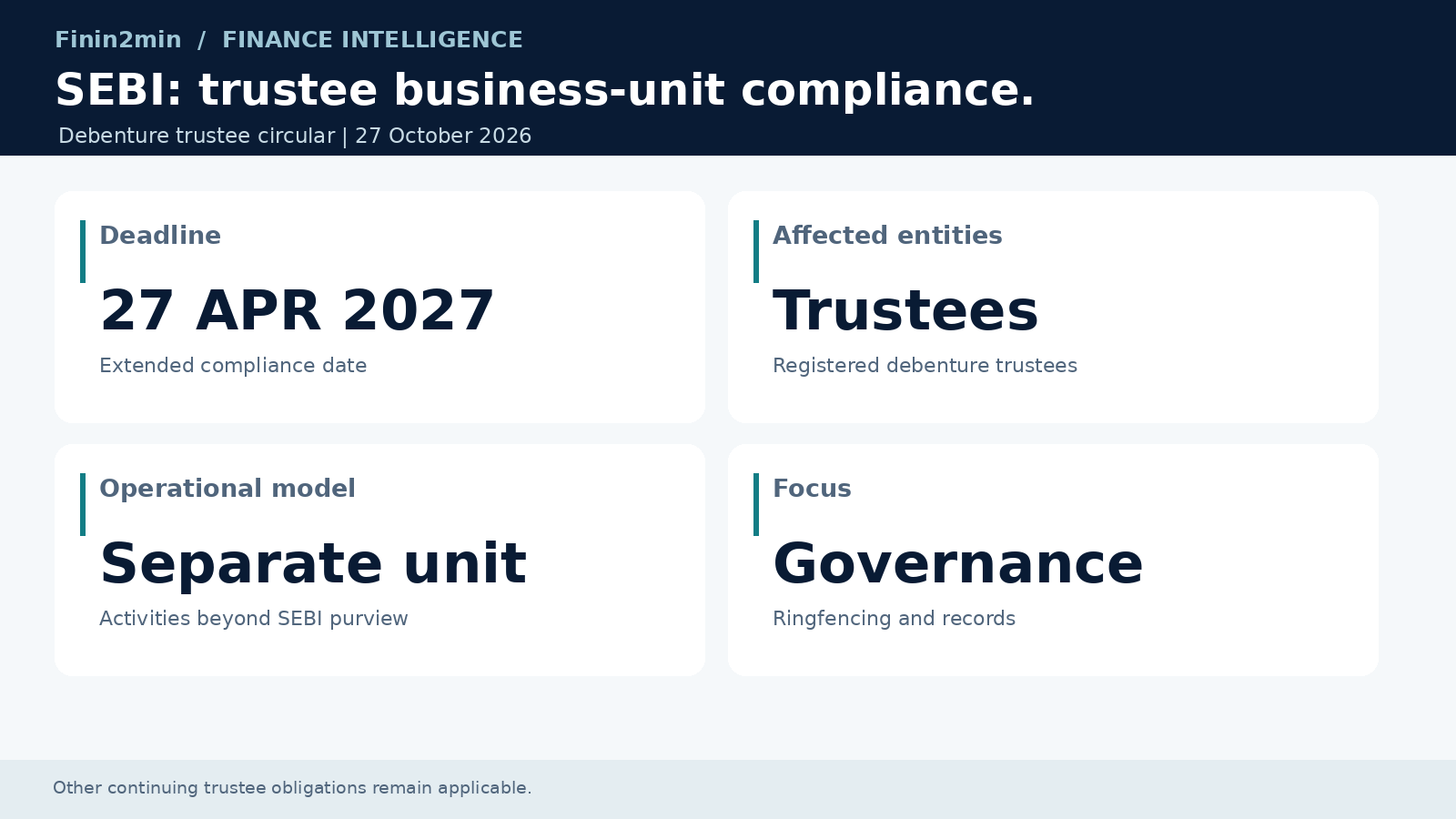
SEBI Circular HO/(201)2026-DDHS-POD1/I/24467/2026 extends the timeline for registered debenture trustees to meet separate-business-unit requirements until 27 April 2027.
The obligation concerns the segregation of activities outside SEBI’s regulatory purview from regulated trustee functions. The extension follows implementation challenges and a wider policy review. All unaffected provisions of the earlier circular continue to apply.
For trustees, this is time to update an implementation plan, map activities, identify ring-fencing of records and personnel, assess technology changes and obtain board or compliance oversight. For debenture issuers and investors, the change is principally about governance and conflicts of interest; it does not alter contractual payment obligations of the underlying bonds.
Other recent SEBI announcements involve closing auctions, cash-market margin relief and research analyst record-keeping. Each has a different effective date and affected population, so they should not be merged into one blanket compliance requirement.
GIFT City: payment systems and cyber-resilience requirements
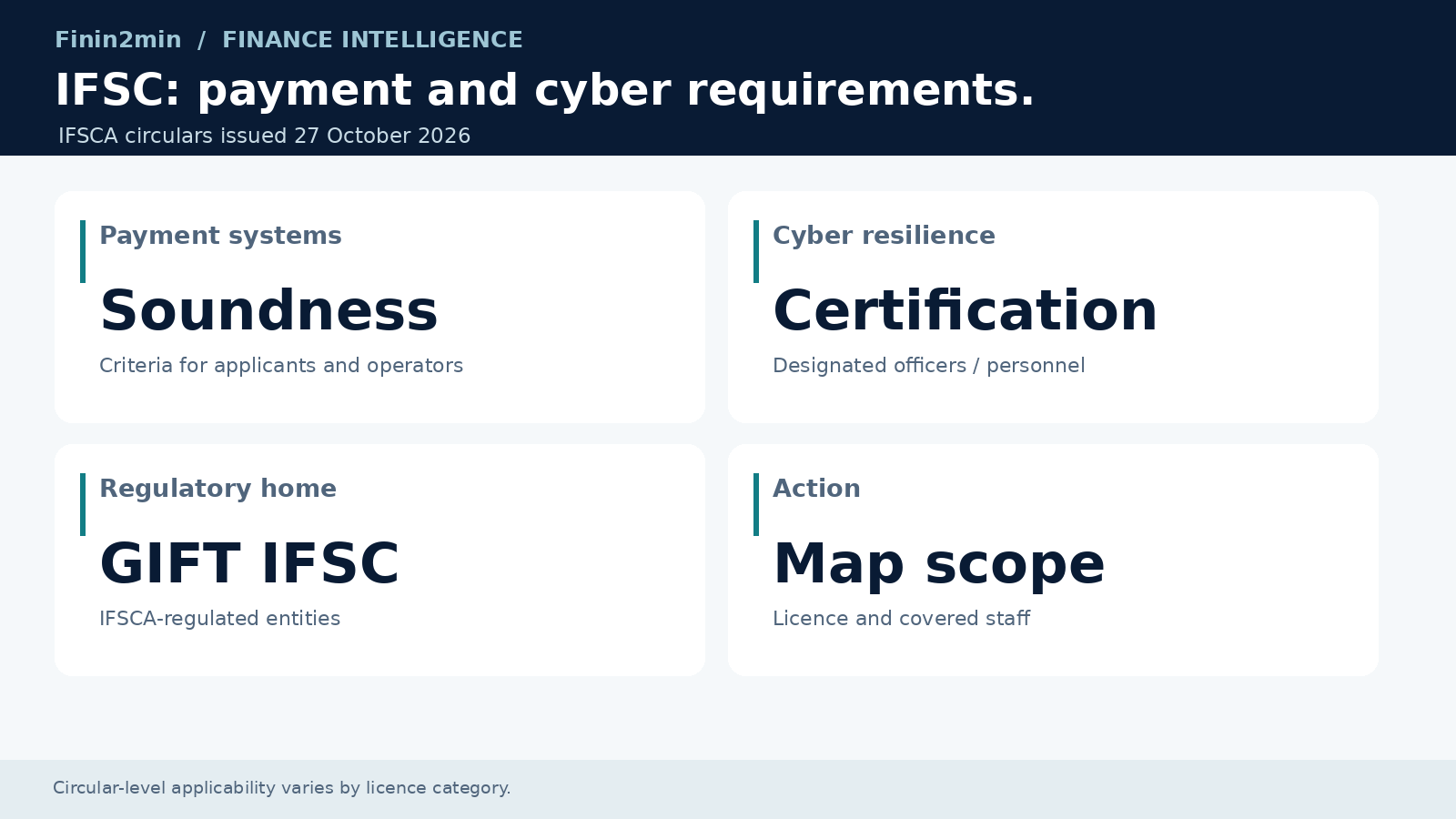
IFSCA issued circulars on 27 October addressing financial-soundness criteria for payment-system operators and cybersecurity certifications for designated personnel in regulated IFSC entities.
For firms operating payment infrastructure from IFSCs, soundness criteria may affect capital planning, admission, ongoing authorisation and governance. Cyber-resilience certification creates a personnel and controls dimension: board-level accountability and training records should align with the applicable circular.
International financial services groups should determine which licence categories, subsidiaries and appointed officers fall within the circulars, and record the applicable milestones. A generic GIFT City registration does not mean every circular applies identically to every regulated entity.
For payment businesses looking to establish in GIFT City, prudential capital, operational resilience, third-party arrangements and contingency planning belong together in the feasibility assessment rather than being left to the post-approval stage.
Sources: [26]
MCA: annual filing fee relief does not move the AGM deadline
MCA General Circular 05/2026 permits FY 2025–26 financial-statement filing through relevant AOC-4 variants until 31 December 2026 and MGT-7/MGT-7A until 31 January 2027 without additional fees.
The relief applies to specified filing forms and fee treatment. It does not, by itself, extend the statutory deadline for holding an annual general meeting. Companies that missed an AGM deadline must consider the consequences separately from their ability to file annual forms without additional fees during the relaxation window.
Company secretaries should segregate three calendars: AGM and approval processes, audited financial statements and attachments, and the actual portal filing. Board reports, auditor reports, secretarial attachments and shareholding particulars should be internally consistent before submission.
Separately, MCA General Circular 06/2026 dated 27 October allows filing of the FY 2025–26 cost-audit report in CRA-4 (XBRL) up to 31 December 2026 without additional fees. This is relief for the specified form; it does not automatically amend every statutory cost-audit obligation. After that window, additional fees can be calculated from the original applicable due date.
The applicable ordinary filing fee still needs to be considered. Do not treat “without additional fees” as a waiver of every possible statutory fee or late-period consequence.
Jio Platforms IPO: official listing notices put 28 October in focus
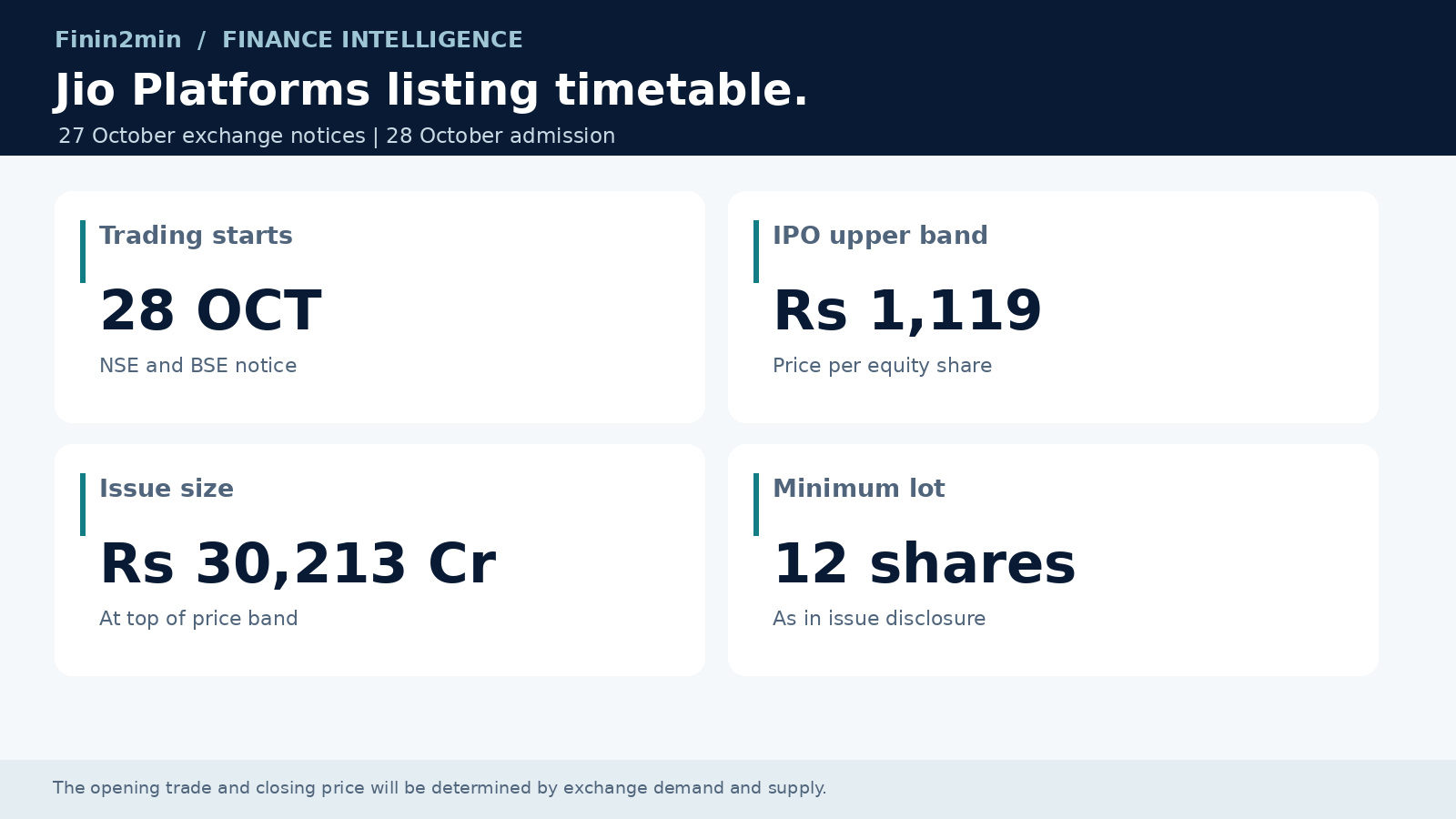
Exchange admission notices dated 27 October state that equity shares of Jio Platforms Limited are to commence trading on NSE and BSE on Wednesday, 28 October 2026.
The IPO was offered at a price band of ₹1,065–₹1,119 per share, with a lot of 12 shares, and the issue size was approximately ₹30,213 crore at the upper end. SEBI published the final prospectus on 26 October, with the exchange notices providing the subsequent listing timetable.
The official issue disclosures matter more than grey-market anecdotes. New investors should examine revenue quality, profitability, cash flows, the role of Reliance group relationships, concentration of telecom and digital-platform revenue, future capital spending and the valuation implied at the offer price.
Listing-day returns are unknowable before trading starts. Allocation applicants should check demat credit, contract notes and tax-cost records. Long-term investors should assess whether the expected earnings trajectory supports the valuation rather than viewing subscription multiples as a forecast of the listing price.
Other corporate and sector developments
Indian autos, pharmaceuticals, realty and select consumption names outperformed on 27 October, whereas heavyweight banks and information technology faced pressure.
Tata Consumer’s quarterly results supported a strong share-price move; Bharti Airtel, Trent and Maruti Suzuki also gained. Sector rotation matters because valuation, demand and cost drivers are different across the economy. An easing in crude prices can assist oil-consuming industries without necessarily benefiting every oil producer or refiner.
Globally, Anthropic-related AI fundraising discussions supported chip makers, while Meta’s funding plans underscored the capital intensity of AI infrastructure. Strong order books do not guarantee high investment returns when financing costs, competition and depreciation also rise.
A practical earnings checklist covers sales mix, pricing, input-cost inflation, funding cost, working capital, contingent liabilities, operating cash flow and the reconciliation between reported profit and recurring profit. Headlines should be interpreted alongside filings rather than used as standalone signals.
Compliance desk: obligations over the next six weeks
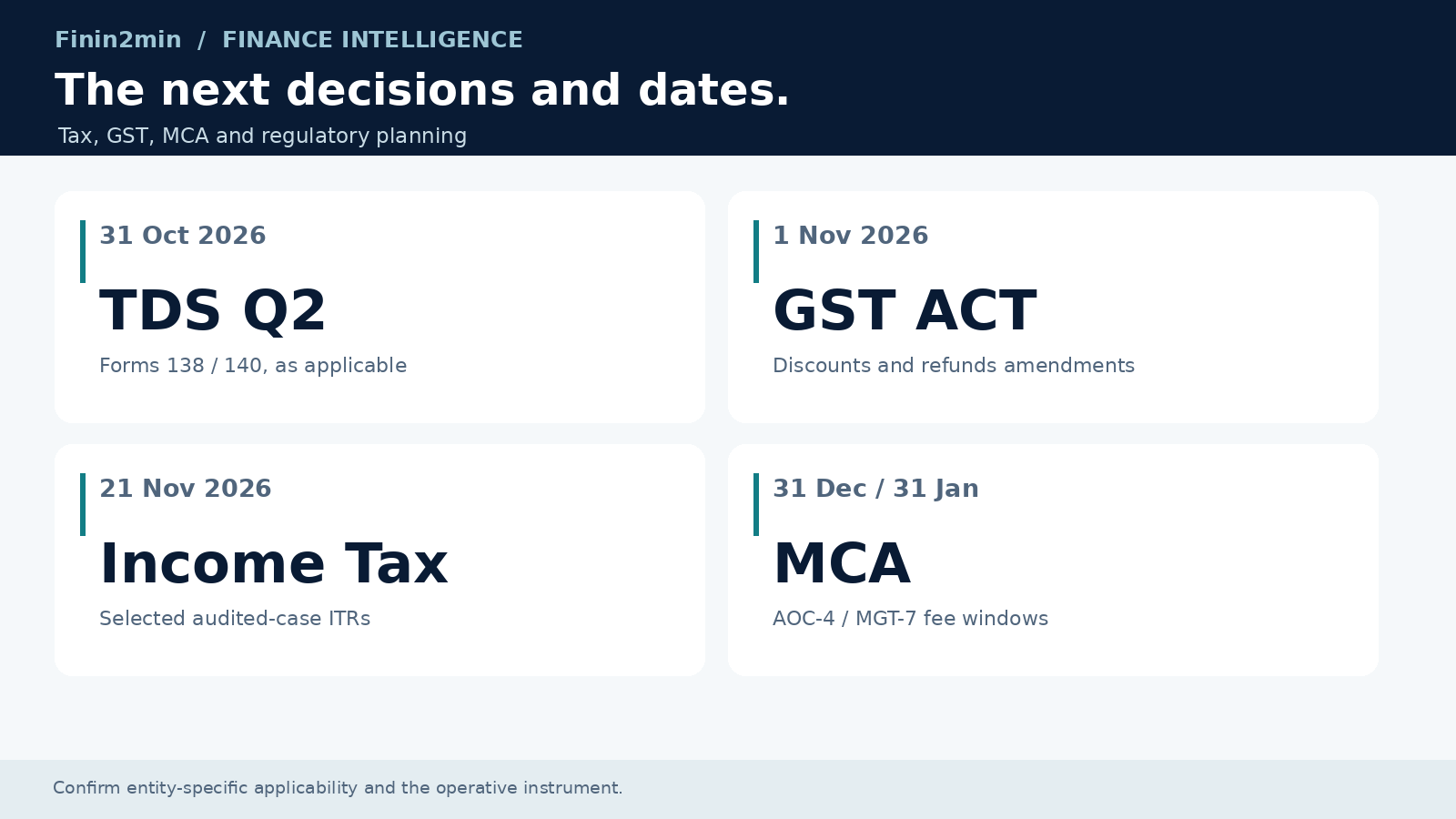
The next dates to diarise are 28 October for the specified SGB tranche and Jio listing, 31 October for applicable Q2 TDS statements, 1 November for GST amendments, 21 November for specified AY 2026–27 ITRs, and the MCA filing windows.
For Q2 July–September TDS reporting, Form 138 (the salary statement previously known as 24Q) and Form 140 (the resident non-salary statement previously known as 26Q) ordinarily fall due on 31 October. Deductors should confirm the form classification and reconcile TAN, challans, deductee PANs and payment details before upload.
AY 2026–27 ITRs for the defined audited category covered by the CBDT extension are due 21 November. The 1 November GST amendments should trigger a check of discount and refund policies, while MCA fee relief covers the specified AOC-4, MGT-7/MGT-7A and CRA-4 windows without replacing governance approvals.
Finance teams should maintain a single matrix of obligation, legal entity, law, tax period, form, accountable owner, supporting evidence and operative date. A system reminder alone cannot protect against errors in the underlying ledger or legal classification.
Sources: [16] [17] [18] [19] [25] [27] [34]
What to monitor on 28 October and beyond
The next session combines the Jio listing, the Federal Reserve decision, the active November GIFT Nifty contract and a changing crude-oil risk premium.
India opening checklist: Jio’s exchange listing and opening price discovery; Nifty breadth versus bank and IT shares; cash FII/DII flows; November GIFT Nifty futures; USD/INR; and the continued strength or weakness of small-cap participation.
Global checklist: Fed interest-rate decision and communication; corporate earnings from US technology firms; Brent and WTI settlement prices; Hormuz traffic and shipping-insurance costs; spot gold, spot silver and US Treasury yields. The October PCE inflation release is scheduled later in the week.
For businesses, the most actionable measures remain revisiting risk limits and working-capital assumptions. For investors, scenario planning should distinguish a peaceful Gulf de-escalation from persistent disruptions, but it should not attach invented probability forecasts or trading calls.
Upcoming calendar at a glance
| Date | Authority | Event or obligation | Who should check |
|---|---|---|---|
| 28 Oct | RBI / NSE | SGB 2020-21 Series I redemption; Jio Platforms listing | Tranche holders and market participants |
| 28 Oct | US Federal Reserve | FOMC decision | Investors, treasuries and lenders |
| 31 Oct | Income-tax | Form 138 / Form 140 Q2 TDS reporting | Applicable deductors |
| 1 Nov | GST / CGST | Commencement of Finance Act 2026 sections 153–155 | Businesses, exporters and advisers |
| 21 Nov | CBDT | Specified audited-category AY 2026–27 ITR deadline | Affected return filers |
| 31 Dec | MCA | AOC-4 variants without additional fees | Companies for FY 2025–26 |
| 31 Dec | MCA | CRA-4 XBRL cost-audit fee-relief deadline | Companies covered by cost audit |
| 1 Jan 2027 | CGST | Specified procedural/e-invoicing provisions | Affected GST businesses |
| 31 Jan 2027 | MCA | MGT-7 / MGT-7A without additional fees | Companies for FY 2025–26 |
| 27 Apr 2027 | SEBI | Debenture trustee separate business unit compliance | Registered debenture trustees |
Sources and further reading
- NSE / BSE — NSE and BSE final index close (27 Oct 2026)
- Reuters — Reuters India equities (27 Oct 2026)
- NSE — NSE provisional institutional cash flow (27 Oct 2026)
- Reuters — Oil settlement and Middle East developments (27 Oct 2026)
- Reuters — Precious metals global session (27 Oct 2026)
- Market quote provider — GIFT Nifty futures reference (28 Oct 2026 02:47 IST)
- Zerodha — GIFT Nifty trading hours (27 Oct 2026)
- NSE market data — NSE index and sector dashboard (27 Oct 2026)
- RBI rates data — USD/INR reference rate (27 Oct 2026)
- Reuters — US stock market close (27 Oct 2026)
- The Conference Board — US consumer confidence survey (27 Oct 2026)
- Federal Reserve — Fed policy schedule (27–28 Oct 2026)
- Ministry of Commerce / PIB — Indian September merchandise trade (15 Oct 2026)
- MoSPI — India inflation and IIP (October 2026)
- Income Tax Department — CBDT proposed rule and Form 173A (27 Oct 2026)
- Income Tax Department — Income-tax due date circular (28 Sep 2026)
- Income Tax Department — TDS Form 138 instructions (October 2026)
- Income Tax Department — TDS Form 140 instructions (October 2026)
- Ministry of Finance / Gazette — GST Act amendment commencement (26–27 Oct 2026)
- Ministry of Finance / Gazette — CGST rules and e-invoice notification (26–27 Oct 2026)
- Ministry of Finance / Gazette — GST rate notification set (27 Oct 2026)
- GST Council / PIB — GST Council 57th meeting decisions (08 Oct 2026)
- SEBI — SEBI debenture trustees extension (27 Oct 2026)
- SEBI — SEBI capital market circulars (15–27 Oct 2026)
- Reserve Bank of India — SGB premature redemption price (27 Oct 2026)
- IFSCA — IFSCA payment system and cyber circulars (27 Oct 2026)
- Ministry of Corporate Affairs / Circular — MCA annual filing fee relaxation (24 Oct 2026)
- SEBI — Jio Platforms prospectus (26 Oct 2026)
- NSE / BSE — Jio listing admission notice (27 Oct 2026)
- Reliance Industries — Jio issue price exchange disclosure (14 Oct 2026)
- US BEA — US personal consumption report calendar (29 Oct 2026)
- US Bureau of Labor Statistics — US inflation release (Oct 2026)
- CBIC Tax Information Portal — CBIC circulars 257/03 to 264/10/2026-GST (26–27 Oct 2026)
- Ministry of Corporate Affairs — MCA circular 06/2026 cost-audit relief (27 Oct 2026)
This Finin2min publication is for general education and information. Figures are instrument- and time-specific. Investment, tax and legal decisions require review of individual circumstances and applicable official instruments. © Finin2min.