India Slides as Jio IPO Surges and Oil Stays Costly | Finance News – 21 October 2026
Indian equities struggle with higher oil prices even as Jio Platforms’ IPO draws strong demand and RBI reiterates its inflation focus.
Market and economic dashboard
| Instrument | Reading | Move or status | As of |
|---|---|---|---|
| Nifty 50 | 22,811.35 | −77.60 / −0.34% | 21 Oct 15:30 IST cash close |
| BSE Sensex | 73,709.69 | −143.21 / −0.19% | 21 Oct official cash close |
| Nifty IT | +2.9% | Day gain | 21 Oct close; approximate |
| Nifty Midcap 100 | 57,565.85 | −1.58% | 21 Oct close |
| Nifty Smallcap 100 | 18,487.30 | −2.37% | 21 Oct close |
| GIFT Nifty October futures | 22,718.00 | −10.50 / −0.05% | 22 Oct 01:35 IST quote |
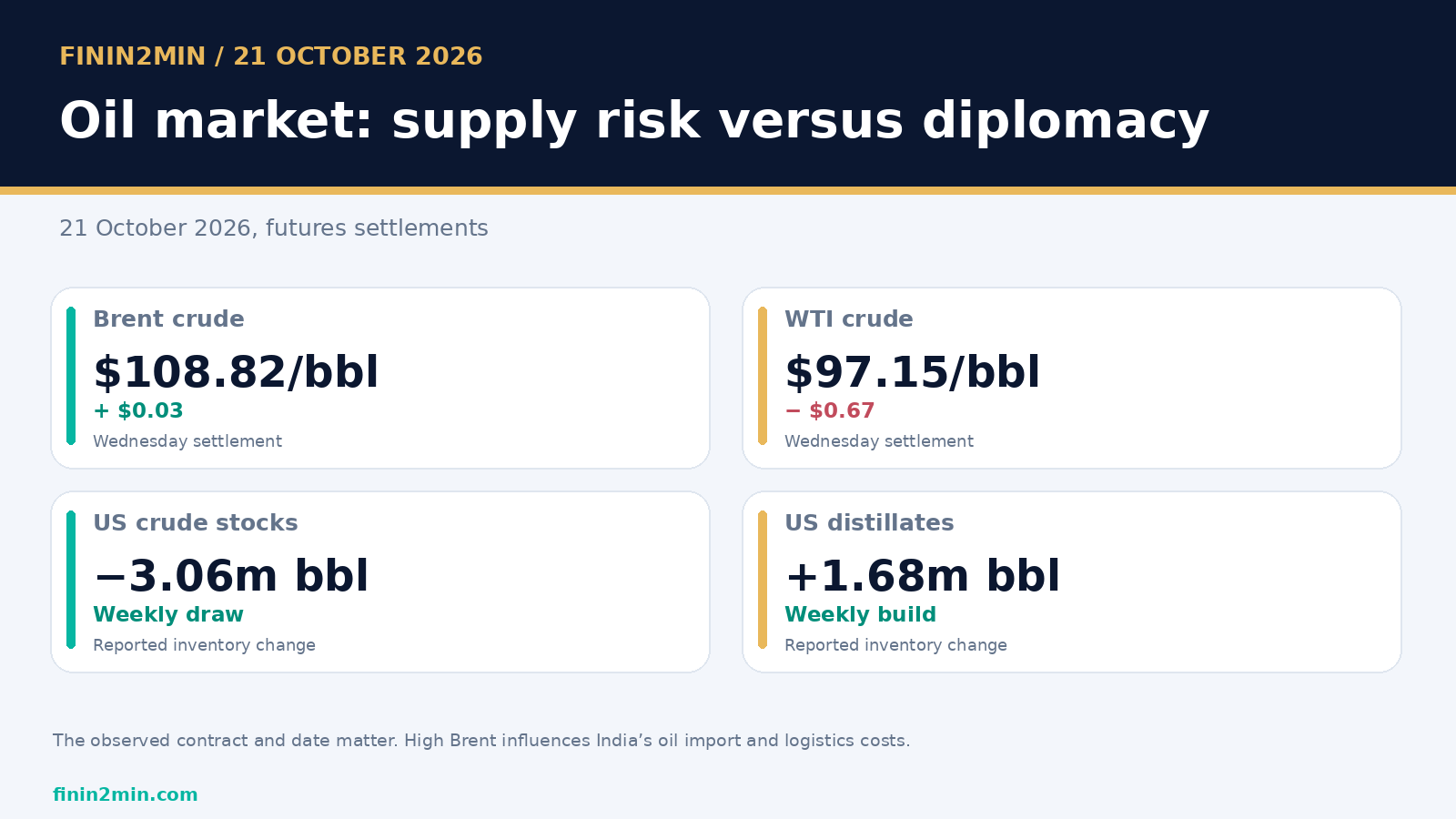
| Brent crude futures | US$108.82/bbl | +US$0.03 | 21 Oct settlement |
| WTI crude futures | US$97.15/bbl | −US$0.67 | 21 Oct settlement |
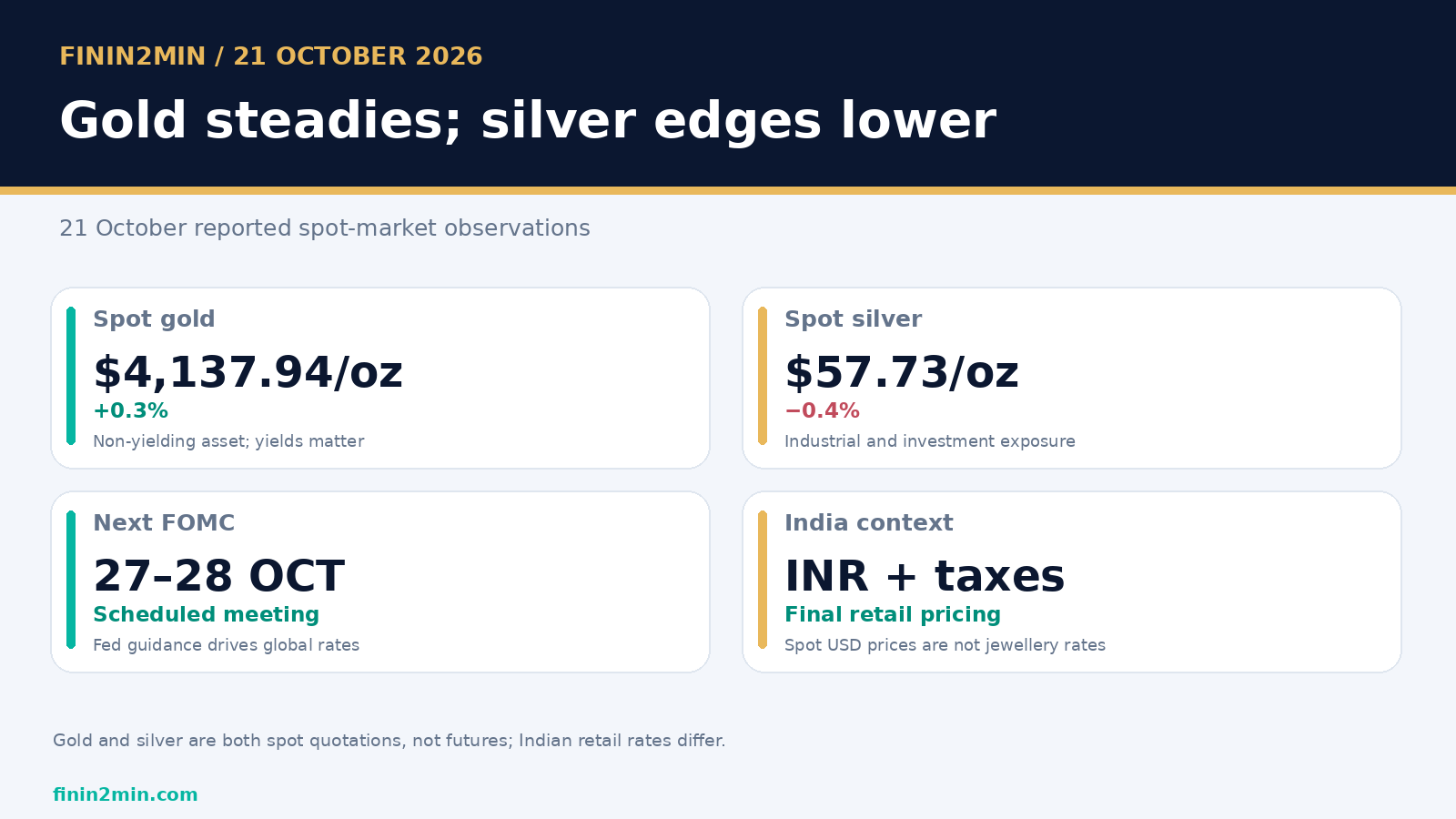
| Spot gold | US$4,137.94/oz | +0.3% | 21 Oct reported spot observation |
| Spot silver | US$57.73/oz | −0.4% | 21 Oct reported spot observation |
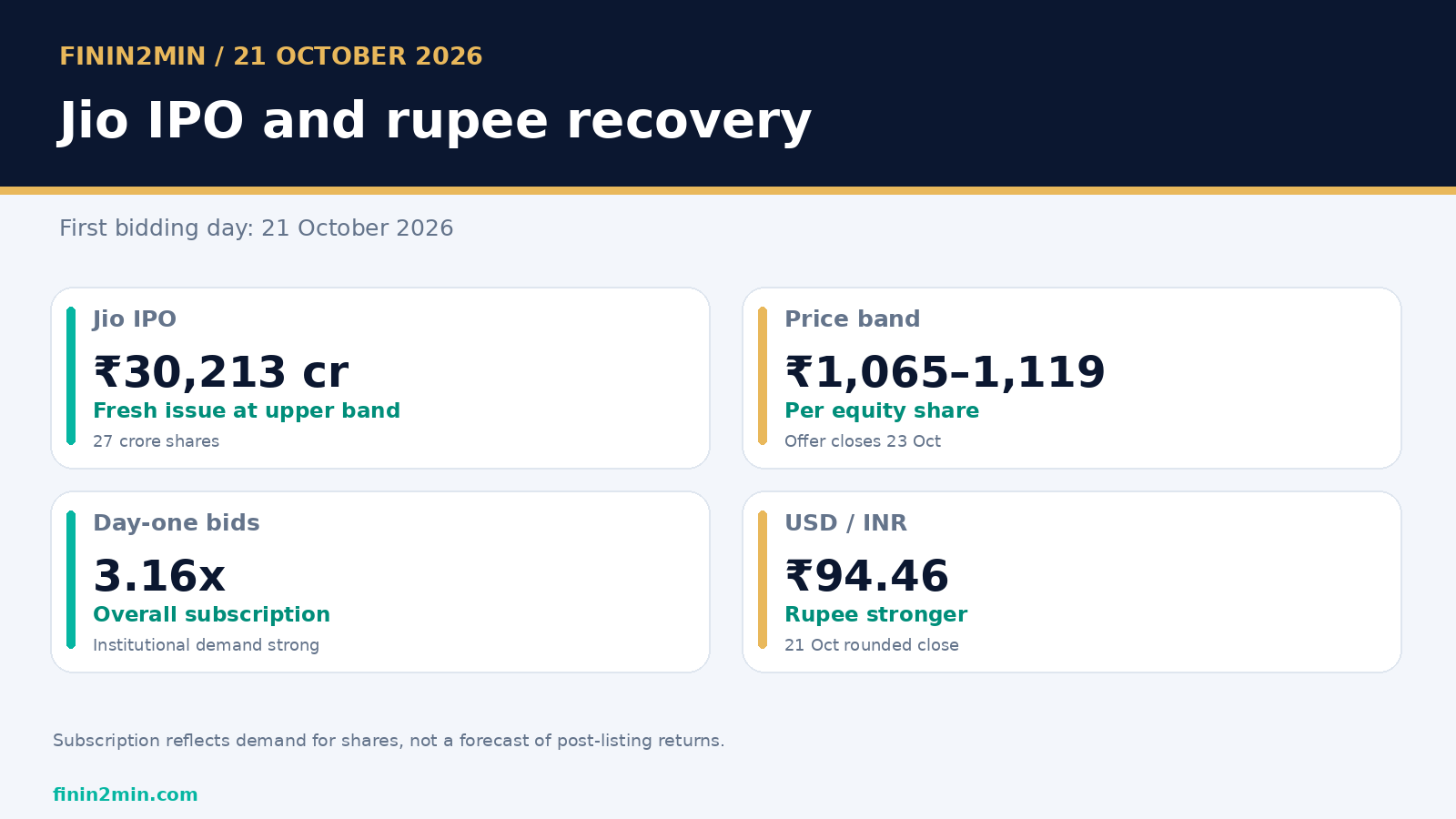
| USD/INR | ₹94.46 per US$ | Rupee strengthened | 21 Oct Indian close (rounded) |
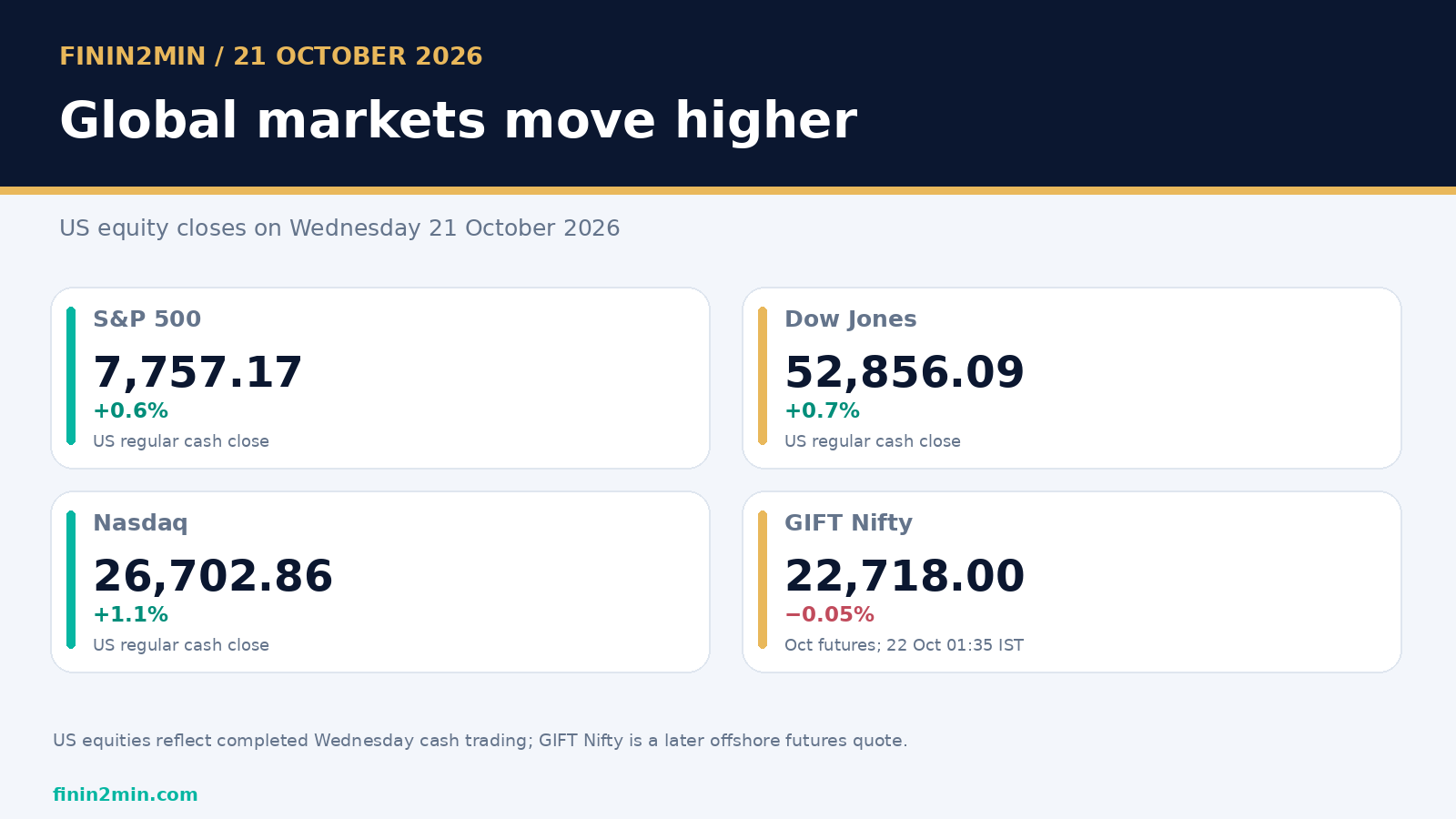
| S&P 500 | 7,757.17 | +0.6% | 21 Oct US cash close |
| Dow Jones | 52,856.09 | +0.7% | 21 Oct US cash close |
| Nasdaq Composite | 26,702.86 | +1.1% | 21 Oct US cash close |
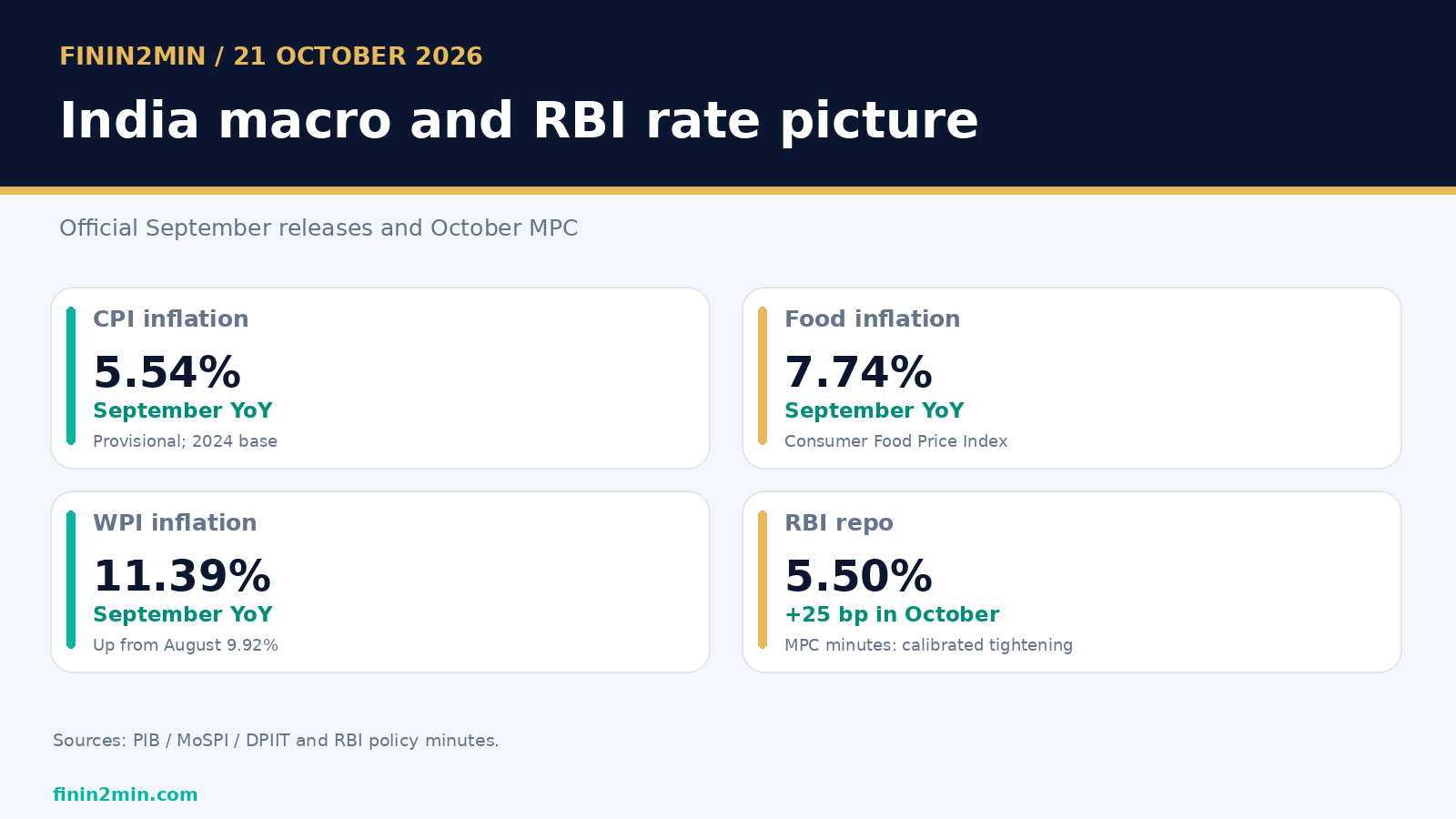
| India CPI YoY | 5.54% | Sep 2026 provisional | Released 12 Oct |
| India food CPI YoY | 7.74% | Sep 2026 provisional | Released 12 Oct |
| India WPI YoY | 11.39% | Sep 2026 provisional | Released 14 Oct |
| RBI repo rate | 5.50% | After 7 Oct +25bp | MPC minutes released 21 Oct |
The market, the IPO and the policy signal
Indian equities ended below their previous close despite an encouraging opening. The Nifty 50 fell 77.60 points to 22,811.35 and the Sensex lost 143.21 points to 73,709.69. Selling became more pronounced outside the headline indices: the Nifty Smallcap 100 dropped 2.37%, and the Midcap 100 fell 1.58%. IT shares were a notable counterweight, rising about 2.9%.
Brent crude finished at $108.82 per barrel and US WTI at $97.15. Gold was around $4,137.94 per troy ounce and silver around $57.73 during the reported US-market observation. The rupee strengthened to roughly ₹94.46 per dollar on IPO-related flows even though high energy prices still threaten India’s import bill.
Jio Platforms’ ₹30,213-crore public issue was fully subscribed on the opening day and drew particularly strong institutional interest. RBI policy minutes highlighted further inflation concerns, while the 21 October extended tax-audit deadline made timely compliance a central priority for accountants and businesses.
Why the market reversed after a positive start
The Nifty recovered early in the day, but buyers were unable to defend the advance. Profit-taking in financials, autos, metals and other cyclical areas outweighed technology strength. The Nifty touched 22,649.90 intraday before recovering part of its losses by the close. This is important: the intraday decline was larger than the final index fall suggests.
Technology stocks benefited from relative earnings resilience and expectations that offshore technology spending could prove less vulnerable than feared. Infosys, HCL Technologies, Tech Mahindra and TCS were among the session’s stronger large-cap names. Bajaj Finance was among the weaker shares as the market weighed funding costs and reported pressure linked to secured lending.
A narrow rally inside IT is not the same as a broad market improvement. When mid- and small-caps fall sharply, investors should examine portfolio concentration, liquidity and position sizes rather than assume a positive large-cap sector guarantees market stability.

Why cash-market flows matter—and what they do not prove
Foreign and domestic institutional activity can help explain market pressure, but daily cash-market numbers are provisional until their respective publication cycles complete. A headline index can fall despite substantial domestic buying because purchases and sales are concentrated in different stocks, sectors and price bands.
The better measure is the combination of official exchange provisional cash flows, changing holdings, sector allocation, currency movements and derivatives positioning. Do not combine NSE provisional cash figures with depository FPI statistics that cover another settlement basis or trading window.
Brent stays above $108 despite a late-session retreat
Brent settled at $108.82 per barrel, just three cents higher, while WTI settled 67 cents lower at $97.15. Both were stronger earlier in the session as traders considered risks to Gulf shipping and supply. The subsequent retreat was linked in part to diplomatic possibilities around Russia and Ukraine and changing views of diesel availability.
US crude inventories dropped by about 3.06 million barrels in the latest reported week, whereas distillate inventories rose by approximately 1.68 million barrels. Crude stocks and diesel stocks can therefore send different short-term messages. Refined-product prices may be driven by refinery utilization, shipping insurance, inventories and regional shortages even when crude prices ease.
India’s practical exposure runs through crude imports, transport fuels, aviation, petrochemicals, logistics and rupee demand. A $1 movement in Brent cannot be converted straight into the same-day Indian pump-price change, since taxes, refining costs, currency and marketing decisions intervene.
Lower yields support gold; silver is more cyclical
Spot gold was reported at $4,137.94 per ounce, up about 0.3%, as US Treasury yields eased. Spot silver stood around $57.73 per ounce, down approximately 0.4%. Gold does not pay interest: when yields drop, the relative opportunity cost of holding bullion typically falls. Silver, by contrast, is influenced by both safe-haven demand and industrial consumption.
Dollar moves and expectations for the next Federal Reserve meeting matter alongside political risk. The Federal Open Market Committee is scheduled for 27–28 October 2026. A higher-for-longer rate outlook can restrain bullion even if geopolitical uncertainty persists.
For Indian readers, global dollar-per-ounce quotes are not Indian retail prices. The rupee, import duties, GST, local premiums, purity and dealer spreads affect the final domestic price.
How to interpret the overnight futures reference
The October GIFT Nifty futures quote was 22,718.00, down 10.50 points from the reported futures reference, at approximately 01:35 IST on 22 October. It is an offshore futures quote, not the NSE cash Nifty 50 and not a promise about where the cash index will open.
Futures may trade at a premium or discount to cash because of carrying costs, dividends and overnight positioning. Their value can move materially before the NSE open. The prudent sequence is to observe the own-contract change first, then US closes, Asian trading, Brent, the rupee and the actual cash opening auction.
IPO demand strengthens the rupee—but oil creates a counterforce
The rupee finished around ₹94.46 per US dollar, supported by overseas equity inflows associated with the Jio Platforms public issue. The currency’s improvement helps reduce the local-currency cost of imports, but the benefit depends on how much of the overseas oil price increase it offsets.
RBI rejected all bids at a treasury-bill auction on 21 October. Such a rejection does not by itself mean sovereign funding has stopped: it indicates the submitted yield levels were not accepted in that auction. Short-term yields, banking liquidity and bill-auction outcomes are important indicators of the cost of money.
Higher funding costs affect banks, NBFCs, leveraged businesses and rate-sensitive consumption. Treasury, finance and lending teams should monitor deposit rates, short-term money-market rates and the tenor of their floating-rate liabilities.
What calibrated tightening means for borrowers
The October Monetary Policy Committee unanimously raised the policy repo rate by 25 basis points to 5.50%. Minutes published on 21 October show concern about inflation, particularly the impact of expensive oil and food prices, while also debating how aggressively to tighten monetary conditions.
The policy stance was characterized as calibrated tightening. That means the committee is sensitive to incoming data rather than committing to a fixed path of interest-rate increases. A higher repo rate may gradually influence floating-rate loans, corporate borrowing, deposit pricing and bond valuations, but transmission varies by lender and contract.
The RBI’s inflation outlook was revised higher, with the overall FY27 projection at about 5.2% and October–December inflation projected near 6%. These projections can change as commodity and food prices move.
Day-one subscription marks a major primary-market event
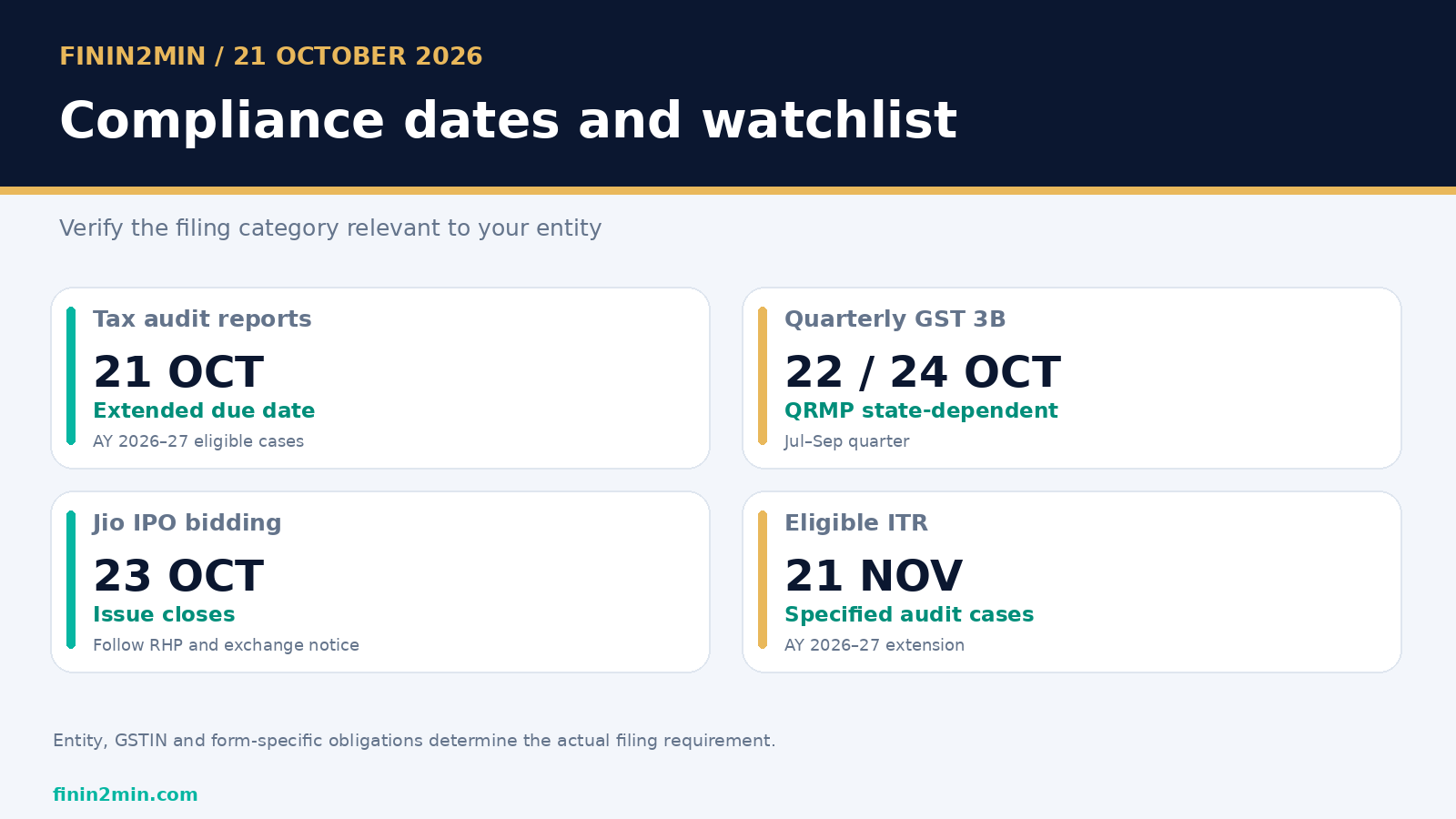
Jio Platforms’ public offer opened on 21 October and is scheduled to close on 23 October 2026. The red herring prospectus states the band at ₹1,065–₹1,119 per equity share; the issue comprises up to 27 crore fresh shares, implying a maximum issue size of about ₹30,213 crore at the top of the band.
By the end of the opening day, applications represented around 3.16 times the shares on offer, with institutional investors particularly active. Subscription is a measure of bidding interest, not proof of the final listing price or longer-term returns. Allocation varies by investor category and the final offer price.
Investors evaluating the company should separate its cash-generating telecom network from prospective AI, cloud and platform growth. Inspect cash flows, spectrum and network investments, subscriber economics, related-party transactions, use of proceeds and competitive risk. The prospectus and official exchange updates are the authoritative documents for application decisions.
CPI 5.54% and WPI 11.39%: why the gap matters
September consumer-price inflation was 5.54% year on year on the new CPI 2024-base series; food inflation was 7.74%. Rural inflation of 6.08% exceeded urban inflation of 4.88%. The release was provisional and reflected broad household cost pressures.
September wholesale-price inflation reached 11.39%, compared with 9.92% in August. The fuel-and-power major group rose 25.85% and manufactured products increased 9.76%. This provides a useful warning about upstream input-cost pressures that may not immediately appear in final consumer prices.
Businesses should compare cost inflation with actual pricing power and supplier contracts. For households, a lower inflation reading would still mean prices are rising—only more slowly—unless the price index itself falls.
Wall Street advances into the next Indian session
US equities finished Wednesday higher: the S&P 500 gained about 0.6% to 7,757.17, the Dow rose 0.7% to 52,856.09 and the Nasdaq Composite added roughly 1.1% to 26,702.86. Earnings and selective technology buying helped the market recover some confidence.
The US 10-year Treasury yield and the dollar remain essential cross-asset variables. A rise in yields can push borrowing costs higher and change valuation comparisons for growth companies; a firmer dollar can be an additional headwind for import-dependent economies.
The October Federal Reserve meeting and the upcoming US inflation-consumption releases could affect equity valuation, bond duration, gold and emerging-market flows. Overnight US gains do not guarantee a strong Indian opening because local earnings, oil and flows can dominate.
Interest margins, credit quality and financing costs stay central
The market is differentiating banks and NBFCs based on deposit mobilisation, cost of funds, loan growth and asset quality. A rising-rate cycle can initially boost returns on some floating-rate assets, but deposits and wholesale funding can also reprice upward, putting pressure on net interest margin.
Bajaj Finance declined more than 3% on 21 October as investors reassessed earnings and loan-book stress concerns. One quarter of headline profit growth should be read with provisions, segment mix, write-offs and underwriting practices.
For bank results, the useful sequence is net interest income, net interest margin, advances/deposits, CASA, slippages, credit costs, capital adequacy and management guidance. For NBFCs, add collections, secured/unsecured mix and access to bank and bond funding.
The 21 October audit deadline and its consequences
The Income Tax Department reiterated that eligible tax audit reports for assessment year 2026–27 were due by 21 October 2026 under the extension. The same period covered certain Form 10B/10BB filings and other prescribed audit forms, subject to eligibility and the relevant provision.
For a report that was due on 21 October, firms should confirm submission acknowledgments, digital signatures, client acceptance where applicable, supporting financial statements and report-versus-return reconciliation. Missing the audit report deadline may expose eligible assessees to late filing consequences or a penalty framework, depending on the facts and the applicable legal provision.
The corresponding extended income-tax return date for specified audit cases is 21 November 2026. The audit report and tax return are distinct compliance events; one extension must not be assumed to cover every assessee or form.
October returns, QRMP and practical reconciliation
Regular monthly GSTR-3B for September is ordinarily due on 20 October. Eligible quarterly filers under the QRMP system submit GSTR-3B for July–September by the state/UT grouping date, commonly 22 or 24 October, unless separately extended.
Before filing, reconcile books with GSTR-1, GSTR-2B, tax ledgers and credit/debit notes. Pay attention to blocked credits, reversals, supplier-side discrepancies, advances, reverse-charge transactions and late additions. A timely return that contains avoidable mismatches can create future notices and cash-flow costs.
Companies operating across states should check the registration-specific due date and portal status; there is no universal 22 October due date for every taxpayer. A filing calendar should contain separate rows for each GSTIN and taxpayer category.
Closing-auction and derivatives rule changes
SEBI issued a circular on 15 October reviewing elements of the Closing Auction Session, market timings and the settlement methodology for derivatives. The circular is relevant because the method that establishes a closing price can affect benchmarks, derivatives settlement values, index funds and intraday execution decisions.
Traders and operations teams should read the operative clauses and implementation timetable rather than extrapolate from an announcement headline. In particular, the auction price formation method, order window, cancellation/amendment rules and settlement reference can affect operational controls.
For investor education, closing prices generated by an auction should be understood as official price-discovery outcomes—not simply the last quote shown on the screen a few seconds before the market ends.
The compliance watch across boardrooms
The quarter-end reporting season is a reminder to assess listed-company disclosure controls, insider-trading restrictions, audit committee packs, related-party approvals and the accuracy of financial-results announcements under the applicable SEBI LODR framework.
Under company law, finance teams should distinguish board approval of financial statements, statutory filing requirements and event-based disclosures; each operates on a different trigger. For insolvency cases, the stage of an NCLT or NCLAT proceeding matters: a petition, an admission order and an approved resolution plan have very different consequences.
The week’s useful work is to update obligations by entity: private company versus listed entity, financial year-end, turnover category, pending notices, charge filings and lender covenant reporting. Avoid treating a proposal as already-effective law.
Financial operations beyond the stock market
Payroll, EPFO/ESI, employee-benefit provision, insurance renewals and RBI/FEMA reporting can affect operating cash flows even on days when there is no major new regulation. Employers should ensure employee deductions, deposits and reconciliation operate on their entity-specific calendar.
Cross-border businesses should match foreign-currency invoices with FEMA documentation, export realisation tracking, the bank’s documentation requirements and the applicable hedge policy. Delays may create reconciliation issues or additional costs independent of market movements.
Payments teams should monitor failed or pending UPI settlements, chargebacks, merchant reconciliation and settlement cut-offs. For all these desks, the operational objective is an audit-ready trail rather than a headline-driven change to process.
Why expensive oil complicates trade balances
India’s merchandise trade deficit for September was approximately US$30.21 billion. When imported crude prices are elevated, the dollar value of imports can rise even if physical volumes are unchanged. A strengthening rupee offers some offset, but a sustained oil shock can still affect the current account and corporate working capital.
The global transmission channels are interconnected: oil feeds inflation and logistics costs; global bond yields influence capital allocation; the dollar affects import bills and FPI returns; and Chinese industrial demand influences metals and mining earnings.
The India–New Zealand Free Trade Agreement entered into force on 20 October 2026, creating a relevant framework for exporters and importers. Preferential treatment depends on the applicable tariff schedule, product classification and rules-of-origin documentation; it should not be assumed for every item.
For businesses, the relevant dashboard is order books, imported-input share, export receivables, shipping transit times, inventories and FX hedges. A domestic equity bounce cannot by itself establish that these pressures are easing.
What to monitor on Thursday, 22 October
First, compare GIFT Nifty futures with their own preceding futures reference and observe whether the signal persists near the NSE pre-open. Second, track whether oil remains around $109 Brent and whether the rupee retains its IPO-supported strength.
Third, watch whether IT leadership broadens to banks, autos and industrials, or whether small- and mid-cap weakness persists. Fourth, monitor Jio Platforms IPO subscription and remaining application timetable. Finally, follow US rates and earnings, RBI liquidity, and pending income-tax/GST acknowledgments.
These are decision inputs, not directional promises. Markets can reverse quickly when overnight developments, exchange positioning and earnings interact.
Reference sources
- NSE India — Cash-market prices and institutional trade methodology (21 October 2026)
- Reuters — Indian equities, sectors and Jio IPO (21 October 2026)
- Reuters — Brent and WTI final settlements; oil inventory context (21 October 2026)
- Reuters — Precious metals and Federal Reserve outlook (21 October 2026)
- Investing.com — GIFT Nifty October futures quoted at 01:35 IST (22 October 2026)
- Reuters — Indian rupee movement and IPO inflows (21 October 2026)
- RBI / Reuters — Monetary Policy Committee October 2026 minutes (21 October 2026)
- RBI / Reuters — Treasury bill auction rejected bids (21 October 2026)
- SEBI — Jio Platforms October 2026 red herring prospectus (15 October 2026)
- Reuters — Jio Platforms IPO bidding and subscription figures (21 October 2026)
- Income Tax Department — Tax audit report deadline 21 October 2026 (16 October 2026)
- PIB / MoSPI — September 2026 CPI inflation release (12 October 2026)
- PIB / DPIIT — September 2026 WPI inflation release (14 October 2026)
- SEBI — Review of Closing Auction Session and derivatives settlement (15 October 2026)
- AP — US equity indices 21 October 2026 closing (21 October 2026)
- Reuters — Oil and rupee transmission risks (19 October 2026)
- CBIC — QRMP framework and eligibility (2020 standing guidance)
- US Federal Reserve — FOMC calendar and decisions (2026 calendar)
- SEBI — Capital market regulatory circulars (October 2026)
- NSE IX — GIFT Nifty exchange and trading sessions (21 October 2026)
- PIB / Ministry of Commerce — September 2026 imports exports and trade balance (15 October 2026)
- Ministry of Commerce — India–New Zealand FTA in force from 20 October 2026 (20 October 2026 effective)
Disclaimer: This publication provides educational financial, legal, tax and economic information. It is not a recommendation to buy or sell any security or commodity and does not replace advice based on an individual’s facts. Prices represent the instruments and as-of timestamps stated. Regulatory applicability depends on current official provisions and the entity’s circumstances.