
FININ2MIN DAILY FINANCE INTELLIGENCE | 20 OCTOBER 2026
20 October 2026: India’s Market Holiday, Global Oil Reversal and the 21 October Setup
India cash-market holiday · Overseas markets through 20 October · Market data and regulatory developments as at 21 October 2026, 02:15 AM IST
Today’s essential takeaway: India’s share markets were closed for Dussehra. Global oil prices retreated from their highs, gold eased, silver advanced and GIFT Nifty futures supplied a separate offshore reference for Wednesday’s reopening. Tax filings and the Jio Platforms IPO bring immediate practical decisions for Indian readers.
01. The 2-minute finance briefing
Indian equities did not trade on Tuesday, 20 October, because of the scheduled Dussehra exchange holiday. Nifty 50 at 22,888.95 and Sensex at 73,852.90 are the last Indian cash-market closes, from Monday, 19 October. Any movement in overseas futures during the holiday is not an Indian cash close.
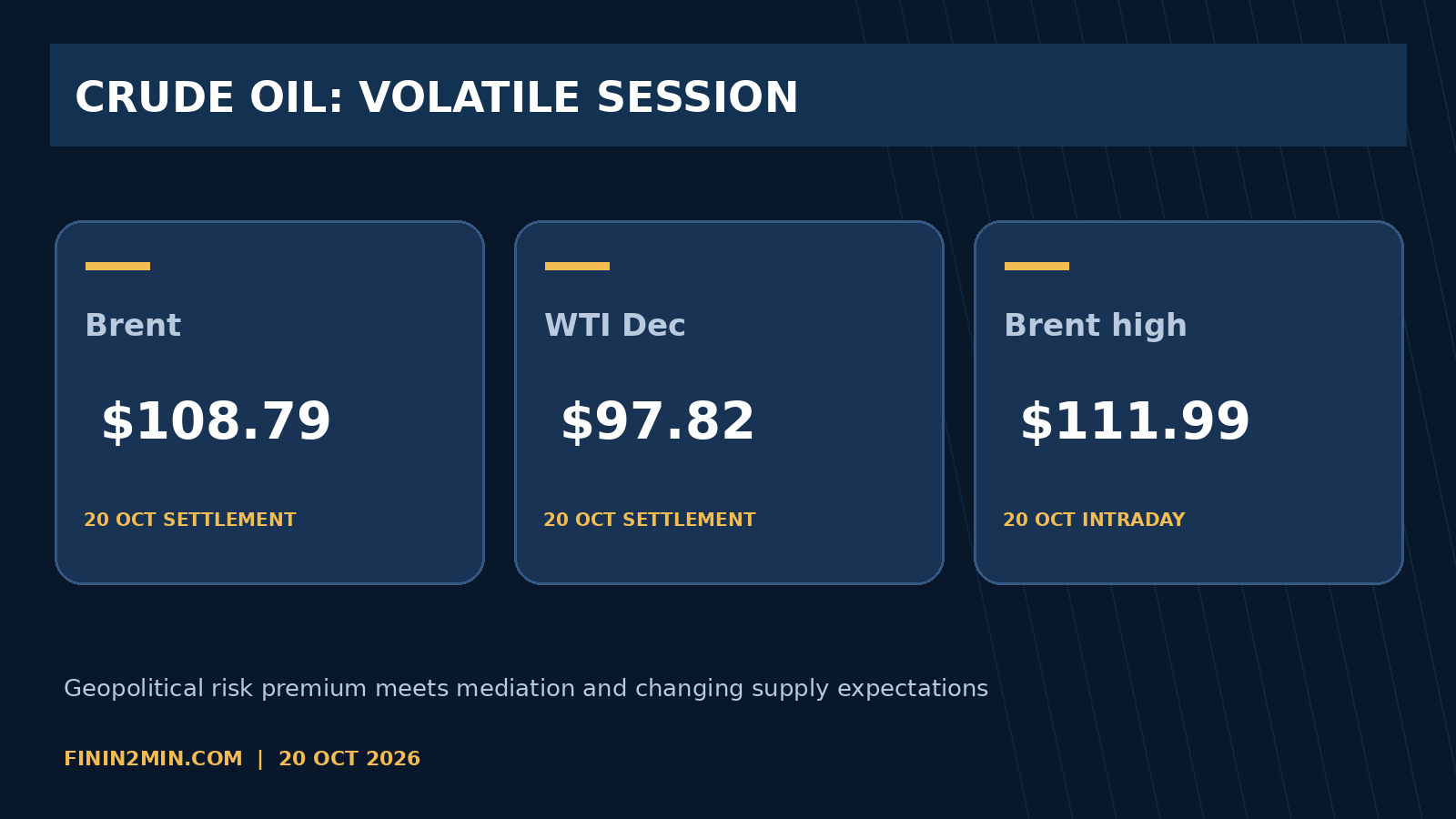
Oil was volatile: Brent climbed to $111.99 during Tuesday’s session but finished at $108.79 per barrel. The December WTI contract ended at $97.82. Spot gold was $4,125.90 per troy ounce at 18:05 GMT and spot silver $57.86 at the same Reuters precious-metals report. The GIFT Nifty October futures completed-session reference was 23,070.00.
Outside markets, the most immediate decisions are tax-audit report filings due on 21 October for relevant taxpayers, the 21–23 October Jio Platforms IPO window, applicable quarterly GST returns and the return of Indian equity trading on Wednesday. Headlines on geopolitical talks did not remove the shipping and fuel-risk premium.
Further reading: NSE India · Reuters · Reuters · Investing.com · Income Tax Department · Reuters
02. India’s market holiday and the reopening
The NSE holiday calendar lists Tuesday, 20 October as Dussehra. Equity, equity derivatives and currency segments were closed, so there was no Nifty or Sensex closing auction and no fresh domestic benchmark return for that date. Investors should distinguish the 19 October close from overseas futures activity on 20 October.
The latest prior cash reading showed Nifty at 22,888.95 (down 257.20 points or 1.11%) and Sensex at 73,852.90 (down 876.37 points or 1.17%) on 19 October. That decline followed a strong previous week and reflected selling in heavyweight shares, particularly private financials.
For 21 October, the relevant opening questions are whether banking shares stabilise, whether the oil pullback lasts, and whether institutional selling is absorbed. Price gaps can form overnight, but pre-opening indicators are not execution prices. Orders should be sized for reopening volatility.

03. GIFT Nifty: the offshore indicator
The completed 20 October GIFT Nifty October-futures reference is 23,070.00, a 0.78% increase on the historical session series, with the day ranging from 22,835.00 to 23,132.50. GIFT Nifty is a US-dollar-settled offshore Nifty-linked futures contract traded through NSE IX.
Its movement is useful because overseas news can be reflected in the contract when the Indian cash exchange is shut. But futures prices incorporate expected dividends, time to expiry, financing and international order flow. A 23,070 futures reading does not guarantee the Nifty cash index will open at 23,070.
On reopening, compare the pre-open indicative cash price with the futures contract, then observe early liquidity and breadth. Distinguish a change in the offshore futures quote from a genuine advance in the Indian benchmark.
Further reading: Investing.com · NSE India
04. Crude oil: dramatic rise, reversal by settlement
Brent crude briefly touched $111.99, its highest in five months, before closing 76 cents lower at $108.79 a barrel. The expiring November WTI contract closed at $101.79, down $1.87. The more active December WTI contract settled at $97.82, down 72 cents. Comparing November WTI with December WTI without stating expiry would create a false one-day move.
The reversals followed reports of the Iranian president discussing mediation with Pakistan’s army chief. At the same time, tanker-security concerns and reported attacks on energy-related targets maintained a significant risk premium. Discussions do not mean that crude shipments, tanker insurance or Gulf refinery capacity have normalised.
Why India cares: higher landed oil costs feed refinery procurement, aviation fuel, logistics, freight and the import bill, while a stronger dollar makes dollar invoices more expensive. A useful budget stress test considers Brent at $100, $110 and $120 together with possible rupee moves, rather than extrapolating one afternoon’s peak.
05. Gold and silver: opposite daily directions
Spot gold traded at $4,125.90 per troy ounce at 18:05 GMT on 20 October, down 0.3% on the quoted session. December COMEX gold futures settled at $4,142.60, down 0.4%. These are different instruments; their absolute prices must not be merged into a single time series.
Spot silver rose 1.4% to $57.86 per troy ounce in the same report. Silver responds not only to safe-haven positioning but also to industrial expectations in electrical equipment, electronics and solar production. A silver rebound alongside a weaker gold price is possible when industrial-demand expectations and positioning differ.
The US Federal Reserve’s 27–28 October meeting and upcoming inflation measures are key inputs for gold. Rising Treasury yields increase the opportunity cost of holding a metal that pays no coupon. Indian buyers should additionally factor USD/INR, local duties, GST and retail premiums; a global dollar quote cannot be treated as an Indian jewellery price.

Further reading: Reuters · US Bureau of Labor Statistics
06. Rupee and bonds: how FX meets inflation
The last regular onshore interbank rupee close before the holiday was approximately ₹94.925 per dollar on 19 October. Overseas and holiday-session indicative FX quotes are not replacements for that domestic interbank closing benchmark.
The rupee’s recovery in the preceding week followed currency-market measures and changes to hedging incentives. But a high oil bill, large goods deficit and prospective foreign portfolio outflows remain underlying demand sources for dollars. For importers, the exchange rate on actual payment dates matters more than a headline closing quote.
Treasury teams can match anticipated dollar receipts and payments by month, compare forward rates with risk appetite, and avoid a one-way assumption about RBI intervention. Long-duration bond valuations also respond to changing inflation and rate expectations.
07. Wall Street: healthcare gains, mega-cap technology lags
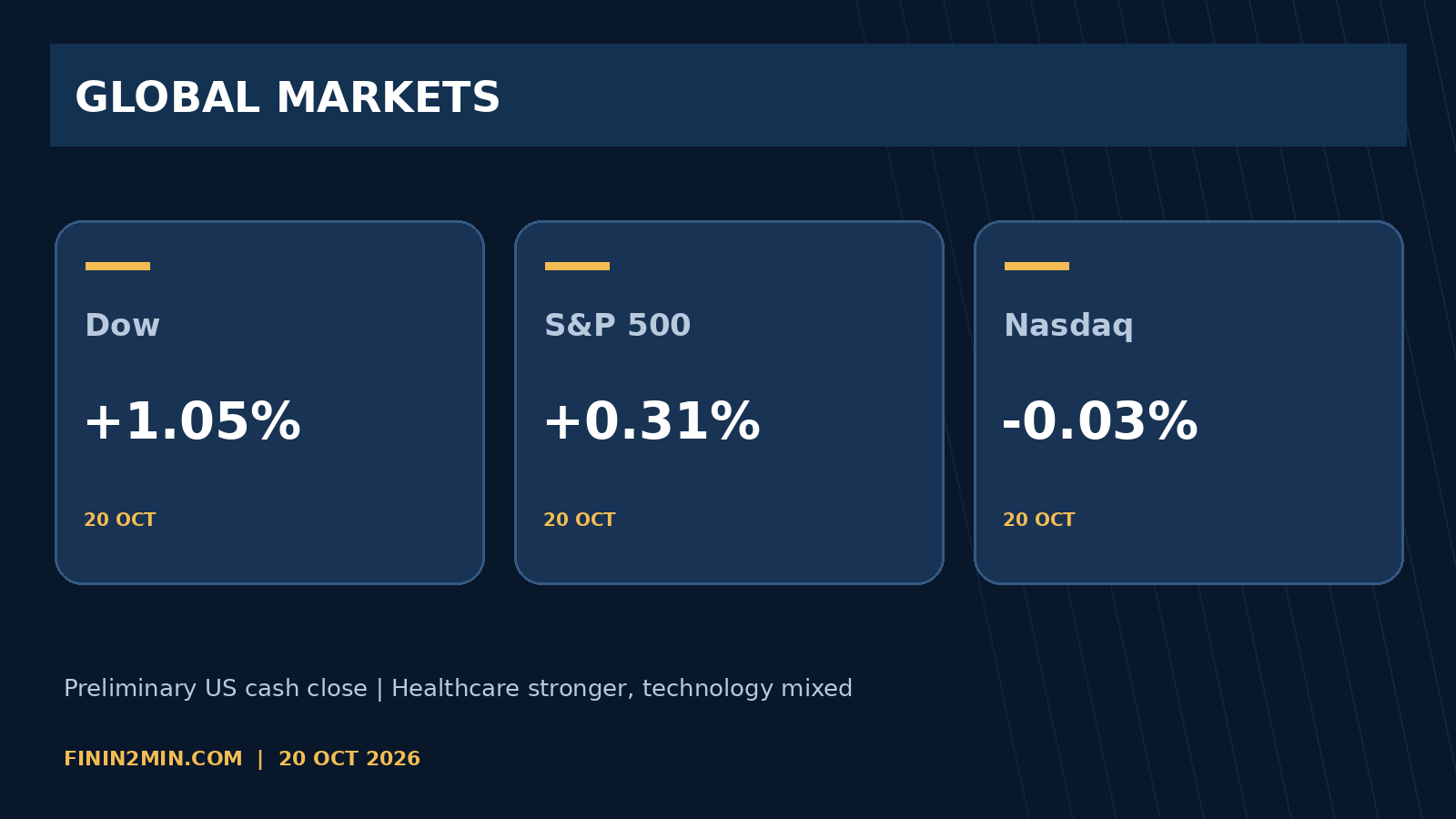
US equities on Tuesday diverged by sector. Reuters preliminary closing figures put the Dow up about 1.05% and the S&P 500 up 0.31%, while the Nasdaq slipped 0.03%. Healthcare, real estate, utilities and smaller companies were among the relatively stronger areas; communications services and energy underperformed.
The market is reassessing whether large investment in AI infrastructure can turn into cash earnings within a reasonable period. At the same time, pharmaceutical and healthcare earnings offered a different source of support. This is sector rotation, not evidence that every US stock advanced.
For India, the connection is through IT-services demand, discount rates and foreign-fund allocation. Indian technology companies with large US clients may face short-term sentiment volatility even if order books are stable; businesses should track customer spending rather than infer contracts from the Nasdaq alone.
Further reading: Reuters
08. India’s inflation: households and factories feel different pressure
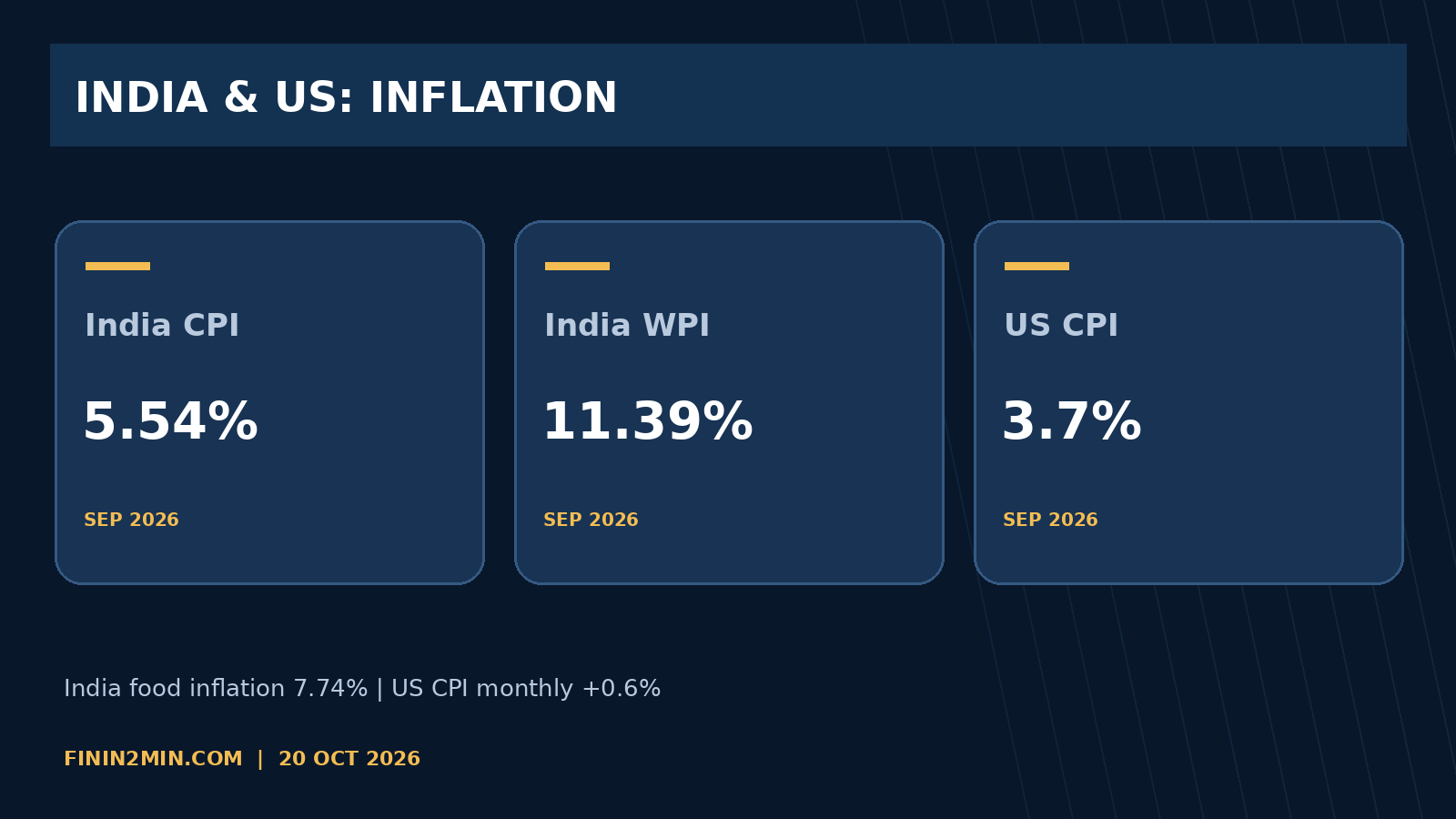
India’s September consumer-price inflation was provisionally 5.54%, versus 4.83% in August. Food inflation was 7.74%, while rural headline inflation of 6.08% exceeded the urban rate of 4.88%. These figures capture the cost of a household basket rather than a company’s purchasing invoices.
Wholesale price inflation was 11.39% for September. Elevated energy and input costs can enter the producer pipeline before firms pass costs to final consumers. A persistent CPI–WPI gap can therefore squeeze margins for transporters, manufacturers, hotels and retailers.
Businesses can review supplier escalation clauses and price-adjustment thresholds. Households should distinguish essential inflation from headline bullion movements. The next CPI and fuel-price readings will help assess whether wholesale costs are passing through to household prices.
Further reading: PIB / MoSPI · Reuters
09. Trade deficit: stronger exports, still a large gap
India recorded September merchandise exports of $44.40 billion and imports of $74.61 billion, leaving a goods deficit of $30.21 billion. The deficit widened compared with $26.86 billion in August, despite better export performance.
Oil, industrial inputs and other essential imports raise dollar demand. Import-dependent companies therefore face both commodity-price and exchange-rate risk. An export growth headline cannot alone establish that external financing pressure has disappeared.
For CFOs, the relevant ratio is net foreign-currency exposure after export receipts and hedges. Separate goods trade from services receipts, and distinguish the monthly merchandise gap from the broader current-account balance.
Further reading: Reuters
10. Jio Platforms IPO: a landmark primary-market test
The Jio Platforms IPO is scheduled to accept public bids from 21–23 October 2026. Its stated price range is ₹1,065–₹1,119 per equity share and the offering proposes up to 270 million fresh shares. At the top of the range, the proceeds would be approximately ₹30,213 crore before issue expenses.
The offering is more than a telecom subscriber story: the business spans mobile access, fixed broadband, cloud and digital infrastructure. Investors should read the red-herring prospectus for subscriber economics, average revenue per user, competition, capex, related-party transactions and material regulatory risks.
Application through a regulated ASBA/UPI mechanism, a correct PAN and demat account, and an understanding of allotment versus listing are practical basics. Unofficial grey-market quotations are not offer prices, guaranteed returns or substitutes for the prospectus.
11. SEBI and corporate regulation: change the process, not the label
SEBI issued a circular dated 15 October 2026 addressing aspects of the closing auction session, market timings and settlement methodology for derivatives. The practical implications depend on the instrument, commencement date and exchange implementation circulars; traders and brokers should check those texts before modifying automated systems.
SEBI also placed consultations on SME IPO standards and the disclosure of utilisation of issue proceeds in the public domain during October. Consultation papers invite market responses; they are not the same as binding regulation. Compliance manuals must distinguish an active rule, an amendment and a proposal.
For listed issuers, portfolio managers and market intermediaries, build a change register mapping each circular or regulation to effective dates, impacted systems, client communication and accountable owners. SEBI’s Portfolio Managers Regulations, 2026 were published with an effective date of 1 April 2027.
12. Income tax: audit reports reach a deadline
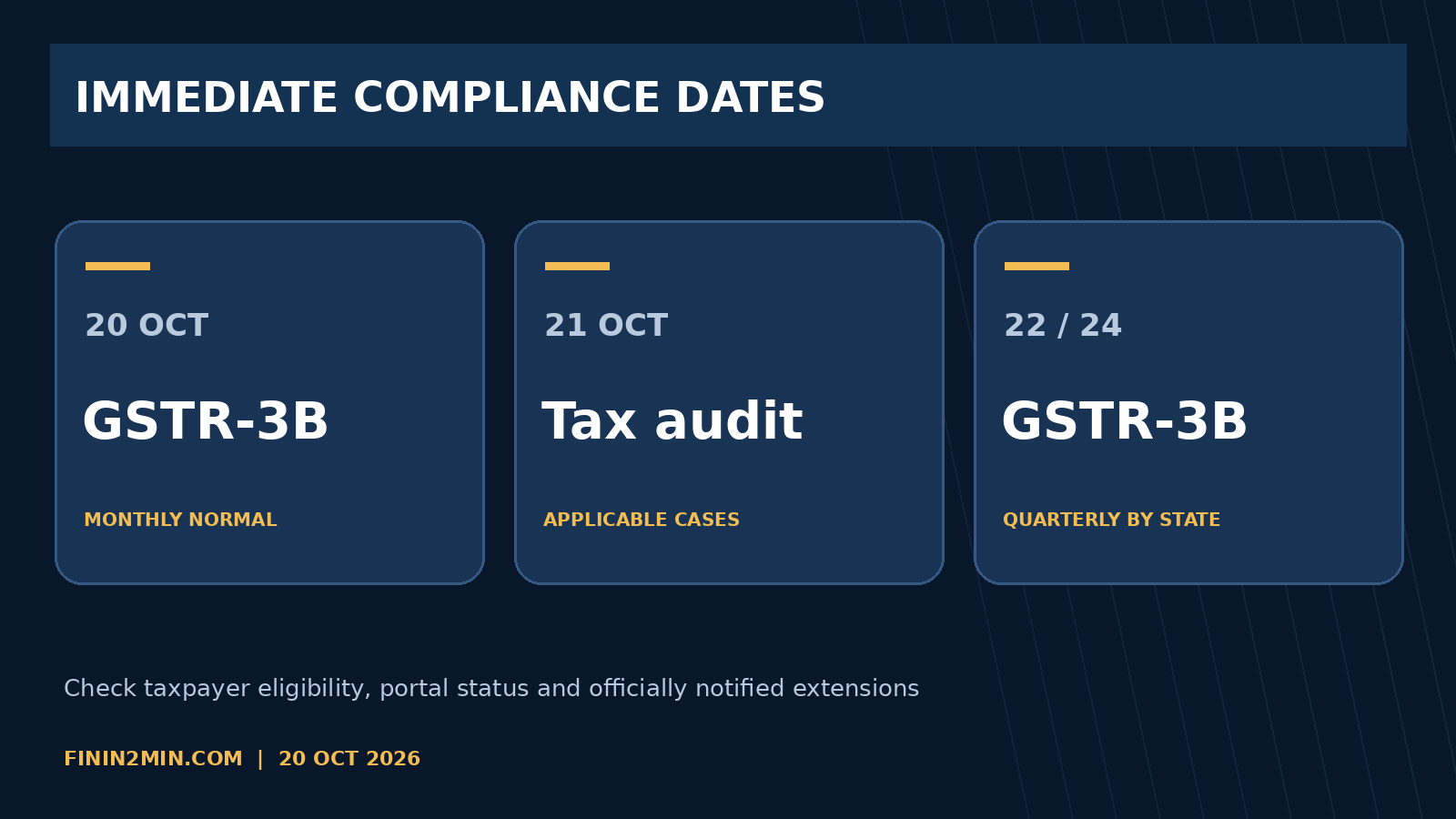
The Income Tax Department’s 16 October portal reminders specify 21 October 2026 for the tax audit report of relevant AY 2026–27 cases. They also mention audit reports in Forms 10B and 10BB for eligible organisations. Applicability differs by taxpayer type and statutory provision.
Where section 44AB applies, the report typically uses Forms 3CA–3CD or 3CB–3CD as appropriate. Preparers should reconcile turnover, tax audit clauses, GST turnover, TDS information and income-tax computation before submission. Portal acknowledgement and auditor acceptance are distinct practical checkpoints.
Keep supporting reconciliations, validate the tax audit report status after upload, and confirm the taxpayer category before using an extended deadline. This is not a blanket extension for every income-tax form or every person.
Further reading: Income Tax Department · Income Tax Department
13. GST: monthly and quarterly obligations
The GST portal states that regular monthly GSTR-3B filers normally have a due date on the 20th of the following month. For quarterly GSTR-3B filers, state/UT grouping generally determines whether the due date is the 22nd or 24th of the month following the quarter.
For September 2026 monthly filers, the ordinary date was 20 October. A holiday in another market does not by itself extend a GST deadline. Taxpayers should inspect the portal’s date applicable to their GSTIN and any relevant extension order.
Before filing, reconcile GSTR-1 outward supply, GSTR-2B input-tax credit, reverse-charge liability, electronic ledgers and credit notes. Missed or inaccurate tax payments can attract interest and late fees under applicable rules. Quarterly filers should review the October deadlines separately.
Further reading: GST Portal
14. Banking and financial inclusion: nationwide camps begin
The Department of Financial Services announced a nationwide financial-inclusion campaign running from 21 October to 31 December 2026 across about 2.70 lakh gram panchayats and urban local bodies. Banks will conduct enrolment, KYC and fraud-awareness activities.
The programme covers PMJDY accounts, enrolment under PMJJBY and PMSBY insurance schemes, Atal Pension Yojana, re-KYC and digital-fraud education. For customers, it offers an opportunity to update dormant or incomplete banking relationships through authorised channels.
Branches and business correspondents should prioritise clear consent, accurate nominee details, customer eligibility and fraud-resistant verification. Customers should never disclose PIN, OTP or login passwords to an agent claiming that KYC must be completed immediately.
Further reading: PIB / Ministry of Finance
15. RBI, lending and corporate treasury
Markets continue to weigh the RBI’s currency-market actions against imported inflation and local funding conditions. Changes in the cost or availability of hedges can affect importer behaviour, short-term money markets and the timing of dollar purchases.
Borrowers should distinguish policy-rate changes from the date their loan rate actually resets. Fixed-rate, MCLR-linked and external-benchmark products respond differently; the loan agreement determines when EMI or tenor changes.
CFO teams can review interest-rate repricing buckets, cash buffers, trade-finance utilisation and FX hedge coverage together. A high headline Brent quotation is not enough to calculate a specific company’s cash-flow hit without throughput, inventory and currency data.
Further reading: Reuters
16. US inflation, yields and central banks
US September consumer inflation was 3.7% year on year and the monthly increase was 0.6%, according to the Bureau of Labor Statistics. Gasoline costs rose sharply during the month. This matters for global markets because inflation can affect the expected path of Federal Reserve interest rates.
On 20 October gold trading reflected tension between geopolitical safety demand and bond yields. The next Federal Reserve decision is scheduled for 27–28 October, and investors are watching economic releases for signs that energy prices are spilling into underlying inflation.
The consequences for India include the direction of the dollar, foreign-fund flows, imported energy costs and valuations of long-duration stocks. The interaction is conditional: oil and yields may fall together in one session but move apart the next.
Further reading: US Bureau of Labor Statistics · Reuters
17. Global energy diplomacy and Indian refiners
Global energy diplomacy remains part of India’s trade and manufacturing story. Discussions around Russian sanctions, Venezuelan barrels and Gulf shipping routes can change which crudes are available to Indian refiners and at what discount or freight cost.
Refinery compatibility is technical: heavy and sour crudes require suitable units, blending and logistics. Switching supply is not a simple matter of buying the lowest quoted global benchmark. Payment terms, sanctions compliance, port access and insurance conditions all affect landed cost.
For importers and exporters, track confirmed policy changes separately from diplomatic statements. Contract review and sanctions screening should use the actual legal text and counterparties, not assumed outcomes of trade negotiations.
18. What investors should watch on 21 October
The reopening agenda begins with the Nifty/Sensex pre-open and sector breadth, especially banks and IT, then tracks Brent’s next futures move, the latest GIFT Nifty contract, INR spot trading and the direction of US yields. The first few minutes of trading often contain significant price discovery after a full-market holiday.
For IPO participants, 21 October marks the scheduled Jio Platforms public subscription opening. Applications should follow the official issue documents and designated intermediary channels. For auditors, the same date is a critical filing checkpoint for the applicable AY 2026–27 report deadline.
No single indicator should drive a decision. A strong GIFT Nifty quote combined with weak domestic breadth, high crude, or strong selling by institutions can produce a complex session. Focus on confirmed market information and personal risk capacity rather than a predicted opening point.
Further reading: NSE India · Investing.com · Income Tax Department · Reuters
19. Compliance calendar: 20–28 October
20 October — NSE and BSE equity markets closed for Dussehra; ordinary September monthly GSTR-3B due date for applicable monthly filers. Check each GSTIN for applicable relief before assuming an extension.
21 October — Indian cash-market trading resumes; specified AY 2026–27 tax audit and Forms 10B/10BB filing reminders reach their stated deadline; Jio Platforms IPO bidding scheduled to open; the national financial-inclusion campaign begins.
22/24 October — quarterly GSTR-3B due dates depend on the applicable state/UT category. 23 October — scheduled final subscription day for the Jio Platforms public issue. 27–28 October — Federal Reserve monetary-policy meeting. Dates can differ by obligation and should be confirmed in the relevant official filing environment.
Further reading: NSE India · Income Tax Department · Income Tax Department · GST Portal · Reuters · PIB / Ministry of Finance · Reuters
Primary data and references
- NSE India — 2026 trading holiday schedule
- NSE India — F&O trading holidays 2026
- Reuters — Brent and WTI settlement, 20 October
- Reuters — Gold and silver, 20 October
- Investing.com — GIFT Nifty October futures historical data
- Reuters — US markets on 20 October
- Reuters — Nifty and Sensex preceding cash close
- PIB / MoSPI — September CPI 2026
- US Bureau of Labor Statistics — US September CPI 2026
- Reuters — India September merchandise trade
- Income Tax Department — e-filing portal updates
- Income Tax Department — Tax audit and Form 10B / 10BB reminders
- GST Portal — GSTR-3B official guide
- SEBI — Capital market circular register
- Reuters — Jio Platforms IPO prospectus and schedule
- PIB / Ministry of Finance — Financial inclusion campaign press release
- SEBI — Portfolio Managers Regulations 2026
- Reuters — US–India energy and trade talks
- Reuters — India rupee and RBI FX signals
- Reuters — Wholesale inflation September 2026
- NSE India — Exchange disclosures and IPO announcements
- SEBI — SME IPO consultation 14 October
- PIB — Ministry of Finance release list
Disclaimer: General finance, tax and legal information only; not investment advice. Prices refer to the instruments and market timestamps stated. Verify applicable filings and obligations through the official regulator or portal. Market prices can change rapidly.