RBI hikes to 5.50%: equities fall, rupee nears record low, crude cools while gold and silver slide
India’s first rate increase in nearly four years has changed the domestic discount-rate regime. The next decision window is a tug-of-war between tighter RBI policy, a weak rupee, still-high global yields and modest relief in crude.
Information cut: 8 October 2026, 00:43 IST
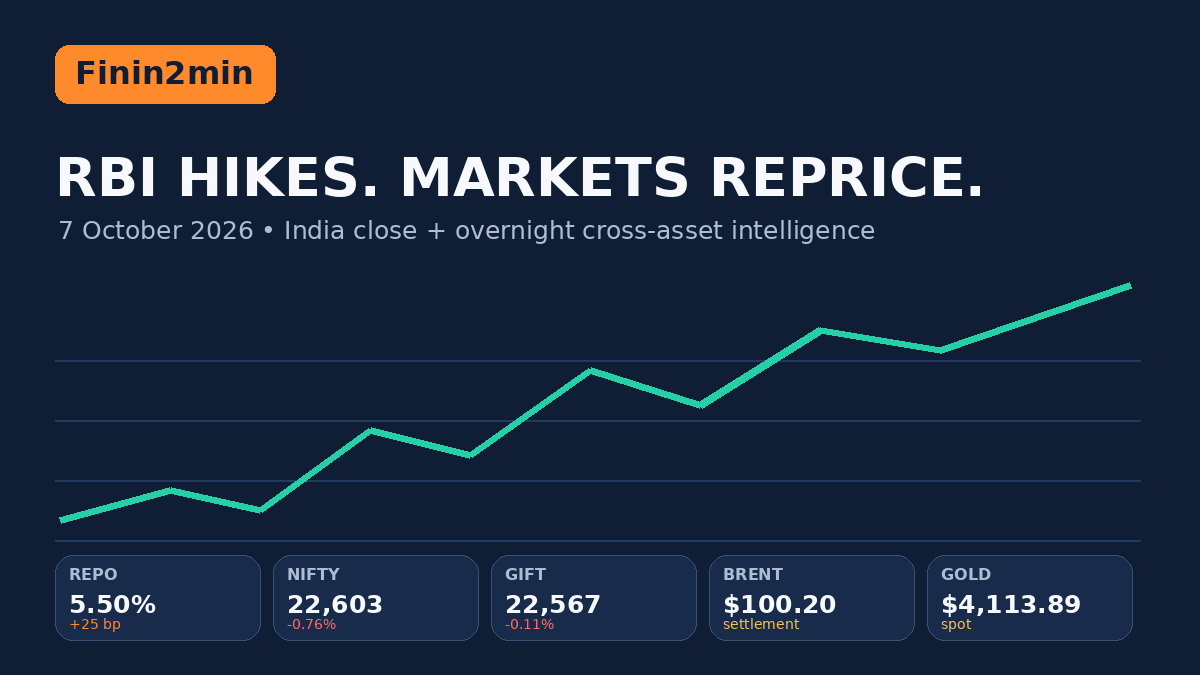
2-Minute Summary
- The RBI raised the repo rate by 25 basis points to 5.50%—its first increase since February 2023—and shifted the policy stance from neutral to calibrated tightening. The six-member MPC voted unanimously.
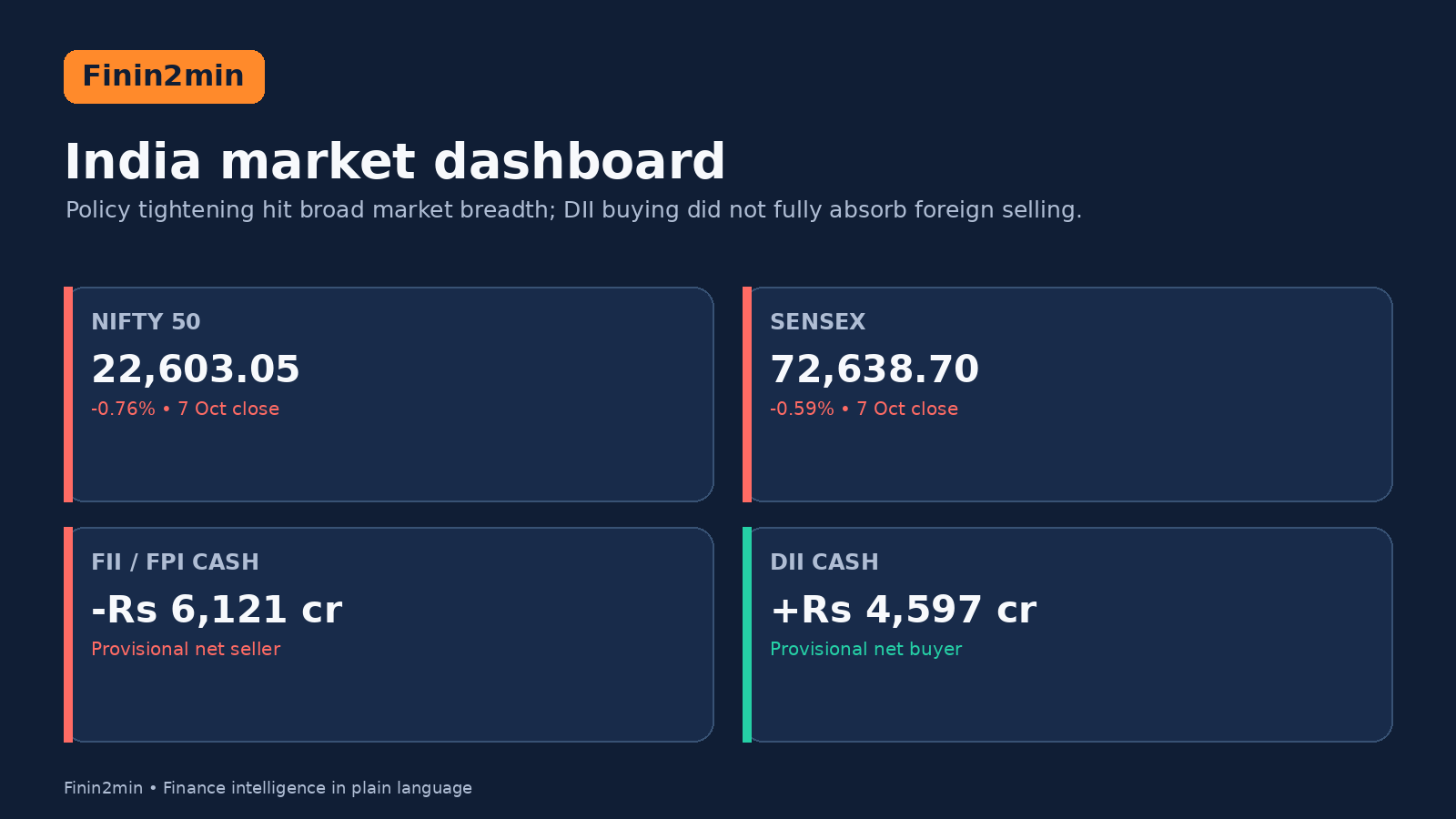
- Indian equities reversed the preceding two-session rebound: Nifty 50 closed at 22,603.05 (-0.76%) and Sensex at 72,638.70 (-0.59%). Fourteen of 16 major sectors fell; metals, realty, autos and FMCG were among the laggards.
- Foreign cash selling intensified: provisional combined cash-market data show FII/FPI net selling of about Rs 6,121 crore versus DII buying of about Rs 4,597 crore, leaving a net institutional deficit near Rs 1,525 crore.
- The rupee ended at 96.7750/$ after touching 96.8450, close to its record low. The RBI hike did not produce a sustained currency rebound because oil, global yields and weak portfolio flows remained adverse.
- At 00:35:56 IST on 8 October, the Oct-26 GIFT Nifty screen showed 22,567.00, down 25 points (-0.11%) from the futures previous close. It was about 36 points below the Nifty cash close—a numerical basis, not a guaranteed opening gap.
- Crude settled lower after the IEA moved to accelerate emergency-stock releases: Brent ended at US$100.20/bbl (-0.38%) and WTI at US$88.28 (-1.30%). Geopolitical and Gulf-storm risks still keep the downside asymmetric.
- Bullion sold off as the dollar and long US yields strengthened: spot gold fell 1.2% to US$4,113.89/oz and spot silver 3.0% to US$59.86/oz. December US gold futures settled at US$4,140.70.
- Regulatory watch is unusually dense: the 57th GST Council meeting is scheduled for 8 October at 11:00 AM after being moved from 7 October, while SEBI issued three debt-market circulars on credit-risk disclosure, merchant-banker exemptions and ISIN rules.
Market Dashboard
| Indicator | Level | Move | Timestamp / status |
|---|---|---|---|
| Nifty 50 | 22,603.05 | -0.76% | 7 Oct India close |
| Sensex | 72,638.70 | -0.59% | 7 Oct India close |
| FII/FPI cash | -Rs 6,121.37 cr | Net seller | 7 Oct provisional combined cash |
| DII cash | +Rs 4,596.57 cr | Net buyer | 7 Oct provisional combined cash |
| USD/INR | 96.7750 | Rupee -0.4% | 7 Oct close; intraday low 96.8450 |
| RBI repo rate | 5.50% | +25 bp | 7 Oct MPC; unanimous |
| GIFT Nifty Oct-26 | 22,567.00 | -25.00 (-0.11%) | 00:35:56 IST, live screen |
| Brent | US$100.20/bbl | -0.38% | 7 Oct settlement |
| WTI | US$88.28/bbl | -1.30% | 7 Oct settlement |
| Spot gold | US$4,113.89/oz | -1.2% | 7 Oct 18:12 GMT |
| Spot silver | US$59.86/oz | -3.0% | 7 Oct Reuters US-close hours |
| US 10Y | 5.316% | +4.4 bp | late-morning US; peak 5.364% |
| US 30Y | 5.696% | +5.5 bp | late-morning US; 24-year high |
| S&P 500 | 7,798.84 | -0.26% | mid-afternoon US |
| Nasdaq | 27,489.08 | -0.40% | mid-afternoon US |
| Dow | 51,196.54 | -0.63% | mid-afternoon US |
India equities: RBI repricing ends the two-day rebound
The Nifty 50 closed at 22,603.05, down 0.76%, while the Sensex ended at 72,638.70, down 0.59%. Fourteen of the 16 major sector indices declined; small-caps still added 0.3% while mid-caps fell 0.6%.
The market reaction was not simply 'rate hike = stocks down'. The important shift was the combination of a 25-bp increase and a move from a neutral stance to calibrated tightening. That tells investors the hurdle rate for equity valuations may stay higher for longer if oil and inflation remain elevated.
Rate-sensitive pockets were mixed rather than uniformly weak. PSU banks held up better, while autos, real estate, FMCG and metals faced pressure. Titan dropped after analysts flagged softer-than-expected jewellery growth, reinforcing that stock-specific earnings quality still matters inside the macro trade.
For the next session, the quality test is whether selling broadens further or whether lower crude offsets the policy shock. A durable equity recovery still needs some combination of stabilising foreign flows, a steadier rupee and relief in long global yields.
Institutional flows: DII absorption no longer fully offsets foreign selling
Provisional combined cash-market activity for 7 October points to FII/FPI net selling of about Rs 6,121.37 crore and DII net buying of about Rs 4,596.57 crore. That leaves a net institutional shortfall of roughly Rs 1,524.80 crore for the session.
The distinction matters. DIIs remain an important shock absorber, but the session did not have the positive combined institutional balance seen on 6 October. Persistent foreign selling is consistent with the global emerging-market backdrop: the Institute of International Finance estimated US$26.3 billion of non-resident outflows from emerging-market stocks and bonds in September.
For Indian investors, the cleaner reversal signal is not a single DII-heavy session; it is a run of sessions in which FII selling fades or turns positive while domestic flows remain supportive.
RBI policy: 5.50% repo, calibrated tightening, higher inflation and growth forecasts
The RBI raised the policy repo rate by 25 basis points to 5.50%, the first increase since February 2023. The six-member MPC voted unanimously and changed the stance from neutral to calibrated tightening. The change in stance is important because it leaves the door open for further moves if inflation data deteriorate.
The RBI lifted its FY inflation forecast to 5.2% from 5.0% and projected headline CPI to average nearly 5.8% over the next three quarters. At the same time, it raised its GDP-growth forecast to 7.1% from 6.7%, signalling that current growth is strong enough to tolerate some additional inflation control.
No CRR increase was announced. The central bank indicated it would continue to use liquidity tools, including bond operations and FX swaps, with reserve-ratio action a less-preferred lever. This is critical for banks: the repo headline changes the policy rate, while liquidity management determines how quickly money-market and deposit rates transmit.
Implications by sector: banks and NBFCs face deposit/borrowing repricing and ALM pressure; housing and autos face higher floating-rate sensitivity; high-duration growth equities face a higher discount rate; insurers and banks can benefit from higher reinvestment yields, but only if credit quality and funding costs remain controlled.

Rupee and reserves: policy tightening has not removed the FX risk premium
The rupee weakened 0.4% to 96.7750/$ after touching 96.8450, near the record low of 96.96. A policy hike normally supports a currency at the margin, but the move was already largely expected and was overwhelmed by high oil prices, strong US yields and sparse portfolio inflows.
India's foreign-exchange reserves were reported at about US$734.6 billion, down roughly US$50 billion from the early-September peak. The decline is consistent with active FX management, including spot-market dollar sales and swap operations. The reserve buffer remains large, but the pace of intervention is itself a signal of how persistent external pressure has become.
For corporates, a weak rupee plus near-US$100 Brent is a joint stress factor: importers should review hedge ratios, exporters should avoid treating currency gains as permanent margin, and leveraged firms should stress-test foreign-currency debt service under higher global rates.

GIFT Nifty: live Oct-26 cue is mildly negative, not a gap forecast
At 00:35:56 IST on 8 October, the live Oct-26 GIFT Nifty screen showed 22,567.00, down 25.00 points (-0.11%) from its own previous close of 22,592. The screen range was 22,563.50-22,574.50 at the captured time.
Against the Nifty cash close of 22,603.05, the numerical futures basis was about -36.05 points. That comparison is context only: futures and cash operate on different clocks, and overnight oil, US yields, Asia, currency moves and policy headlines can change the signal before the domestic open.
The practical sequence is to read the first fresh GIFT quote together with Brent/WTI, USD/INR offshore levels, US Treasury yields and the 8 October GST Council policy flow. No single overnight print should be treated as a guaranteed opening direction.

Crude oil: emergency stocks pull prices lower, but the supply tail risk remains
Brent settled 38 cents lower at US$100.20/bbl and WTI fell US$1.16 to US$88.28/bbl. The key late-session driver was the International Energy Agency's decision to accelerate previously announced emergency-stock releases and prioritise diesel, potentially bringing around 100 million barrels to market faster.
The bearish supply-relief signal is meaningful for India, but it is not a clean return to normality. US crude inventories unexpectedly fell 3.2 million barrels, Middle East security risks remain elevated, and a Gulf of Mexico storm threatens production and refining capacity. Those factors can quickly reverse a reserve-release-driven decline.
India transmission: a sustained Brent move below US$100 would help the current-account, inflation and rupee narrative; a renewed spike would do the opposite. Airlines, paints, chemicals, logistics and fuel-sensitive consumer sectors remain the fastest equity channels for the oil move.

Gold and silver: high yields overpower safe-haven demand
Spot gold fell 1.2% to US$4,113.89/oz by 18:12 GMT, its lowest level since early August, while December US gold futures settled 1.1% lower at US$4,140.70. Spot silver fell 3.0% to US$59.86/oz.
The main pressure came from a firmer dollar and exceptionally high long-term US yields. Gold does not pay a coupon, so a rising real/nominal yield structure raises the opportunity cost of holding it even when geopolitical demand is strong. Silver is more volatile because it carries both monetary/safe-haven and industrial-demand sensitivity.
For Indian buyers, domestic bullion can diverge from dollar prices because USD/INR is near record weak levels. A fall in international gold can therefore be partly offset in rupee terms. Separate the global metal move from the currency translation before making allocation conclusions.
Global rates and risk assets: the discount-rate shock is still the dominant global variable
The US 10-year Treasury yield was 5.316% in late-morning trade after touching 5.364%, a 24-year high. The 30-year yield was 5.696%, also around a 24-year high. These levels tighten financial conditions globally even if policy rates move less aggressively than markets fear.
In Reuters mid-afternoon trading, the S&P 500 was down 0.26% at 7,798.84, the Nasdaq 0.40% at 27,489.08 and the Dow 0.63% at 51,196.54. These are intraday readings because the US cash session was still open at this edition's information cut.
Fed minutes showed disagreement over the rationale for the September hike, and markets had cut the probability of another October increase to roughly 19.4% from 37.6% a week earlier. Yet the long end remains under pressure because oil, fiscal/debt supply and inflation risk are keeping term premiums elevated.
For India, this global rate channel matters through FPI flows, the rupee, equity valuation multiples and the cost of offshore funding.

Tax, GST and compliance: 8 October becomes a major policy date
The 57th GST Council meeting is scheduled for Thursday, 8 October 2026 from 11:00 AM at Bharat Mandapam, New Delhi, after being moved from 7 October by the GST Council Secretariat. The change is documented in Office Memorandum F.No.1392/57th GSTCM/GSTC/2026 dated 5 October 2026.
Registration, returns, refunds, dispute resolution and input-tax-credit processes are expected to be major discussion areas. Any agenda item remains a proposal until the Council makes its recommendation and the required notification, circular, rule or legislative change is issued. Businesses should not alter tax positions based on pre-meeting expectations.
For AY 2026-27 taxpayers in the specified covered audit category, the operative tax-audit report date is 21 October 2026 and the related return date is 21 November 2026. Monthly GST filers should also keep the standard 11 October GSTR-1 and 20 October GSTR-3B cycles on the working calendar, subject to taxpayer category and any specific extension.

SEBI debt-market package: three circulars land on the same day
SEBI issued three material debt-market circulars on 7 October. The first introduces a Credit Risk-o-Meter as an additional disclosure mechanism for debt securities (Circular HO/17/11/22(1)2026-DDHS-POD1).
The second provides an exemption from mandatory merchant-banker appointment for private placements by certain listed issuers (Circular HO/17/11/24(7)2026-DDHS-POD1/I/23122/2026). Eligibility conditions and transaction scope should be checked directly against the circular before relying on the exemption.
The third reviews ISIN provisions for debt securities issued on a private-placement basis (Circular HO/17/11/24(8)2026-DDHS-POD1/I/23125/2026). Issuers, debenture trustees, exchanges, depositories and debt desks should map the requirements into issuance checklists rather than treat the circular as a purely disclosure-side change.
The broader message is that SEBI is simultaneously strengthening investor risk signalling and reducing friction in high-quality debt issuance.

Next-session decision dashboard
1) First fresh GIFT Nifty quote after the overnight global session; 2) Brent/WTI reaction to reserve releases, Gulf storm and Middle East headlines; 3) USD/INR around the 96.8-97 area and RBI intervention intensity; 4) India 10-year yield and bank/NBFC repricing after the MPC shift; 5) FII selling versus DII absorption; 6) US 10-year/30-year yields; 7) outcome headlines from the 57th GST Council meeting; 8) implementation reading of SEBI's three debt circulars.
The cross-asset hierarchy is important: RBI has tightened, but oil has eased; the rupee remains weak, but GIFT is only mildly negative; bullion is falling, but primarily because yields and the dollar are high. The next move is likely to be decided by which of these forces persists rather than by one headline in isolation.
October working calendar
| Date | Authority | Item | Practical reading |
|---|---|---|---|
| 8 Oct 2026 | GST Council | 57th Council meeting, 11:00 AM | Policy event; proposals are not law until the required legal instrument follows |
| 11 Oct 2026 | GST | GSTR-1 — standard monthly cycle | Verify taxpayer category and any specific extension |
| 20 Oct 2026 | GST | GSTR-3B — standard monthly cycle | Verify taxpayer category and state-specific position |
| 21 Oct 2026 | CBDT | Tax-audit report — specified AY 2026-27 category | Operative extended date |
| 31 Oct 2026 | Income-tax | Q2 TDS statements — form/category dependent | Verify form and deductor category |
| 21 Nov 2026 | CBDT | ITR — same specified audit category | Operative extended date |
Selected primary/global sources
- Reuters — India equities close / RBI market reaction
https://www.reuters.com/world/india/indian-shares-likely-open-lower-ahead-rbi-rate-decision-2026-10-07/ - Reuters — RBI monetary policy decision
https://www.reuters.com/world/india/india-raises-policy-rate-by-25-bps-first-hike-nearly-four-years-2026-10-07/ - Reuters — Rupee and RBI policy reaction
https://www.reuters.com/world/india/rupee-see-mild-pressure-with-rbi-rate-decision-liquidity-measures-focus-2026-10-07/ - NSE — FII/FPI & DII trading activity
https://www.nseindia.com/reports/fii-dii - Investing.com India — GIFT Nifty 50 Futures - Oct 26
https://in.investing.com/indices/gift-nifty-50-c1-futures - Reuters — Crude oil settlement
https://www.reuters.com/business/energy/oil-prices-rise-storms-air-strikes-threaten-supply-2026-10-07/ - Reuters — Gold and silver
https://www.reuters.com/world/india/gold-edges-lower-with-focus-fed-minutes-rate-path-clues-2026-10-07/ - Reuters — US Treasury yields
https://www.reuters.com/business/us-30-year-bond-yield-hits-fresh-24-year-high-2026-10-07/ - Reuters — Wall Street intraday / Fed minutes
https://www.reuters.com/business/wall-st-futures-slip-yields-oil-rebound-fed-minutes-focus-2026-10-07/ - Reuters — Emerging-market flows
https://www.reuters.com/business/finance/hawkish-fed-triggers-emerging-market-outflows-september-2026-10-07/ - Reuters — India FX reserves
https://www.reuters.com/world/india/indias-fx-reserves-fall-fourth-week-down-50-billion-september-peak-2026-10-07/ - SEBI — Circular list - 7 Oct debt measures
https://www.sebi.gov.in/sebiweb/home/HomeAction.do?doListing=yes&sid=1&smid=0SEBI&ssid=7 - SEBI — Credit Risk-o-Meter circular
https://www.sebi.gov.in/legal/circulars/oct-2026/introduction-of-credit-risk-o-meter-as-an-additional-disclosure-mechanism-for-debt-securities_105081.html - SEBI — Merchant banker exemption circular
https://www.sebi.gov.in/legal/circulars/oct-2026/exemption-from-the-requirement-of-mandatory-merchant-banker-appointment-for-debt-issued-through-private-placement-by-certain-listed-issuers_105080.html - SEBI — ISIN review circular
https://www.sebi.gov.in/legal/circulars/oct-2026/review-of-provisions-related-to-international-securities-identification-number-isin-for-debt-securities-issued-on-private-placement-basis_105076.html - GST Council Secretariat — 57th GST Council meeting schedule
https://gstcouncil.gov.in/ - PIB / CBDT — AY 2026-27 audit / return timelines
https://www.pib.gov.in/PressReleaseIframePage.aspx?PRID=2316050&lang=2®=48
Methodology & disclaimer
Primary regulators/exchanges and official releases are preferred for tax, regulatory and compliance items. Reuters is used for time-sensitive market/global reporting. Market series are instrument-, contract-, status- and timestamp-labelled.
Educational and informational content only. Not investment, tax or legal advice. Market prices and regulatory positions can change; readers should verify current applicability for their circumstances.