
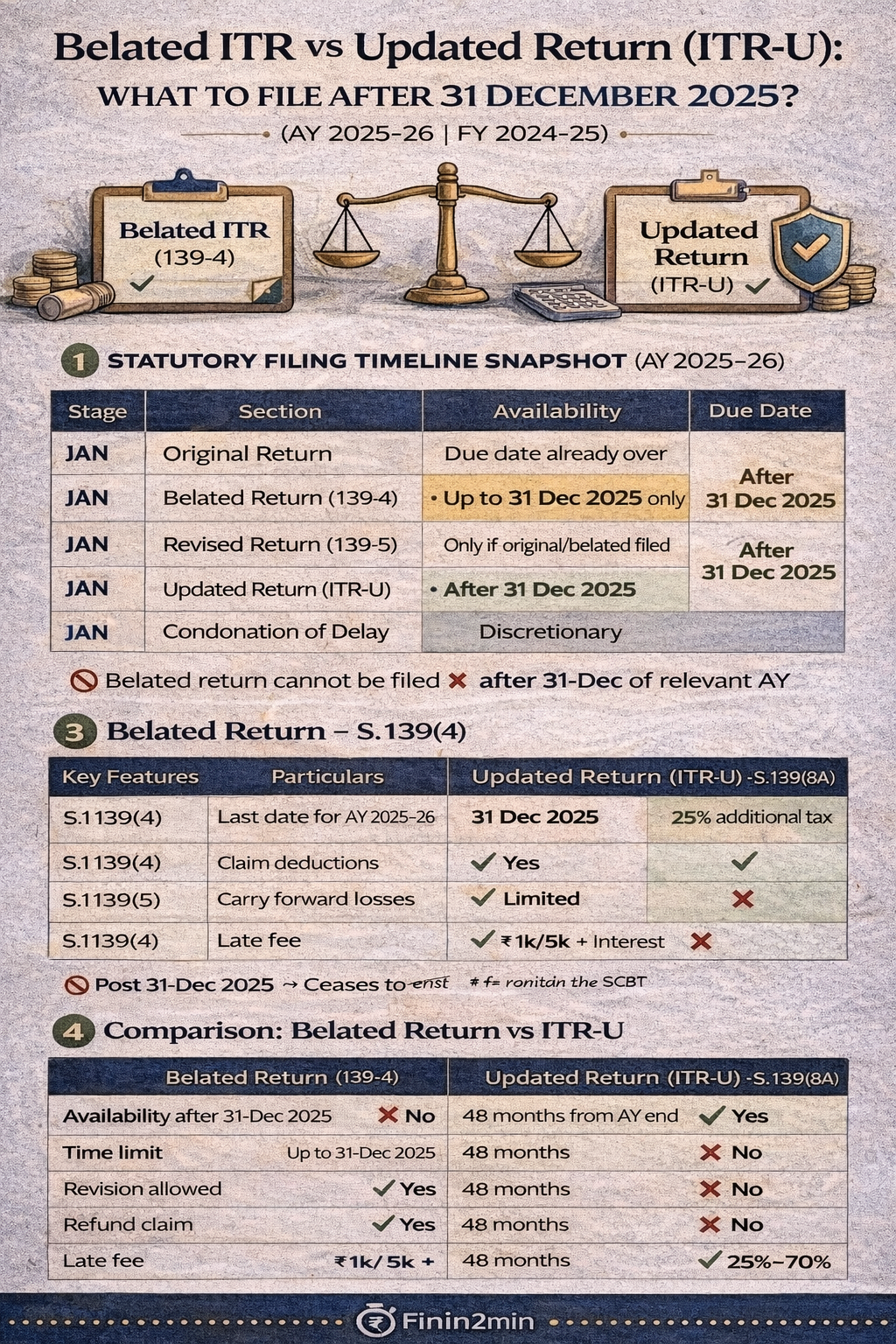
(AY 2025–26 | FY 2024–25)
Filing timelines under the Income-tax Act, 1961 are strictly enforced. However, the law also provides graded remedial mechanisms for taxpayers who miss deadlines.
For Assessment Year (AY) 2025–26, 31 December 2025 is a critical cut-off date. After this date, the choice narrows significantly.
This article explains — in a practical, tabular format — which option remains available, its cost, limitations, and compliance implications.
1️⃣ Statutory Filing Timeline Snapshot (AY 2025–26)
| Stage | Section | Availability |
|---|---|---|
| Original return | 139(1) | Due date already over |
| Belated return | 139(4) | Up to 31 Dec 2025 only |
| Revised return | 139(5) | Only if original/belated filed |
| Updated return (ITR-U) | 139(8A) | After 31 Dec 2025 |
| Condonation of delay | 119(2)(b) | Discretionary |
Belated/revised return cannot be filed after 31 December of the relevant AY (unless assessment completed earlier).
2️⃣ Belated Return — Section 139(4)
A belated return allows filing after missing the original due date but within the statutory window.
Key Features
| Particulars | Position |
|---|---|
| Last date for AY 2025–26 | 31 December 2025 |
| Can claim deductions (80C, 80D, etc.) | ✅ Yes |
| Can revise later | ✅ Yes (within time) |
| Carry forward losses | ⚠️ Limited (business & capital loss not allowed) |
| Refund claim | ✅ Allowed |
| Late fee | ₹1,000 / ₹5,000 (Section 234F) |
| Interest | Sections 234A/B/C |
🔔 Post-31 December 2025 → This option ceases to exist
3️⃣ Updated Return (ITR-U) — Section 139(8A)
Introduced to promote voluntary post-deadline compliance, ITR-U is available even after belated/revised timelines expire, but at a cost and with restrictions.
Eligibility Window
| Time from end of AY 2025–26 | Additional Tax Payable* |
|---|---|
| Up to 12 months (till 31 Mar 2027) | 25% of tax + interest |
| 12–24 months | 50% |
| 24–36 months | 60% |
| 36–48 months (till 31 Mar 2030) | 70% |
* Additional tax is levied under Section 140B
Restrictions (Critical)
| Item | Allowed in ITR-U? |
|---|---|
| Declare loss | ❌ No |
| Carry forward losses | ❌ No |
| Claim or enhance refund | ❌ No |
| Reduce earlier tax liability | ❌ No |
| Revise ITR-U | ❌ Not permitted |
| Proceedings already initiated | ❌ Not allowed |
ITR-U is only upward-correction oriented.
4️⃣ Belated Return vs Updated Return — Side-by-Side Comparison
| Parameter | Belated Return (139-4) | Updated Return (139-8A) |
|---|---|---|
| Availability after 31 Dec 2025 | ❌ No | ✅ Yes |
| Time limit | Up to 31 Dec 2025 | 48 months from AY end |
| Revision allowed | ✅ Yes | ❌ No |
| Refund claim | ✅ Yes | ❌ No |
| Loss declaration | ⚠️ Limited | ❌ No |
| Carry forward losses | ⚠️ Restricted | ❌ No |
| Additional tax | ❌ No | ✅ 25%–70% |
| Nature | Regular compliance | Voluntary correction |
| Best used for | Late but genuine filing | Risk mitigation |
5️⃣ What Are Your Options After 31 December 2025?
Option A — ITR-U (Statutory Route)
✔ Predictable
✔ Time-bound
✔ Avoids prosecution risk
✖ Costly
✖ No refunds or losses
Best for:
- Missed filing entirely
- Under-reported income
- Compliance clean-up
Option B — Condonation of Delay (Section 119(2)(b))
| Feature | Position |
|---|---|
| Authority | CBDT / Jurisdictional PCIT |
| Relief possible | Refund / deduction |
| Approval | Discretionary |
| Time | Uncertain |
| Grounds required | Genuine hardship |
⚠️ Not a right — only a discretionary relief
6️⃣ Compliance Decision Matrix (Finin2min Practical View)
| Situation | Recommended Action |
|---|---|
| Missed filing but before 31 Dec 2025 | File Belated Return immediately |
| Missed filing after 31 Dec 2025 | Evaluate ITR-U |
| Refund involved | Consider condonation |
| Under-reported income | ITR-U safer than waiting |
| Loss carry-forward needed | No remedy post-deadline |
7️⃣ Key Takeaways (Executive Summary)
- 31 December 2025 is the final statutory exit for belated returns
- After this date, ITR-U is the only guaranteed compliance route
- ITR-U comes with higher tax cost and strict limitations
- Refunds and loss benefits die after the belated deadline
- Condonation should be used sparingly and strategically
📌 Finin2min Compliance Insight
“File within the belated window whenever possible.
Post-deadline compliance is no longer about saving tax — it is about managing risk.”
