
How to File Income Tax Return (ITR) in India — Complete Guide 2025 | Finin2min
Every earning individual in India is required to file an Income Tax Return (ITR) if their income exceeds the basic exemption limit under the Income-tax Act, 1961.
Filing returns accurately and on time helps avoid penalties and ensures seamless refunds and financial record keeping.
1️⃣ Understanding ITR Forms (AY 2025-26)
| Form | For Whom | Purpose |
|---|---|---|
| ITR-1 (Sahaj) | Resident individual with income ≤ ₹50 L from salary/pension | Simplest form |
| ITR-2 | Individuals with capital gains, foreign income | Detailed return |
| ITR-3 | Business / professional income | For proprietors |
| ITR-4 (Sugam) | Presumptive income (44AD/44ADA/44AE) | Simplified return |
| ITR-5 | Firms / LLPs / AOPs | Entity filing |
| ITR-6 | Companies other than charitable | Corporate filing |
| ITR-7 | Trusts / charitable institutions | Specific purpose |
2️⃣ Prerequisites for Filing ITR
- Active PAN & Aadhaar linked.
- Valid mobile number and email registered with Income Tax portal.
- Form-16 from employer.
- TDS certificates & bank statements.
- Investment proofs (Section 80C–80U).
- Capital gains details (if any).
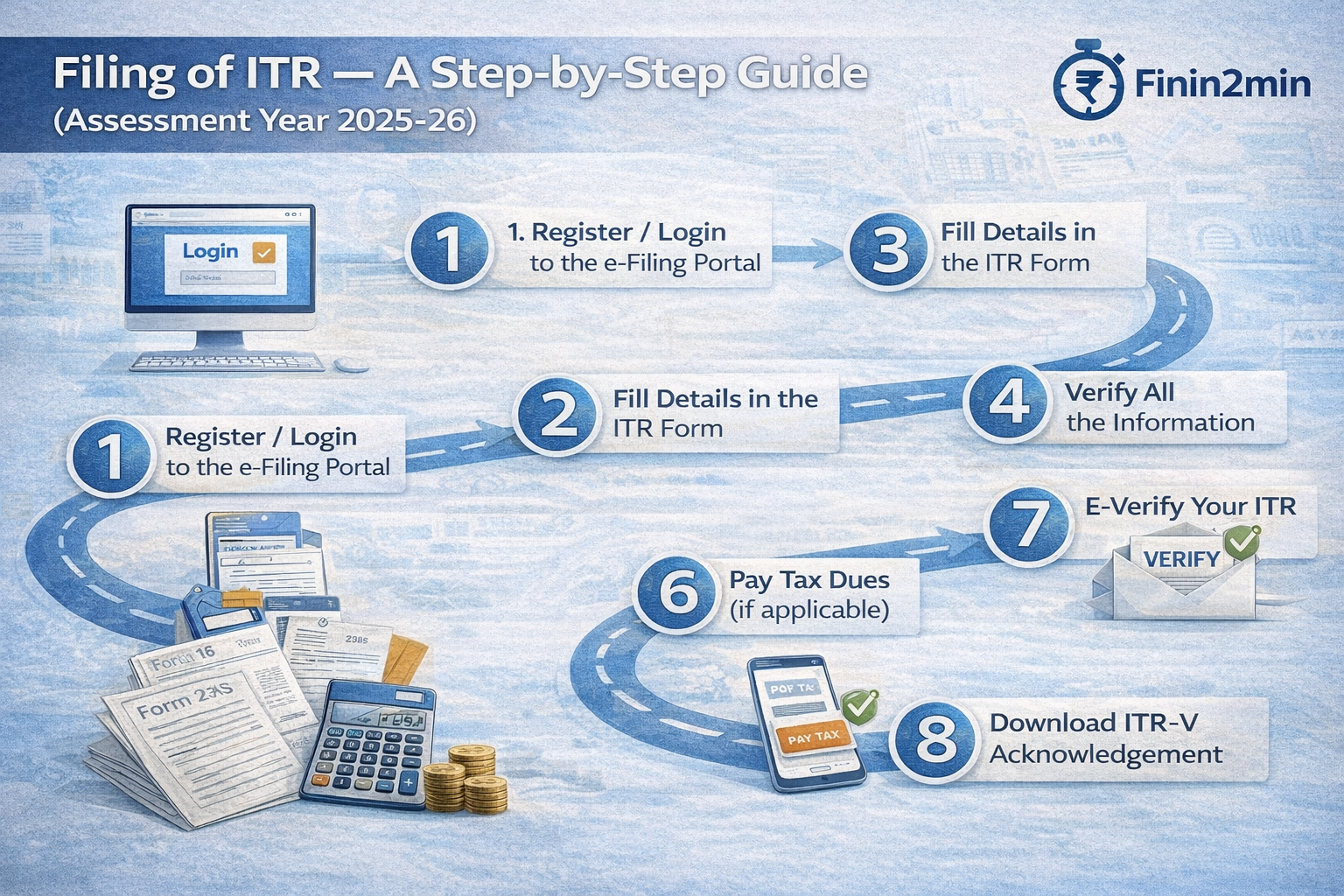
3️⃣ Step-by-Step ITR Filing Process
Step 1 — Login to the Portal
Go to 👉 incometax.gov.in → Login using PAN and password.
Step 2 — Select ‘e-File → Income Tax Return’
Choose Assessment Year 2025-26 → Select online mode of filing.
Step 3 — Select Appropriate ITR Form
The system suggests ITR-1 to ITR-7 based on your profile.
Step 4 — Fill in Details
Personal Info → Income Details → Deductions → Taxes Paid.
Step 5 — Verify TDS & Advance Tax
Data auto-populates from Form 26AS & AIS/TIS. Check for mismatch.
Step 6 — Claim Deductions (80C–80U)
Enter eligible deductions for investments, medical insurance, donations.
Step 7 — Compute Tax Liability / Refund
The portal automatically calculates liability under old vs new regime.
Step 8 — E-Verify Return
Use any one of these methods:
- Aadhaar OTP
- Net-banking login
- Digital Signature Certificate (DSC)
- Offline ITR-V submission
Step 9 — Acknowledgment & Processing
Download acknowledgment → Return processed within 4–6 weeks by CPC, Bengaluru.
4️⃣ Common Errors to Avoid
- Using wrong ITR form.
- Mismatch between Form-16 and 26AS.
- Ignoring interest income from savings.
- Forgetting to verify ITR → leads to invalid filing.
5️⃣ Penalties for Late Filing (FY 2024-25)
A late fee is mandatory for any return filed after the original due date (e.g., September 16, 2025, for individuals):
Exemption: No late fee applies if your total income is below the basic exemption limit.
Income up to ₹5 Lakh: A late fee of ₹1,000.
Income above ₹5 Lakh: A late fee of ₹5,000 if filed by December 31, 2025.
Interest on Unpaid Tax (Section 234A)
If you have outstanding tax liability, you must pay simple interest at 1% per month (or part of a month).
Even a delay of one day into a new month triggers interest for the entire month.
Interest starts from the day immediately following the original due date and continues until the actual date of filing.
Inability to Carry Forward Losses
Filing after the due date disqualifies you from carrying forward most current-year losses to offset against future profits. This includes:
Note: House property losses and unabsorbed depreciation can still be carried forward even with a late return
Business losses.
Capital losses (on properties, stocks, etc.).
✅ Summary
Filing ITR is not just a legal requirement but an important financial discipline.
The new portal and AIS/TIS data integration make filing simpler and transparent.
📚 References
- Income-tax Act, 1961
- CBDT Notification No. 03/2024
- https://incometax.gov.in
💬 FAQs
1. Can I file ITR without Form-16? Yes, if you have salary slips and 26AS details.
2. What is the last date to file ITR for FY 2024-25? 16th September 2025 (extended from usual due date of 31st July 2025).
3. Do I need to file ITR if income < ₹2.5 L? Not mandatory, but recommended for record and loan eligibility.
