
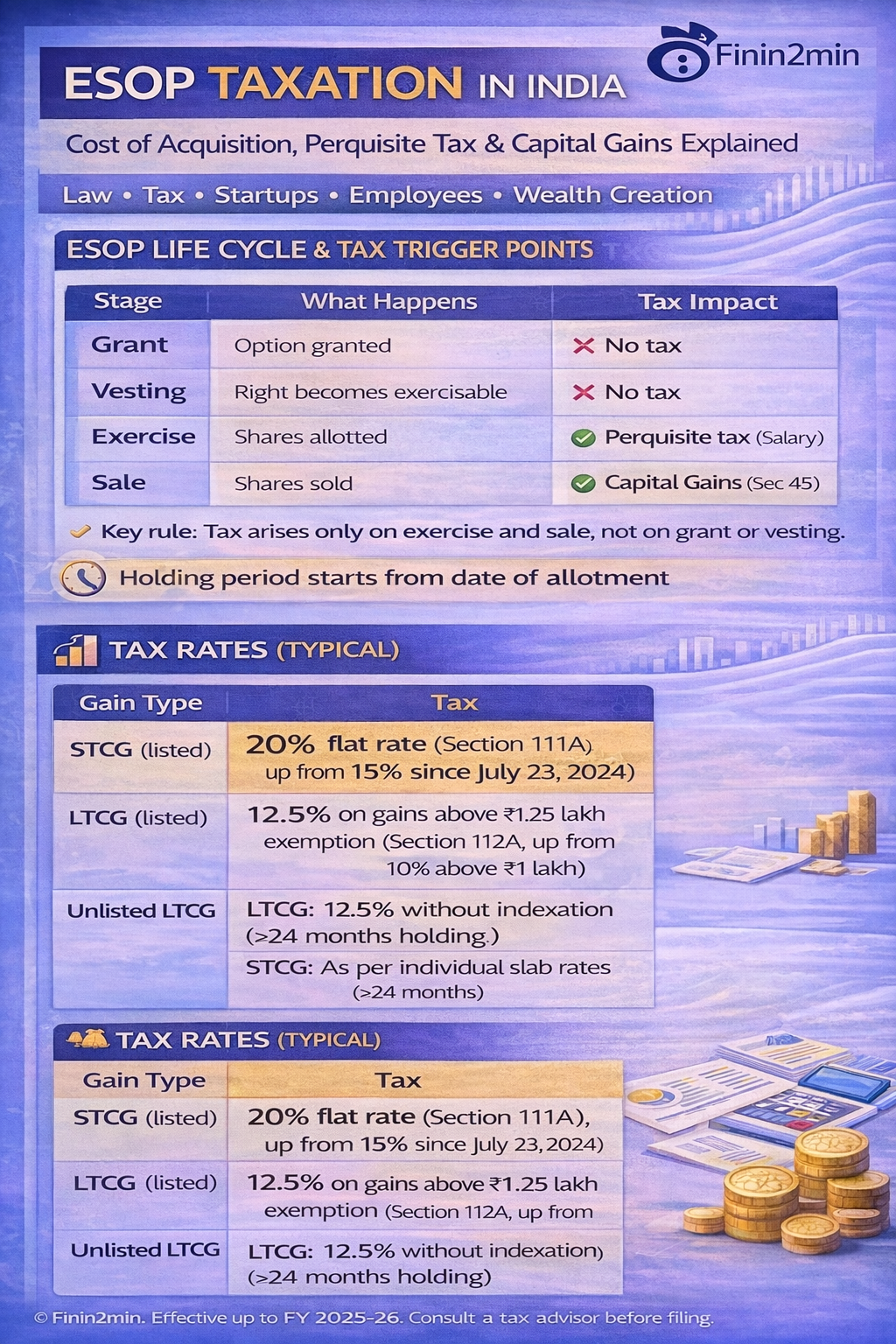
Cost of Acquisition, Perquisite Tax & Capital Gains Explained
Law • Tax • Startups • Employees • Wealth Creation
2-minute read | Practical | Liquidity-aware | Compliance-first
1️⃣ WHAT IS AN ESOP (IN LAW & PRACTICE)
Employee Stock Option Plan (ESOP) gives employees the right (not obligation) to buy company shares at a fixed price after a vesting period.
📜 Legal basis
- Companies Act, 2013 – Section 62(1)(b)
- Companies (Share Capital & Debentures) Rules, 2014 – Rule 12
📌 Requires:
- Shareholder special resolution
- Defined vesting, exercise price, valuation
- Non-transferable till exercise
2️⃣ ESOP LIFE CYCLE & TAX TRIGGER POINTS
| Stage | What Happens | Tax Impact |
|---|---|---|
| Grant | Option granted | ❌ No tax |
| Vesting | Right becomes exercisable | ❌ No tax |
| Exercise | Shares allotted | ✅ Perquisite tax (Salary) |
| Sale | Shares sold | ✅ Capital Gains (Sec 45) |
📌 Key rule: Tax arises only on exercise and sale, not on grant or vesting.
3️⃣ TAX AT EXERCISE — PERQUISITE (SALARY INCOME)
📜 Section 17(2)(vi), Income-tax Act
Taxable Perquisite = FMV on exercise date – Exercise price
| Particulars | Amount |
|---|---|
| FMV on exercise | ₹300 |
| Exercise price | ₹50 |
| Perquisite taxable | ₹250 per share |
✔ Taxed under Salary
✔ Employer deducts TDS u/s 192
✔ Applies to listed & unlisted shares
📌 FMV rules
- Listed shares → Market price (Rule 3)
- Unlisted shares → Merchant Banker valuation (Rule 3(8))
4️⃣ STARTUP RELIEF — DEFERRAL OF PERQUISITE TAX
📜 Section 192(1C) — Finance Act, 2020
Applicable only to eligible DPIIT-recognised startups
⏳ Perquisite tax deferred to earliest of:
- Sale of shares
- Exit from company
- 48 months from end of AY of exercise
📌 Not an exemption — only timing relief
📌 TDS liability still exists (timing deferred)
5️⃣ CAPITAL GAINS ON SALE — SECTION 45
Once shares are sold:
📜 Section 45 + Section 49(2AA)
Cost of acquisition = FMV already taxed as perquisite
| Particulars | Amount |
|---|---|
| Sale price | ₹500 |
| Cost (FMV at exercise) | ₹300 |
| Capital Gain | ₹200 |
✔ Prevents double taxation
✔ Statutorily settled under Section 49(2AA)
6️⃣ HOLDING PERIOD & TAX RATES (VALIDATED)
⏱ Holding period starts from date of allotment
| Share Type | LTCG Threshold |
|---|---|
| Listed equity | > 12 months |
| Unlisted shares | > 24 months |
💰 Tax Rates (Typical)
| Gain Type | Tax |
|---|---|
| STCG (listed) | 20% flat rate (Section 111A, up from 15% since July 23, 2024) |
| LTCG (listed) | 12.5% on gains above ₹1.25 lakh exemption (Section 112A, up from 10% above ₹1 lakh) |
| Unlisted LTCG | LTCG: 12.5% without indexation (>24 months holding). STCG: As per individual slab rates (≤24 months) |
7️⃣ SPECIAL CASES — RSU, SAR, PHANTOM STOCKS
| Instrument | Shares issued? | Tax Treatment |
|---|---|---|
| RSU | Yes | Perquisite + Capital Gains |
| SAR (cash-settled) | ❌ No | Salary income |
| Phantom stock | ❌ No | Salary income |
📌 No capital gains if no shares allotted.
8️⃣ KEY JUDICIAL PRINCIPLES (SETTLED LAW)
⚖️ Landmark Cases
- CIT v. Infosys Technologies Ltd. (SC)
→ Tax arises on exercise, not grant - Ramamoorthy Sridharan (ITAT)
→ FMV taxed as perquisite = cost for CG - Conflicting HC views exist only for cash compensation on unexercised ESOPs
📌 Core ESOP taxation framework is largely settled.
9️⃣ FOREIGN ESOPS — ADDITIONAL COMPLIANCE
🧾 FEMA / Income-tax
- FA Schedule mandatory for ROR residents
- LRS applies on exercise price paid abroad
- TCS applicable on remittance (claimable as credit)
🔟 COMMON MISTAKES (AND HOW TO AVOID)
❌ Expecting capital gains without perquisite tax
❌ Ignoring valuation report for unlisted shares
❌ Not planning cash for exercise-stage tax
❌ Missing FA Schedule disclosure
❌ Assuming startup deferral = exemption
✔ Plan exercise timing + liquidity event together
✔ Track FMV reports & TDS certificates
📌 FININ2MIN SUMMARY TABLE
| Event | Tax Head | Section |
|---|---|---|
| Exercise | Salary (Perquisite) | 17(2)(vi) |
| Sale | Capital Gains | 45 |
| Cost rule | FMV = cost | 49(2AA) |
| Startup deferral | Timing relief | 192(1C) |
🎯 FININ2MIN TAKEAWAY
ESOPs are taxed twice — but on two different value layers.
- Exercise → Salary tax on benefit
- Sale → Capital gains on appreciation
📌 The real risk is liquidity mismatch, not tax rate.
📌 Smart planning = timing exercise near exit or liquidity.
⚠️ DISCLAIMER
This article reflects Indian tax and corporate law as applicable up to FY 2025-26. ESOP taxation depends on share type, valuation, residency and employer status. Always validate with company documents and tax advisors.
Article related to –
ESOP taxation in India
ESOP perquisite tax calculation
Capital gains on ESOP shares
Cost of acquisition for ESOP
ESOP tax after exercise and sale
ESOP tax rates FY 2025-26
Listed vs unlisted ESOP capital gains
Startup ESOP tax explained
ESOP liquidity and tax planning
