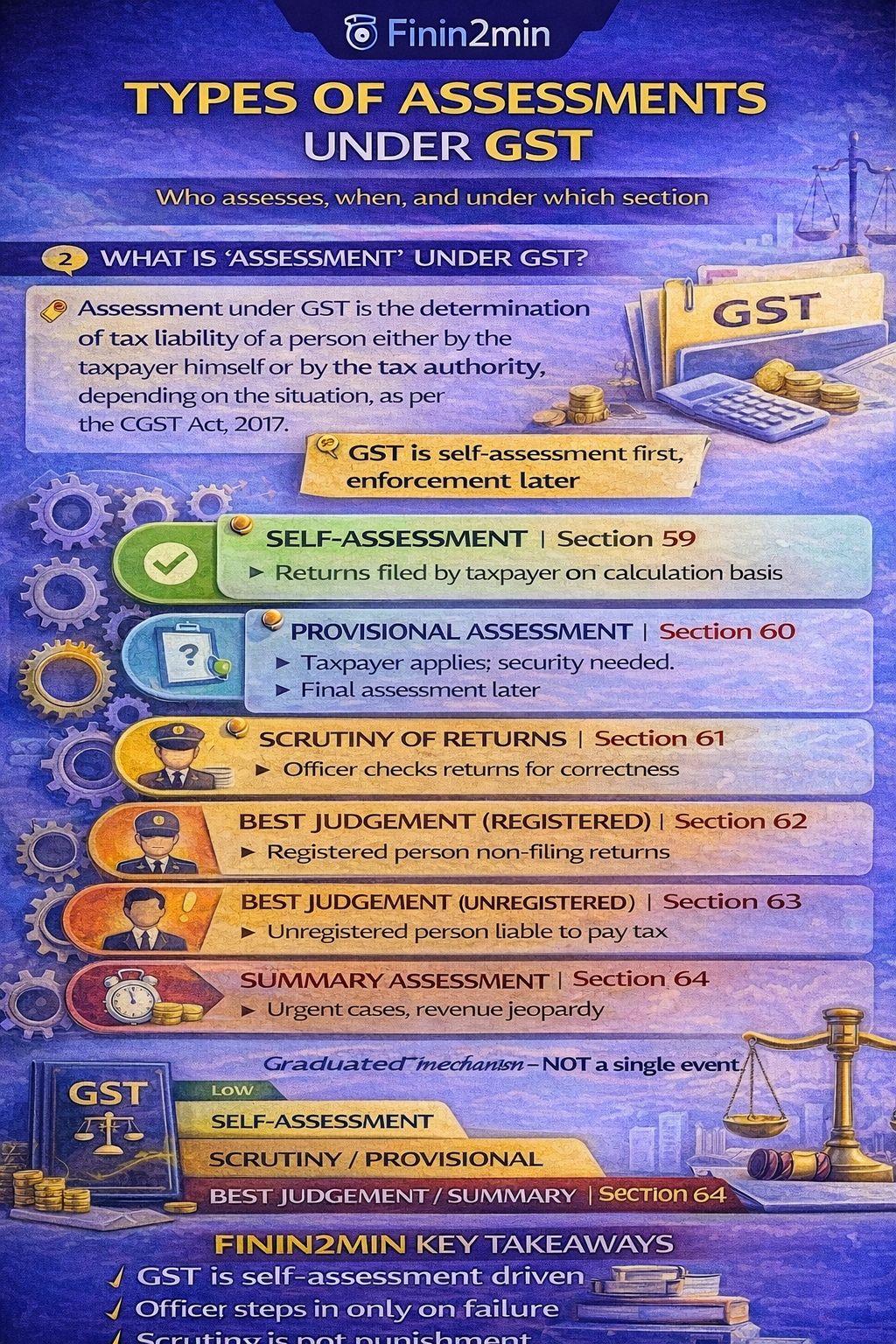
Assessment under GST is the determination of tax liability of a person either by the taxpayer himself or by the tax authority, depending on the situation, as per the CGST Act, 2017.
📌 GST is self-assessment first, enforcement later.
2️⃣ Snapshot: All Types of GST Assessments
Type of Assessment
Section
Who Determines Tax
When It Applies
Self-Assessment
59
Taxpayer
Regular compliance
Provisional Assessment
60
Taxpayer + Officer
Rate/value uncertainty
Scrutiny of Returns
61
Tax Officer
Return mismatches
Best Judgement (Registered)
62
Tax Officer
Non-filing of returns
Best Judgement (Unregistered)
63
Tax Officer
Taxable but unregistered
Summary Assessment
64
Tax Officer (with approval)
Urgent revenue risk
3️⃣ Self-Assessment — Section 59 (Default Rule)
Aspect
Details
Nature
Trust-based
Returns involved
GSTR-1, GSTR-3B, Annual Return
Officer involvement
❌ None
ITC & tax calculation
Done by taxpayer
Illustrative Example
Particulars
Amount (₹)
Taxable outward supply
10,00,000
GST @ 18%
1,80,000
ITC available
1,20,000
Net GST payable
60,000
📌 Most GST liabilities arise here.
4️⃣ Provisional Assessment — Section 60
Trigger
When correct value or tax rate is unclear
Who applies
Taxpayer
Officer’s role
Permits provisional payment
Security required
Bond + security
Outcome
Final assessment later + adjustment
Example
Situation
Action
New product — tax rate unclear (12% or 18%)
Apply for provisional assessment
Provisional tax paid
@12%
Final rate decided
18%
Adjustment
Differential tax + interest
📌 Used sparingly, but very important in classification disputes.
5️⃣ Scrutiny Assessment — Section 61
Purpose
To verify correctness of returns
Initiated by
Proper Officer
Scope
Data mismatch, ITC excess, tax short-paid
Result
Explanation accepted or further proceedings
Common Scrutiny Triggers
Issue
Example
ITC mismatch
GSTR-3B > GSTR-2B
Turnover mismatch
GSTR-1 vs GSTR-3B
Rate mismatch
Wrong HSN rate
📌 Scrutiny ≠ demand. It is a pre-enforcement check.
6️⃣ Best Judgement Assessment — Sections 62 & 63
A. Section 62 — Registered Person
Applies to
Registered taxpayer
Default
Non-filing of returns
Basis
Past returns, available data
Objective
Enforce compliance
Example: Returns not filed for 6 months → Officer estimates tax → Assessment order issued.
B. Section 63 — Unregistered Person
Applies to
Liable but unregistered person
Basis
Market data, inspections, records
Consequence
Tax + penalty exposure
Example: Business crosses threshold but no GST registration → Officer assesses tax.
GST assessment is a graduated mechanism — not a single event. If returns are accurate and reconciled, most taxpayers never face officer-driven assessment.
This content is for general information and educational purposes only. It does not constitute legal, tax, accounting, or professional advice. Views expressed are based on prevailing laws and interpretations at the time of publication. Readers should consult their professional advisors before taking any action.
Article related to –
types of assessment under GST self assessment provisional scrutiny GST best judgement assessment GST summary assessment section 64 GST GST assessment sections explained GST audit vs assessment