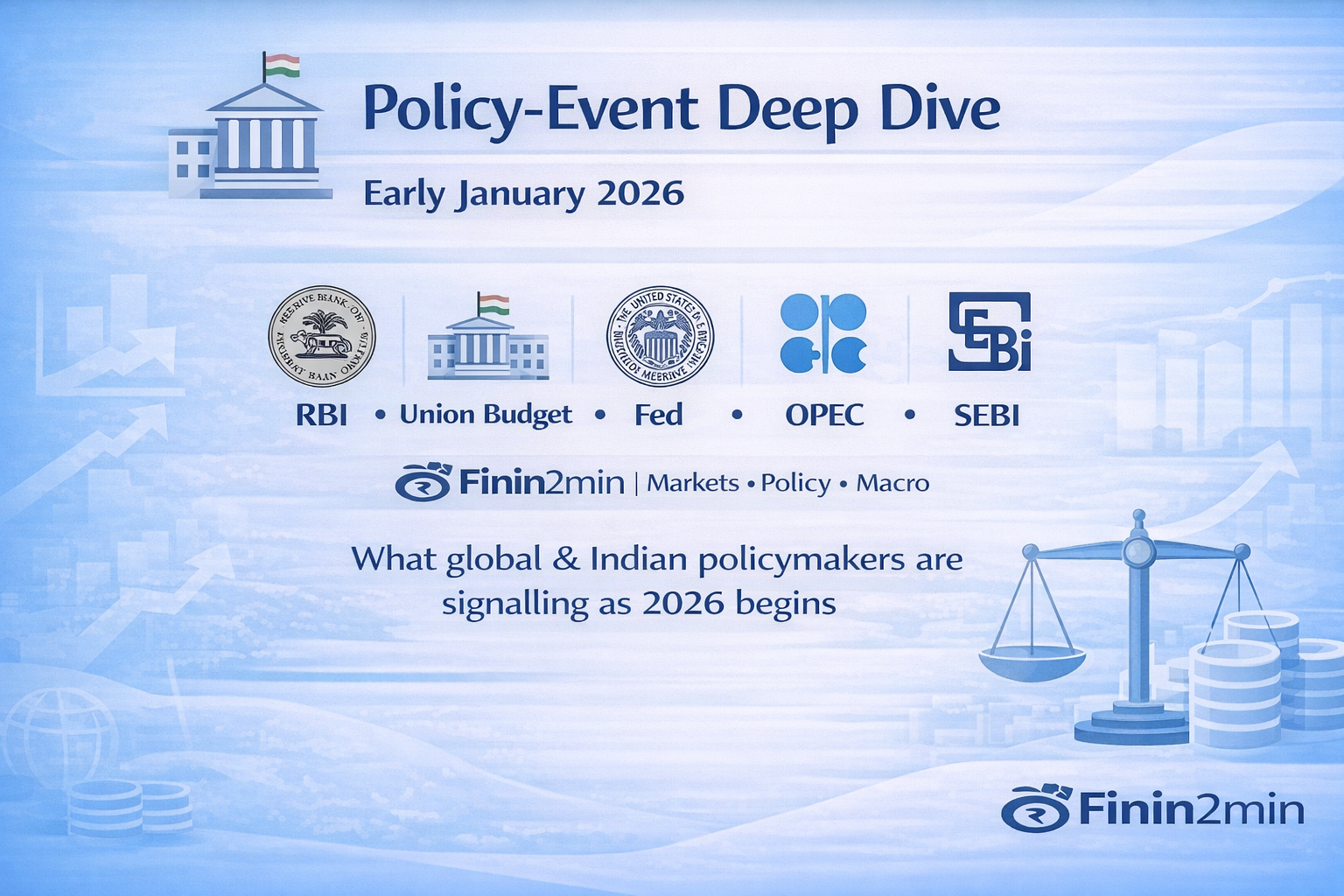
(RBI • Union Budget • Fed • OPEC • SEBI)
🇮🇳 RBI — Policy Signal Check (Pre-February MPC)
Entity: Reserve Bank of India
Where we stand
- Policy stance remains “withdrawal of accommodation”, though communication has turned noticeably less hawkish than mid-2025.
- Liquidity is being actively managed via VRRR / VRR auctions to prevent unintended easing.
- Rupee stability continues as a core operational priority, supported by calibrated market intervention.
What markets are reading
- Rate cuts are not immediate, but the H2 FY26 easing narrative is strengthening.
- December 2025 inflation and early-January prints will act as critical guideposts for rate guidance.
- RBI focus has clearly shifted toward financial stability, NBFC risk-weights, and credit discipline, rather than growth signalling.
What to watch
- February MPC commentary on inflation trajectory
- Liquidity stance as government cash balances normalise
- Any change in language around “durable disinflation”
🏛 Union Budget 2026 — Early Policy Contours (February Focus)
Entity: Ministry of Finance
Emerging signals
- Capex continuity over populism remains the base-case assumption.
- Fiscal consolidation path is likely to stay intact, with glide-path credibility key for bond markets.
- Selective health-linked taxation (e.g., tobacco) reflects behavioural fiscal policy.
- Energy transition / green capex is emerging as a medium-term theme, feeding into FY27 planning.
Market sensitivity
- Infrastructure, defence, railways, logistics
- PSU banks (credit growth + bond-portfolio stability)
- FMCG remains vulnerable to indirect-tax recalibration
What to watch
- Capex allocation versus fiscal-deficit arithmetic
- Any changes in capital-gains or securities taxation
- Disinvestment and asset-monetisation roadmap
🇺🇸 U.S. Federal Reserve — Pivot Timing, Not Direction
Entity: Federal Reserve
Current posture
- Policy rates remain restrictive, but forward guidance is explicitly data-dependent.
- Markets are pricing gradual rate cuts later in 2026, not an abrupt pivot.
Why it matters for India
- Fed easing would be supportive for EM capital flows, INR stability, and IT exports.
- However, sticky U.S. services inflation remains the key upside risk to rates.
What to watch
- U.S. labour-market cooling pace
- Core PCE trend versus growth resilience
- Communication consistency (avoiding policy whiplash)
🛢 OPEC / OPEC+ — Price Defence, Not Aggression
Entity: OPEC
Current setup
- Brent remains range-bound in a $60–65/bbl comfort zone, but structurally fragile.
- OPEC+ continues to signal discipline and compliance, rather than aggressive new cuts.
- Middle East geopolitical tensions remain a known upside risk to prices.
India impact
- Supportive for current-account balance and inflation management.
- Downstream oil-marketing margins remain broadly stable.
What to watch
- Compliance among smaller producers
- Any sudden geopolitical supply disruption
- Demand signals from China and Europe
📜 SEBI — Compliance-First Capital Markets
Entity: Securities and Exchange Board of India
Regulatory direction
- Strong emphasis on risk management, disclosures, and governance standards.
- Mutual-fund approvals, SME scrutiny, and intermediary accountability remain in focus.
Market implication
- Structurally positive for market depth, credibility, and investor trust.
- Near-term friction for weaker or opaque participants.
What to watch
- MF inflow sustainability amid elevated valuations
- Enhanced disclosures for new-age companies
- Balance between enforcement intensity and ease of doing business
📌 Finin2min Policy Lens — This Week
- Global policy is shifting from firefighting to fine-tuning.
- India stands out for macro stability and regulatory credibility.
- Growth is no longer liquidity-fuelled alone — discipline is emerging as the new alpha.
✅ Bottom Line
Early-2026 policy signals point to a measured, rules-based environment:
No sudden easing.
No policy shocks.
High premium on compliance, balance-sheet strength, and execution.
👉 This is a market where selectivity beats speed.
