
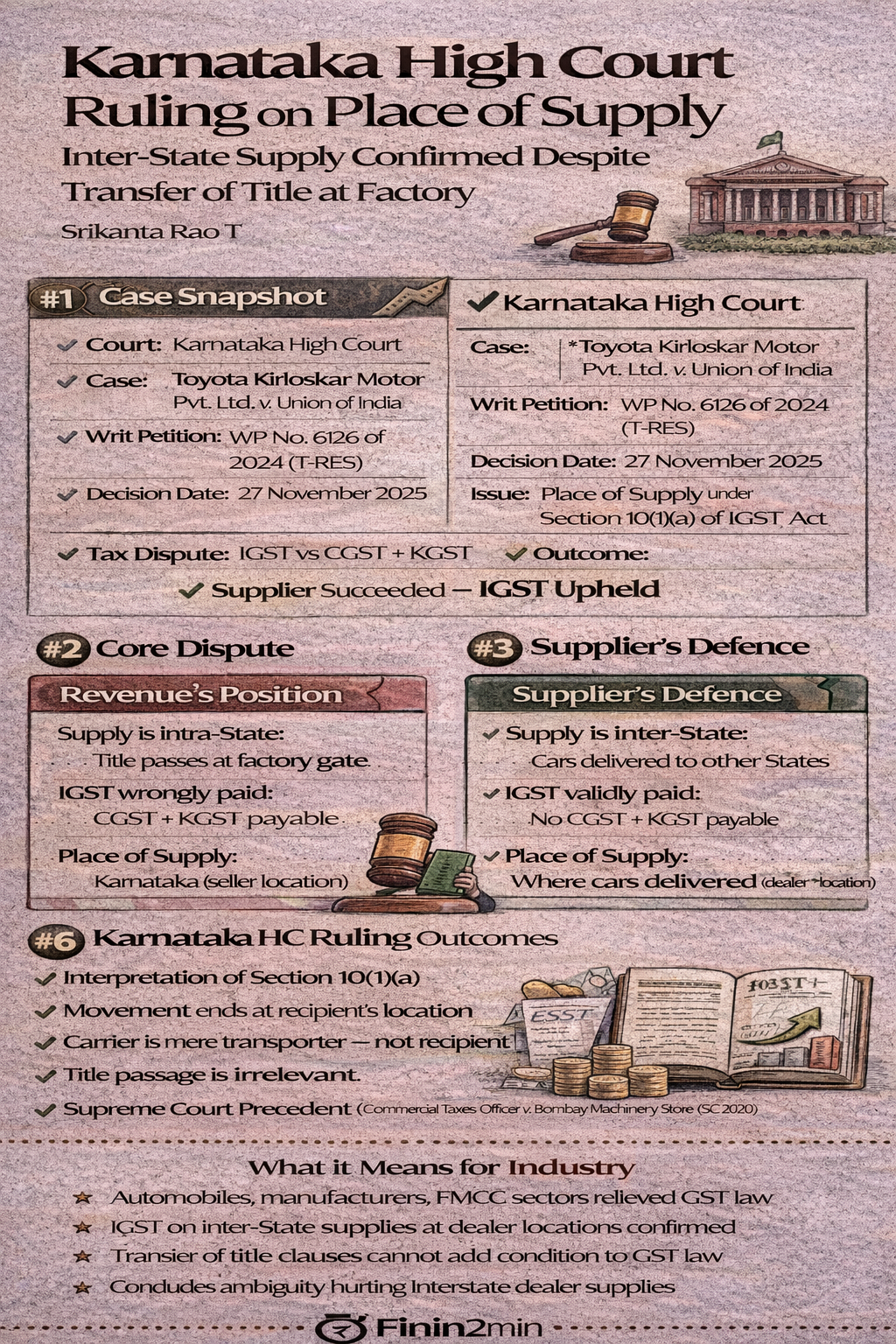
Inter-State Supply Confirmed Despite Transfer of Title at Factory
(Toyota Kirloskar Motor Pvt. Ltd. v. UOI – Nov 2025)
1️⃣ Case Snapshot (At a Glance)
| Particulars | Details |
|---|---|
| Court | Karnataka High Court |
| Case | Toyota Kirloskar Motor Pvt. Ltd. v. Union of India & Ors. |
| Writ Petition | WP No. 6126 of 2024 (T-RES) |
| Decision Date | 27 November 2025 |
| Issue | Place of Supply under Section 10(1)(a) of IGST Act |
| Tax Dispute | IGST vs CGST + KGST |
| Outcome | Supplier succeeded – IGST upheld |
2️⃣ Core Legal Issue
Whether supply of motor vehicles to dealers located outside Karnataka becomes an intra-State supply merely because:
- Title and risk pass at the factory gate in Karnataka, and
- Goods are handed over to a common carrier at Karnataka?
3️⃣ Relevant Statutory Provision (Validated)
Section 10(1)(a) – IGST Act, 2017
| Parameter | Statutory Position |
|---|---|
| Applicability | Supply of goods within India (non-import/export) |
| Test | Whether supply involves movement of goods |
| Place of Supply | Location of goods when movement terminates for delivery to recipient |
| Key Point | No reference to transfer of ownership/title |
✔️ The statute focuses on “termination of movement for delivery”, not “passing of title”
4️⃣ Revenue’s Stand (Rejected by Court)
| Revenue Argument | Basis |
|---|---|
| Supply is intra-State | Title & risk pass at factory gate |
| Delivery completed at Karnataka | Dealer agreement clauses |
| IGST wrongly paid | CGST + KGST payable |
| Place of supply | Karnataka (factory location) |
📌 Error Identified: Revenue imported Sale of Goods Act concepts into GST law.
5️⃣ Supplier’s Stand (Accepted)
| Supplier’s Argument | Reasoning |
|---|---|
| Supply is inter-State | Dealers located outside Karnataka |
| Movement continues | Till dealer location |
| Carrier ≠ Recipient | Dealer is the recipient |
| IGST correctly discharged | No double taxation possible |
6️⃣ Karnataka HC’s Findings (Key Holdings)
A. Interpretation of Section 10(1)(a)
| Aspect | Court’s Finding |
|---|---|
| Movement of goods | Continues till delivery to recipient |
| Common carrier | Merely a transporter, not recipient |
| Termination of movement | At dealer’s destination, not factory |
| Transfer of title | Irrelevant for place of supply |
✔️ Passing of title ≠ Termination of movement
B. Revenue Neutrality
| Scenario | Impact |
|---|---|
| IGST already paid | Refund required if CGST+KGST demanded |
| Result | Double taxation |
| Court’s view | Legally impermissible |
7️⃣ Supreme Court Support (Binding Precedent)
Commercial Taxes Officer v. Bombay Machinery Store (SC – 2020)
| Principle | Legal Position |
|---|---|
| Movement begins | When goods handed to carrier |
| Movement ends | When delivery taken from carrier |
| Constructive delivery | Not recognised |
| Administrative interpretation | Cannot override statute |
📌 GST law mirrors CST logic on movement of goods
8️⃣ Divergent Kerala HC View (Why It’s Distinguishable)
| Case | Kun Motor Co. Pvt. Ltd. (Kerala HC) |
|---|---|
| Context | E-way bill requirement |
| Facts | Temporary registration, insurance, vehicle usage |
| Finding | Treated as used personal effect |
| Limitation | Fact-specific; not a pure POS ruling |
⚠️ Does not dilute Section 10(1)(a) interpretation in commercial dealer supplies
9️⃣ Comparative Legal Position (Quick Chart)
| Test | Karnataka HC | Kerala HC |
|---|---|---|
| Focus | Destination delivery | Ownership indicators |
| POS Determination | Recipient location | Seller location |
| Alignment with SC | ✔ Yes | ❌ Weak |
| Applicability | Industry-wide | Fact-specific |
🔟 Compliance & Industry Impact
What This Ruling Clarifies
| Area | Impact |
|---|---|
| Dealer supplies | Inter-State if destination is outside State |
| IGST liability | Correct even if title passes earlier |
| Audit objections | Cannot rely on title clauses |
| Double taxation | Prevented |
🧠 Finin2min Practical Takeaways
✔ Place of supply follows movement, not ownership
✔ Carrier is not the recipient
✔ Title clauses in contracts cannot override GST statute
✔ Audit interpretations must align with Section 10(1)(a)
✔ Industry relief for automobile & manufacturing sector
📌 Final Word
The Karnataka High Court ruling restores statutory discipline to GST place-of-supply analysis.
By aligning with Supreme Court jurisprudence, it rejects administrative overreach and provides much-needed certainty for inter-State dealer supplies.
Under GST, delivery destination determines place of supply — not factory gates, invoices, or title clauses.
