
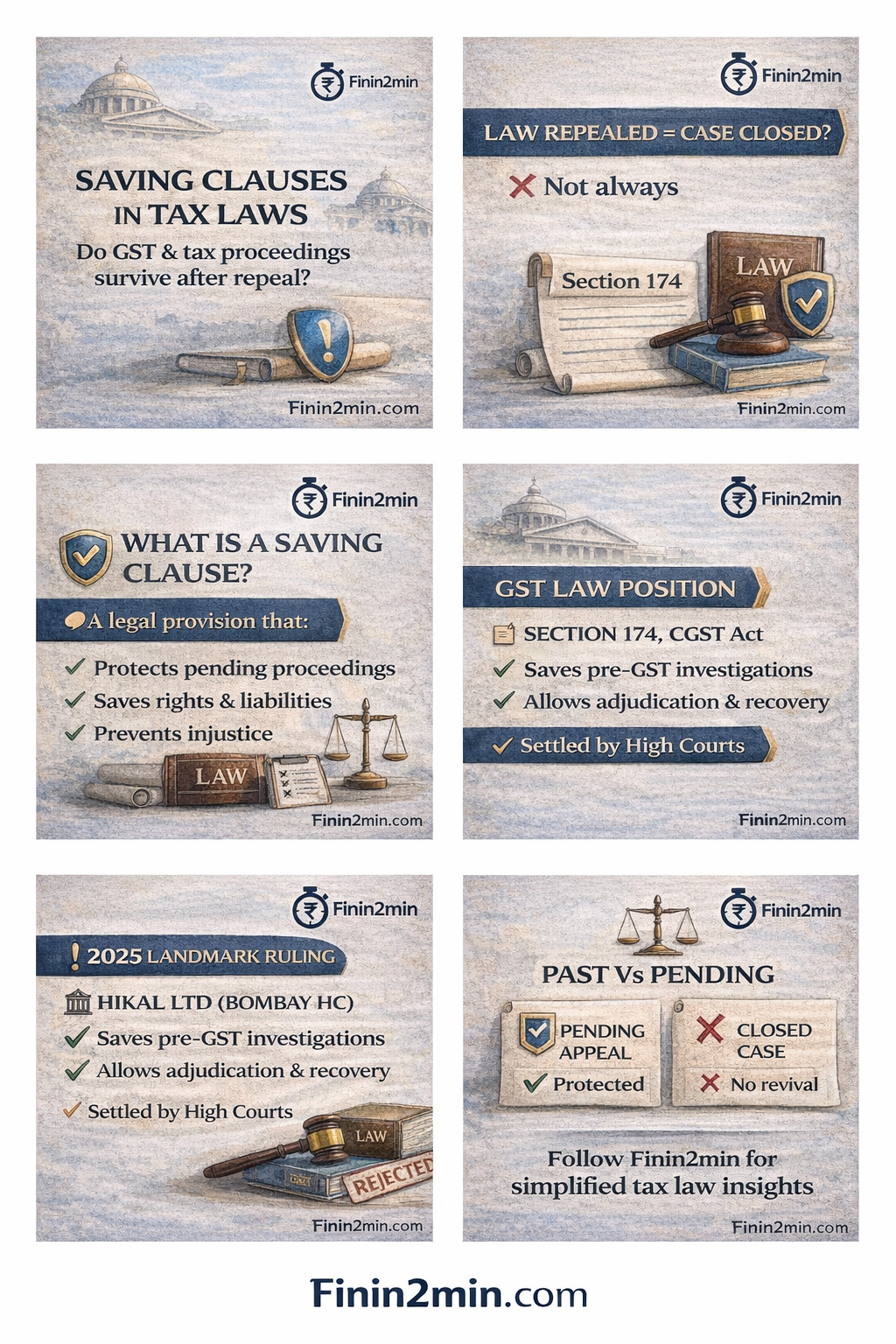
Continuity of Proceedings After Repeal, Omission or Amendment
1️⃣ Introduction
Over the last decade, Indian tax laws have undergone frequent amendments, repeals, and legislative substitutions. Landmark transitions such as the replacement of indirect tax laws by the Central Goods and Services Tax Act, 2017 and continuous amendments to the Income-tax Act, 1961 have raised a recurring and critical question:
What happens to pending proceedings when a law, rule, or notification is repealed or omitted?
This question directly affects:
- Assessments
- Investigations
- Adjudications
- Appeals
- Recovery and enforcement proceedings
The answer lies in the concept of a “Saving Clause” — a legislative mechanism that preserves rights, liabilities, and proceedings initiated under a repealed or amended law.
2️⃣ What Is a Saving Clause?
A saving clause is a statutory provision that protects past actions, accrued rights, and pending proceedings from being nullified when a law is repealed, omitted, or replaced.
Purpose of a Saving Clause
- Prevent legal vacuum
- Avoid injustice to revenue or taxpayers
- Ensure continuity of proceedings
- Protect vested rights and liabilities
In absence of a saving clause, the repealed provision may be treated as non-existent, subject to limited exceptions.
This principle does not override an express statutory saving clause.
Indian courts treat saving clauses as legislative intent overrides common law.
3️⃣ Common Law Principle on Repeal
Under common law principles of statutory interpretation:
A repealed law is treated as if it never existed, except for transactions that are “past and closed”, unless saved by a saving clause.
Thus:
- Pending matters survive only if saved
- Closed matters remain unaffected
4️⃣ Constitutional Recognition of Saving Clauses
The Indian Constitution itself incorporates saving principles:
| Article | Scope |
|---|---|
| Article 277 | Protects State and local bodies’ power to levy taxes until Parliament provides otherwise |
| Article 305 | Saves pre-Constitution trade and business laws from invalidation |
This demonstrates that saving clauses are a constitutional necessity, not merely a drafting formality.
5️⃣ Saving Clause Under GST Law – Section 174, CGST Act, 2017
Section 174(2) – Repeal and Saving
Section 174 of the CGST Act expressly saves proceedings under pre-GST laws such as:
- Finance Act, 1994 (Service Tax)
- Central Excise Act, 1944
- VAT laws
Proceedings Saved Include:
- Investigations
- Show Cause Notices
- Adjudications
- Appeals
- Recovery proceedings
6️⃣ Key Judicial Pronouncements (Pre-GST Proceedings)
📌 Important Case Laws
| Case | Ratio |
|---|---|
| Vianaar Homes Pvt. Ltd. (Delhi HC) | Service tax recovery survives repeal due to Section 174 |
| Aargus Global Logistics (Delhi HC) | Investigations & adjudications saved |
| Amrita Institute (Madras HC) | Levy continues where taxable event survives |
| Dev Versha Publication (Uttarakhand HC) | GST officers can issue SCN for pre-GST service tax |
| Sheen Golden Jewels (Kerala HC) | Notices under saving clauses are valid |
🔍 Conclusion: Section 174 acts as a statutory shield preserving pre-GST liabilities.
7️⃣ Saving Clause vs Amendments Within GST Law
⚠️ Important Distinction
The above judgments apply only to repeal of pre-GST laws, not to:
- Amendments within CGST Act
- Omission of CGST Rules
- Withdrawal of Notifications
For such cases, specific saving clauses are essential.
8️⃣ Saving Through Notifications – An Illustration
Example: Notification No. 17/2017–IGST (Rate)
“…rescinds the notification… except as respects things done or omitted to be done before such rescission”
✅ This phrase constitutes an explicit saving clause, protecting past actions.
📌 Rule:
If a notification omits this language → proceedings may lapse.
9️⃣ Role of the General Clauses Act, 1897 – Section 6
Section 6 – Effect of Repeal
Section 6 applies only when a Central Act repeals another Central Act, unless contrary intention appears.
What Section 6 Saves:
- Rights and liabilities
- Penalties and punishments
- Investigations and legal proceedings
❌ What It Does NOT Apply To:
- State Acts repealed by State laws
- Subordinate legislation (Rules / Notifications)
- Omissions without saving clauses
🔟 Applicability Matrix – Section 6, General Clauses Act
| Scenario | Section 6 Applies? |
|---|---|
| Central Act repealed by Central Act | ✅ Yes |
| Central Act repealed by State Act | ❌ No |
| Rule/Notification omitted | ❌ No |
| Specific saving in statute | ❌ Not required |
| Saving in notification | ❌ Not required |
1️⃣1️⃣ Omission vs Repeal – Judicial Evolution
Conflicting Judicial Views
| Case | Principle |
|---|---|
| Rayala Corporation (SC) | Omission ≠ repeal; Section 6 not applicable |
| Kolhapur Cane Sugar (SC) | Section 6 not applicable to repeal of rules |
| Shree Bhagwati Steel (SC) | Omission may operate as repeal |
| Krishna Processors (Guj HC) | Omitted provisions not saved |
1️⃣2️⃣ Landmark GST Ruling – Rule 96(10) Omission
Hikal Ltd. v. Union of India (Bom HC, 2025)
- Rule 96(10) omitted without saving clause
- Court held:
- Pending SCNs lapse
- Appeals pending abate
- Proceedings not “past and closed” fail
Similar View Taken In:
- Lucky Dyeing Mills (CESTAT)
- Addwrap Packaging (Guj HC)
- Sri Sai Vishwas Polymers (UK HC)
1️⃣3️⃣ What Is “Past and Closed”? (Practical Chart)
| Stage | Status | Relief Available |
|---|---|---|
| SCN pending | Pending | ✅ Yes |
| Appeal pending | Pending | ✅ Yes |
| Order passed & no appeal | Closed | ❌ No |
1️⃣4️⃣ Key Takeaways for Taxpayers & Professionals
Before concluding that proceedings survive or lapse, verify:
1️⃣ Is there a specific saving clause in the statute?
2️⃣ Does the Finance Act contain a saving clause?
3️⃣ Does the amending notification preserve past actions?
4️⃣ Is Section 6 of General Clauses Act applicable?
5️⃣ Is the matter pending or past & closed?
1️⃣5️⃣ Conclusion
The jurisprudence under GST and allied tax laws has firmly established that:
A saving clause is not a procedural formality—it is the backbone of legal continuity.
- With saving clause → proceedings survive
- Without saving clause → proceedings may lapse
- Section 6 GCA is not a universal cure
Taxpayers and authorities must carefully analyse statutory intent, nature of repeal, and legislative hierarchy before initiating or defending proceedings.
