
🔹 Executive Summary (At a Glance)
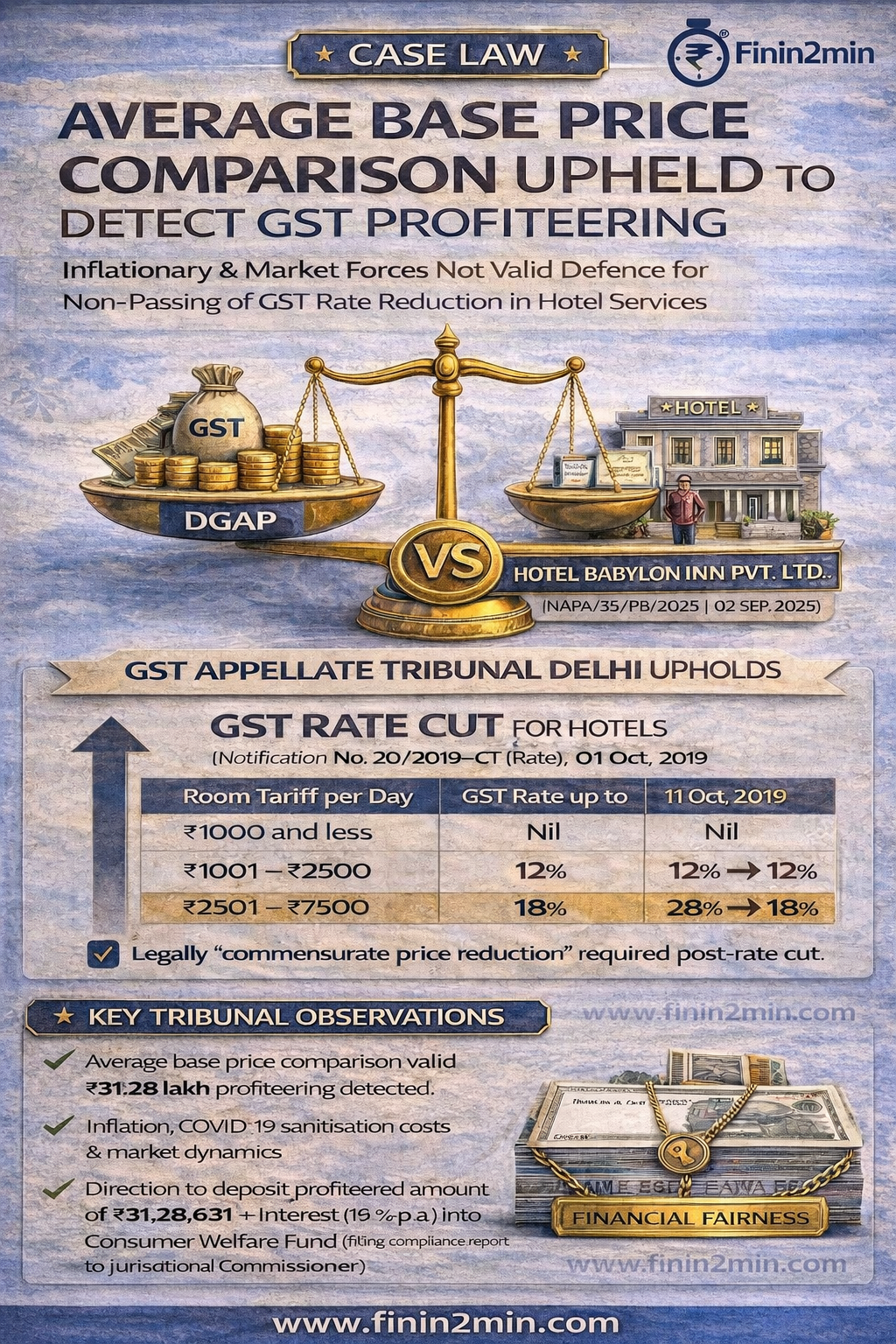
The GST Appellate Tribunal, Delhi in DGAP v. Hotel Babylon Inn Pvt. Ltd.
[NAPA/35/PB/2025 | Order dated 02 September 2025] held that:
- Hotels must pass on GST rate reduction benefits through price reduction
- Average base price comparison is a valid method to compute profiteering
- Inflation, COVID-19 costs, seasonality & market forces are not valid defences
- ₹31.28 lakh profiteered amount + 18% interest ordered to be deposited in Consumer Welfare Fund
- Inflationary & Market Forces not a Valid defense for Non-Passing of GST Rate Reduction on Hotel Services
The ruling reinforces the strict consumer-centric intent of Section 171 of the CGST Act.
🔹 Background of the Case
Parties
- Appellant: Directorate General of Anti-Profiteering (DGAP)
- Respondent: Hotel Babylon Inn Pvt. Ltd.
Trigger for Investigation
DGAP initiated proceedings alleging that the Respondent failed to pass on GST rate reduction benefits on hotel accommodation services effective from 1 October 2019, despite a statutory rate cut.
🔹 GST Rate Reduction on Hotel Accommodation
📊 GST Rate Change (Notification No. 20/2019–CT (Rate), dated 30.09.2019)
| Room Tariff per Day | GST Rate up to 30.09.2019 | GST Rate from 01.10.2019 |
|---|---|---|
| ₹1,000 or less | Nil | Nil |
| ₹1,001 – ₹2,500 | 12% | 12% |
| ₹2,501 – ₹7,500 | 18% | 12% ⬇️ |
| ₹7,501 and above | 28% | 18% ⬇️ |
➡️ Statutory expectation: Prices must reduce commensurately post-rate cut.
🔹 Allegations by DGAP
- Hotel tariffs remained unchanged post-GST rate reduction
- Base prices were effectively increased
- DGAP used average base price comparison methodology
- Profiteering quantified at ₹31,28,631
🔹 Respondent’s Defence
The Respondent argued:
- Hotel pricing depends on market forces & seasonal demand
- COVID-19 sanitisation & operational costs increased prices
- GST was charged separately, hence benefit passed
- Room tariffs fluctuate daily, making comparisons unreliable
- Average base price methodology was incorrect
🔹 Issues for Consideration
- Whether the Respondent profiteered by not passing GST rate reduction?
- Whether average base price comparison is a valid methodology?
- Whether inflation, COVID costs, and market dynamics justify non-passing of benefit?
🔹 Tribunal’s Findings & Analysis
1️⃣ GST Rate Reduction Not Passed On
- Tribunal observed that tariffs were not reduced despite lower GST
- Section 171 mandates actual price reduction, not mere tax disclosure
2️⃣ Average Base Price Comparison is Valid
The Tribunal upheld DGAP’s methodology:
- Comparison of average base prices pre- and post-rate reduction
- Appropriate where:
- Transaction values vary
- Prices are dynamic (hotels, airlines, e-commerce)
“The methodology adopted by DGAP is reasonable, scientific and aligned with the statutory mandate.”
3️⃣ Market Forces & COVID Arguments Rejected
The Tribunal categorically rejected the Respondent’s defence:
- Inflation & sanitisation costs were unsupported by documentary evidence
- Market dynamics defence termed an: “afterthought and a castle built in air”
- Commercial hardships cannot override statutory obligations
4️⃣ Strict Interpretation of Section 171
Relying on Reckitt Benckiser India Pvt. Ltd. v. Union of India
[2024 SCC Online Del 588], the Tribunal held:
- There is a rebuttable presumption of profiteering if prices are not reduced
- Burden lies on the supplier to prove benefit was passed
🔹 Final Directions of the Tribunal
| Particular | Direction |
|---|---|
| Profiteered Amount | ₹31,28,631 |
| Interest | 18% p.a. |
| Period | From 01.10.2019 till realisation |
| Deposit | Consumer Welfare Fund |
| Compliance | Report to be filed by Jurisdictional Commissioner |
🔹 Legal Provisions Involved
📜 Section 171 – CGST Act, 2017
Mandates passing of:
- GST rate reduction
- ITC benefit
by way of commensurate price reduction
📜 Rule 133(3) – CGST Rules, 2017
Authorises:
- Recovery of profiteered amount
- Interest @ 18%
- Deposit into Consumer Welfare Fund
🔹 Our Commentary & Practical Impact
🔍 Key Takeaways for Hospitality Industry
| Aspect | Tribunal’s View |
|---|---|
| Dynamic pricing | Not a defence |
| COVID cost escalation | Must be proven |
| GST shown separately | Not sufficient |
| Price comparison | Average base price valid |
| Consumer benefit | Mandatory |
🔹 Compliance Lessons
✔ Document cost increases with verifiable data
✔ Re-work pricing immediately after GST changes
✔ Maintain audit-ready pricing justification
✔ Avoid post-rate base price escalation
🔹 Conclusion
This ruling strengthens the anti-profiteering jurisprudence by confirming that:
- Economic hardship does not dilute statutory consumer protection
- Hotels and service providers must ensure real benefit transfer
- Average base price comparison remains a robust compliance benchmark
Failure invites financial recovery, interest, and reputational risk.
